



Heat Pump Installation Vancouver | BCRC
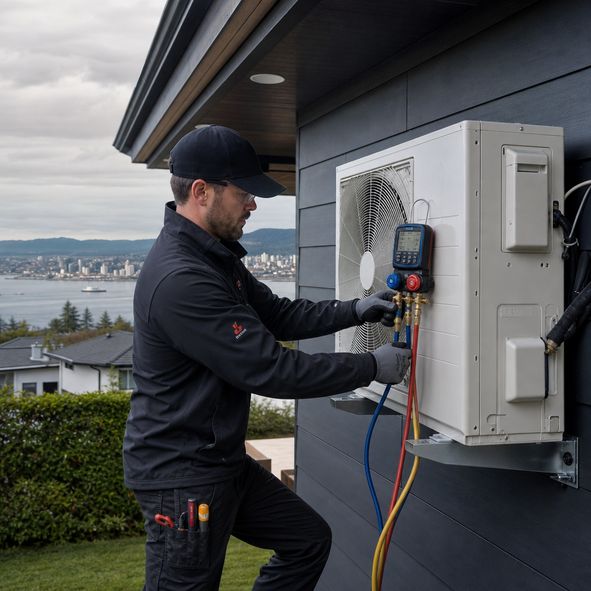
Vancouver Homeowners Are Quietly Cutting Heating Bills in Half — Here’s How
Picture this: it’s a damp February morning in East Vancouver. While your neighbour scrapes ice off their windshield and dreads their next FortisBC gas bill, your home sits at a perfect 21°C — heated silently, efficiently, and cleanly by a system that pulled warmth straight out of the frigid outdoor air. No combustion. No carbon monoxide risk. No fuel price spikes. Just physics working brilliantly in your favour. This is the quiet miracle of a modern cold-climate heat pump, and for Greater Vancouver homeowners, it represents the single most impactful HVAC upgrade available today. At BCRC Heating and Cooling, our Red Seal certified technicians have made this transformation a reality for hundreds of Metro Vancouver families — and this comprehensive guide will show you exactly how it works, what it costs, and how to maximize every dollar of available government rebate.
The Ancient Roots of Heat Transfer Engineering
The concept of moving heat from one place to another rather than generating it from scratch is far older than the electric age. The Romans mastered radiant heat distribution through their hypocaust system — a sophisticated underfloor and wall-cavity network that circulated hot air from a central furnace throughout bathhouses and villas as early as the 1st century BCE. The engineering principle was elegant: rather than heating every room with its own open flame, capture heat centrally and distribute it efficiently.
Ancient Koreans independently developed the ondol, a floor-heating system that channelled combustion gases beneath stone floors, providing radiant warmth that is still referenced in modern heated-floor design. Chinese imperial palaces used hollow wall systems channelling warm air from exterior fire pits. In each civilization, the brightest engineering minds arrived at the same conclusion: moving heat is smarter than making it repeatedly from scratch. This foundational insight — that thermodynamic transfer beats raw combustion for efficiency — is the very principle encoded in every heat pump compressor spinning in Vancouver homes today.
Industrial Breakthroughs That Built Modern HVAC
The leap from ancient radiant floors to modern refrigerant-cycle heat pumps required several centuries of compounding discovery. In 1748, Scottish physician William Cullen demonstrated artificial refrigeration at the University of Glasgow, proving that evaporating liquids absorb heat — the core mechanism of every air conditioner and heat pump ever built. By 1852, Lord Kelvin formalized the thermodynamic theory of the heat pump, coining the term and calculating theoretical efficiencies that engineers are still chasing today.
The 20th century brought electrification and mass manufacturing. By the 1930s, experimental heat pumps were installed in European buildings. It was not until the 1940s and 1950s, however, that American engineers began deploying large-scale heat pump systems in commercial buildings across the southern United States. Early residential units were bulky, refrigerant-inefficient, and catastrophically undersized for cold climates — a critical limitation that kept adoption low in Canada for decades. The systems worked brilliantly above 5°C but struggled as outdoor temperatures dropped, earning a reputation for unreliability in northern winters that, as we will examine shortly, modern engineering has thoroughly demolished.
The 20th-Century Standardization and the Cold-Climate Turning Point
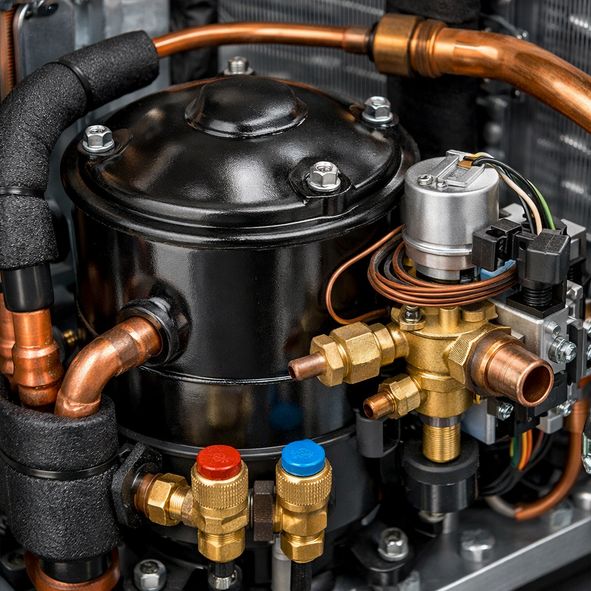
The 1973 oil crisis forced a global rethink of residential energy consumption and accelerated HVAC research dramatically. Governments and manufacturers poured resources into improving heat pump coefficients of performance (COP). The introduction of the scroll compressor in the 1980s was a watershed moment — quieter, more reliable, and dramatically more efficient than piston-type compressors, the scroll compressor became the backbone of residential heat pump technology.
The 1990s brought the inverter-driven variable-speed compressor, originally pioneered by Mitsubishi Electric and Daikin in Japan — two brands that BCRC Heating installs regularly across Metro Vancouver. Unlike single-stage compressors that cycle fully on and off, inverter compressors modulate their speed continuously, matching output precisely to demand. This eliminates the energy-wasting on-off cycling that plagued earlier systems, delivering COP values consistently between 3.0 and 5.0 — meaning three to five units of heat energy delivered for every one unit of electrical energy consumed. By contrast, the most efficient gas furnace available today converts fuel to heat at a maximum efficiency of approximately 98%, a ceiling that physics imposes on combustion. Heat pumps, by moving rather than making heat, are not bound by this ceiling.
The Modern Era: Cold-Climate Hyper-Heat Technology and Smart Diagnostics
The defining technological leap of the 2010s and 2020s has been the cold-climate heat pump — systems engineered specifically to maintain high efficiency at outdoor temperatures far below the historic threshold of viability. Mitsubishi Electric’s Hyper-Heat (H2i) technology, Daikin’s Fit series, and Bosch’s Inverter Ducted systems are certified to deliver full rated heating capacity at outdoor temperatures as low as -25°C, making them not merely viable but genuinely superior choices for every climate zone in the Greater Vancouver region, including higher-elevation communities in North Vancouver, Coquitlam, and Abbotsford.
Modern systems now integrate seamlessly with smart home ecosystems. Wi-Fi enabled controllers from Mitsubishi (MELCloud), Daikin (Daikin One+), and Lennox (iComfort) allow homeowners to monitor real-time energy consumption, adjust zone temperatures remotely, receive predictive maintenance alerts, and even grant BCRC Heating’s service technicians remote diagnostic access — identifying refrigerant pressure anomalies, coil fouling, or electrical faults before they escalate into costly emergency callouts. This connectivity transforms the heat pump from a passive appliance into an active, data-generating energy management node in your home.
Heat Pump Types Available for Vancouver Homes: A Technical Breakdown
Selecting the correct system architecture is as important as selecting the correct brand. BCRC Heating’s certified load-calculation process considers your home’s square footage, envelope insulation R-values, window-to-wall ratio, solar orientation, and existing ductwork condition before recommending any equipment. The primary system types available to Metro Vancouver homeowners include:
- Ducted Central Heat Pumps: Ideal for homes with existing forced-air ductwork. A single outdoor unit connects to an air handler installed in the furnace closet or utility room, distributing conditioned air through existing supply and return ducts. Brands such as Lennox, Daikin, and Bosch excel in this configuration. This is typically the most cost-effective retrofit for homes already equipped with ducted systems.
- Ductless Mini-Split Systems: The definitive solution for homes without ductwork — ranchers, heritage homes, suites, and additions. One outdoor compressor unit connects to between one and eight indoor wall-mount, ceiling cassette, or floor-console air handlers via refrigerant linesets routed through a small penetration in the exterior wall. Each indoor unit operates independently, enabling true room-by-room zone control. Mitsubishi Electric’s ductless lineup is the benchmark in this category for quietness and cold-climate performance.
- Multi-Zone Mini-Split Systems: A single high-capacity outdoor unit serving multiple independent indoor heads simultaneously. Architecturally flexible and rebate-eligible, these systems are ideal for larger homes, strata townhouses, or households where different family members have significantly different comfort preferences.
- Hybrid Dual-Fuel Systems: A heat pump paired with a gas furnace as a backup heating source. The heat pump handles the majority of heating load during mild weather, while the furnace activates as a supplemental source during extreme cold snaps. This configuration offers the lowest utility bills of any system type while maintaining the reliability of gas backup — a compelling option for FortisBC customers in colder Metro Vancouver microclimates.
Top Heat Pump Brands BCRC Installs in Vancouver
BCRC Heating and Cooling works exclusively with industry-leading manufacturers whose products have demonstrated proven reliability in BC’s coastal and continental climate conditions. Our primary installation brands include:
- Mitsubishi Electric: The global benchmark for ductless mini-split technology. The Hyper-Heat (H2i) series maintains 100% rated capacity at -15°C and operates down to -25°C, making it the top choice for North Vancouver and higher-elevation installations. Whisper-quiet indoor units and industry-leading twelve-year compressor warranties distinguish this brand above all others in the ductless category.
- Daikin: Japan’s largest HVAC manufacturer offers an exceptional range from entry-level residential mini-splits to commercial variable refrigerant volume (VRV) systems. The Daikin Fit ducted heat pump is particularly well-suited to Vancouver’s heritage housing stock where furnace closet space is limited, featuring a compact side-discharge outdoor unit that installs against a wall rather than requiring open clearance on all sides.
- Bosch: German engineering precision applied to North American residential HVAC. Bosch’s IDS (Inverter Ducted Split) series features ultra-quiet variable-speed compressors and is backed by a ten-year parts warranty. Particularly strong in ducted retrofit applications where efficiency and acoustics are primary concerns.
- Lennox: Outstanding integration with the iComfort smart thermostat platform and excellent AHRI-certified efficiency ratings. Lennox’s XP25 heat pump holds one of the highest HSPF2 (Heating Seasonal Performance Factor) ratings available, translating directly to lower BC Hydro bills over the system’s operational lifespan.
BCRC’s Detailed Heat Pump Installation Process
A properly executed heat pump installation in Vancouver is a multi-stage technical project, not a commodity transaction. BCRC Heating’s proven installation methodology ensures optimal performance, full warranty validity, and code-compliant results on every project.
- Step 1 — In-Home Assessment and Manual J Load Calculation: Our certified technician visits your home and performs a detailed heat load calculation per ACCA Manual J protocols, measuring room-by-room heat loss and gain based on insulation values, window area, ceiling height, and local design temperatures. This calculation — not a rule-of-thumb estimate — determines the correct system capacity. Oversized equipment short-cycles, reducing efficiency and comfort. Undersized equipment runs continuously without achieving setpoint. Neither outcome is acceptable on a BCRC installation.
- Step 2 — System and Brand Recommendation: Based on the load calculation, your existing infrastructure, your budget, and applicable rebate eligibility, we present a detailed proposal with recommended equipment, efficiency ratings, projected annual energy savings, and expected rebate amounts. We carry no brand allegiance — the brand recommendation is driven entirely by your home’s requirements.
- Step 3 — Permit Application: BCRC pulls all required City of Vancouver mechanical permits before work begins. Installing without permits voids manufacturer warranties, creates insurance liability, and can complicate real estate transactions. Every BCRC installation is fully permitted, documented, and inspection-ready.
- Step 4 — Installation Day: Our Red Seal certified technicians mount the outdoor unit on purpose-built vibration-isolating pad feet or wall brackets, route copper linesets through the building envelope with airtight penetration seals, install and commission indoor air handlers or the ducted air handler, complete all low-voltage thermostat wiring, and charge the refrigerant circuit to manufacturer-specified superheat and subcooling values using digital manifold gauges. Electrical connections are made by our licensed electrical subcontractors to BC Electrical Code standards.
- Step 5 — System Commissioning, Testing, and Homeowner Training: We run the system through full heating and cooling modes, verify airflow at all registers or indoor units, test all operating modes including defrost cycle operation, program the smart thermostat or Wi-Fi controller, and walk you through basic operation, filter maintenance schedules, and emergency procedures before we leave your home.
Heat Pump Size Selection Guide for Vancouver Homes
| Home Size (Square Feet) | Recommended Heat Pump Capacity (Tons) | Typical System Type |
|---|---|---|
| Under 1,000 sq ft | 1.0 – 1.5 tons | Single-zone ductless mini-split |
| 1,000 – 1,500 sq ft | 1.5 – 2.0 tons | Single or dual-zone ductless |
| 1,500 – 2,000 sq ft | 2.0 – 2.5 tons | Ducted central or multi-zone ductless |
| 2,000 – 2,500 sq ft | 2.5 – 3.0 tons | Ducted central or multi-zone ductless |
| 2,500 – 3,000 sq ft | 3.0 – 3.5 tons | Ducted central or large multi-zone |
| Over 3,000 sq ft | 3.5+ tons (zoned system) | Dual ducted or multi-zone VRF |
These are indicative ranges only. A proper ACCA Manual J calculation performed by BCRC’s technicians during your in-home assessment will produce the definitive sizing recommendation for your specific home.
System Comparison Matrix: Heat Pump vs Traditional HVAC Options
| Attribute | Gas Furnace | Electric Baseboard | Ducted Air Source Heat Pump | Ductless Mini-Split Heat Pump |
|---|---|---|---|---|
| Heating Efficiency | Up to 98% AFUE | 100% (resistance) | Up to 300%+ COP (HSPF2 rated) | Up to 400%+ COP at mild temps |
| Cooling Capability | No (furnace only) | No | Yes (central AC) | Yes (zone-by-zone) |
| Cold Climate Performance | Excellent | Excellent (unlimited) | Excellent to -25°C (cold-climate models) | Excellent to -25°C (Hyper-Heat models) |
| Carbon Emissions (BC grid) | High (fossil fuel) | Near-zero (BC Hydro is 98% renewable) | Near-zero | Near-zero |
| Typical Installed Cost (Vancouver) | $4,000 – $8,000 | $500 – $2,000 per room | $7,000 – $14,000 | $3,500 – $10,000 |
| CleanBC Rebate Eligible | No | No | Yes — up to $6,000 | Yes — up to $6,000 |
| Typical System Lifespan | 18 – 25 years | 25+ years | 15 – 20 years | 15 – 20 years |
| Indoor Air Quality Impact | Combustion risk (CO) | No combustion risk | Filtration, no combustion | Filtration, no combustion |
| Smart Control Integration | Via thermostat only | Limited | Full smart thermostat integration | Dedicated Wi-Fi app control |
Greater Vancouver Homeowner Maintenance Guide
A correctly installed heat pump in Vancouver’s coastal climate will reliably serve your home for fifteen to twenty years — provided it receives proper, regular maintenance. Our Red Seal technicians recommend the following maintenance schedule for optimal longevity and efficiency:
- Monthly: Inspect and clean or replace indoor unit air filters. Ductless mini-split washable filters should be rinsed under lukewarm water and allowed to dry completely before reinstallation. Dirty filters are the single most common cause of reduced airflow, coil icing, and compressor overload.
- Seasonally (Spring and Fall): Clear the outdoor unit of leaves, seed pods, cottonwood fluff, and debris. In Greater Vancouver’s wet climate, moss and algae growth on outdoor coil fins is more prevalent than in drier regions — a soft brush or low-pressure water rinse prevents airflow restriction and coil corrosion.
- Annually: Schedule a professional maintenance inspection with BCRC Heating. Our technicians verify refrigerant charge using digital manifold gauges, inspect electrical connections for corrosion in Vancouver’s coastal salt-air environment, clean evaporator and condenser coils chemically, test defrost cycle operation, lubricate fan motor bearings where applicable, and verify smart thermostat calibration and scheduling.
- Coastal Climate Consideration: Homes within approximately five kilometres of the coastline in areas such as West Vancouver, Tsawwassen, White Rock, and Vancouver’s west side experience elevated airborne salt and humidity levels that accelerate aluminum fin corrosion on outdoor units. BCRC recommends specifying units with factory-applied Blue-Fin or Dura-Fin coil coating for all coastal installations — a specification detail that significantly extends outdoor unit lifespan in these environments.
Frequently Asked Questions: Heat Pump Installation Vancouver
How does a heat pump actually heat my home — isn’t it just moving cold air around?
This is one of the most common misconceptions about heat pump technology, and clearing it up reveals just how remarkable the physics involved truly are. A heat pump does not heat air by resistance or combustion — it extracts thermal energy from outdoor air and moves it indoors using the refrigeration cycle. Even at -15°C, outdoor air contains substantial thermal energy. The heat pump’s outdoor coil acts as an evaporator: a refrigerant with an extremely low boiling point (such as R-410A or the newer R-32 and R-454B refrigerants) absorbs this ambient thermal energy and vaporizes. The vapour is then compressed by the inverter compressor, which raises both its pressure and temperature dramatically — the same principle that makes a bicycle pump warm when you compress air quickly. This high-temperature, high-pressure refrigerant vapour then flows to the indoor coil, where it condenses and releases its heat energy into your home’s air supply. The refrigerant returns to the outdoor unit, expands through an electronic expansion valve, and the cycle repeats continuously. Modern cold-climate systems like Mitsubishi’s Hyper-Heat maintain full rated capacity at -15°C outdoor temperature and continue operating (at reduced but still highly efficient output) down to -25°C — well below any temperature Vancouver will realistically experience.
What heat pump rebates am I actually eligible for in Vancouver, and how do I claim them?
Metro Vancouver homeowners can access rebates from multiple stacked programs simultaneously, and the combined value can be substantial. The CleanBC Better Homes Program, administered by the Province of BC, offers rebates ranging from $1,000 to $6,000 depending on the system type, efficiency rating (measured in HSPF2 for heating and SEER2 for cooling), and whether you are replacing a fossil fuel system. BC Hydro offers additional rebates for qualifying electric-to-electric upgrades and ductless mini-split installations in electrically heated homes. The Canada Greener Homes Grant provides federal funding of up to $5,600 but requires a pre-installation EnerGuide evaluation by a registered energy advisor — a step that must be completed before work begins, not after. FortisBC provides rebates for dual-fuel hybrid system installations that retain gas backup capability. BCRC Heating is a registered contractor in all active rebate programs and handles the entire application process on your behalf, including coordinating energy evaluations, compiling required equipment documentation (AHRI certificates, model numbers, efficiency ratings), and submitting claims within program deadlines. The administrative complexity of rebate stacking is real — homeowners attempting to navigate it independently frequently miss filing deadlines or submit incomplete documentation. Our team’s rebate expertise is a core part of the value we deliver on every installation.
My home doesn’t have ductwork — am I a good candidate for a heat pump?
Absolutely, and in many respects a ductless mini-split heat pump is a superior solution for homes without existing ductwork compared to any ducted system. Installing new ductwork in a home not originally designed for it is an enormously disruptive and expensive undertaking — routing ducts through finished walls, ceilings, and floor cavities of Vancouver’s heritage housing stock is frequently impractical without significant renovation. Ductless mini-split systems eliminate this entirely. The refrigerant lineset connecting the outdoor compressor to the indoor air handler requires only a small penetration through the exterior wall — typically 75mm in diameter — which is then sealed and insulated. Installation is typically completed in one day for a single-zone system. Each indoor head delivers conditioned air directly to its zone without duct losses — conventional ducted systems lose between 20% and 30% of conditioned air to duct leakage and thermal loss in unconditioned spaces. This means a ductless mini-split of equivalent rated capacity often delivers more usable heat to your living space than a ducted system of the same size. Multi-zone ductless systems allow a single outdoor unit to serve up to eight indoor heads independently, providing whole-home coverage with individual zone control — a level of comfort customization impossible with single-zone ducted systems.
How long does heat pump installation take, and what disruption should I expect?
For a standard single-zone ductless mini-split installation in a typical Vancouver residence, BCRC Heating’s team typically completes the work within four to eight hours — most homeowners are fully operational by end of day. A whole-home multi-zone ductless system serving three to five zones typically requires one to two days. Ducted central heat pump installations replacing an existing furnace and air handler require two to three days to allow for equipment change-out, refrigerant line installation, electrical work, and commissioning. Hybrid dual-fuel system installations are similar in scope to ducted installations. During the installation process, the HVAC system will be non-operational, but we coordinate timing to minimize inconvenience. We protect your flooring, walls, and furniture throughout, clean up completely before leaving, and commission the system fully before the final handshake. For complex multi-zone or hybrid system installations, we can often stage the work so that portions of the home retain heating capability overnight. If you have an existing emergency heat source such as an electric fireplace or baseboard, we will confirm in advance whether it can serve as backup during installation day — particularly relevant for installations scheduled during winter months.
Ready to Make the Switch? BCRC Heating and Cooling Is Your Local Expert
The evidence is unambiguous: for Greater Vancouver homeowners, a properly specified and expertly installed cold-climate heat pump delivers lower energy bills, reduced carbon emissions, superior year-round comfort, and access to thousands of dollars in government rebates — all backed by fifteen to twenty years of reliable operation. The question is no longer whether a heat pump makes sense for your Vancouver home. The question is who you trust to install it correctly. At BCRC Heating and Cooling, our Red Seal certified technicians bring over a decade of Metro Vancouver HVAC expertise, genuine manufacturer training certifications, and a commitment to premium materials and durable installation practices that protect your investment for the long term. We handle every permit, every rebate application, and every commissioning step with the same precision standard on every project — because the hidden components of a great installation are what separate a system that performs flawlessly for twenty years from one that fails at five. For a free in-home assessment, expert system recommendation, and reliable, Red Seal certified heat pump installation and Services in Vancouver, contact the local experts at BCRC Heating and Cooling today at (604) 781-7272 or visit bcrcheating.com — your first step toward a warmer, greener, and more cost-efficient home starts with a single call.