



Burnaby’s Heat Pump Revolution: Why Smart Homeowners Are Making the Switch
Picture this: a single, elegantly engineered system that keeps your Burnaby home at a perfect 21°C on a damp November morning and a refreshingly cool 23°C during one of Metro Vancouver’s increasingly intense summer heat domes — all while consuming up to 300% less energy than the conventional heating system it replaced. This is not marketing language. This is the quiet, thermodynamic miracle of a properly sized, professionally installed heat pump, and it is transforming home comfort across Burnaby’s diverse neighbourhoods, from Metrotown’s dense condominiums to the sprawling family homes of Deer Lake and Burnaby Heights.
At BCRC Heating and Cooling, our Red Seal Master Technicians have designed, installed, and commissioned hundreds of heat pump systems across Burnaby and the Greater Vancouver region. This comprehensive guide will walk you through everything you need to know — from the ancient engineering principles that inspired modern heat transfer technology, to the cutting-edge cold-climate inverter systems available today, to the BC-specific rebates that can put thousands of dollars back in your pocket.
Ancient Roots and Early Engineering: The Science That Started It All
The fundamental principle behind your modern heat pump — moving thermal energy from one place to another rather than generating it from scratch — is not a 21st-century innovation. It is, in fact, an engineering concept with roots stretching back over two millennia.
The Roman hypocaust system, deployed extensively across the Empire from approximately 100 BCE, was arguably humanity’s first sophisticated heat distribution network. Engineers would construct raised flooring supported by pilae — short brick columns — creating a plenum beneath the living space. A furnace, or praefurnium, located outside the building, would force hot combustion gases beneath the floor and up through hollow clay tiles embedded in the walls, radiating warmth throughout the structure. Roman bathhouses in Britain, including the remarkably preserved ruins at Bath, demonstrate that these engineers understood radiant heat transfer at a surprisingly sophisticated level. While the hypocaust was not a heat pump in the modern sense, it established the foundational concept of moving thermal energy efficiently through a structure — a concept our Burnaby installations honour every day.
Centuries later, Swiss physicist Nicolas Léonard Sadi Carnot formalized the thermodynamic theory of heat engines in his 1824 treatise, laying the mathematical groundwork that would eventually describe exactly how a heat pump compressor cycle operates. Lord Kelvin, in 1852, was the first to theorize that a reversed heat engine — one that uses work to move heat from cold to hot, rather than extracting work from hot to cold — could theoretically deliver more thermal energy than the mechanical energy consumed to drive it. This was the intellectual birth certificate of the heat pump.
The Industrial Breakthroughs: From Theory to Technology
The transition from thermodynamic theory to practical heat-moving machinery accelerated dramatically through the late 19th and early 20th centuries, driven by parallel advances in refrigeration and mechanical engineering.
Jacob Perkins, an American inventor working in London, built the first practical vapour-compression refrigeration machine in 1834, demonstrating that a volatile fluid — in his case, diethyl ether — could absorb heat as it evaporated and reject that heat as it condensed under pressure. This refrigeration cycle, run in reverse, is precisely what every heat pump installed by BCRC in Burnaby performs thousands of times per day. The working fluid, now a modern low-global-warming-potential refrigerant such as R-410A or the increasingly prevalent R-32 and R-454B, absorbs latent heat from the outdoor air across the evaporator coil, is compressed to a higher pressure and temperature, and then rejects that amplified heat energy through the indoor coil or air handler.
The early 20th century brought critical advances in compressor technology. The development of the hermetically sealed compressor in the 1930s — a design that encases both the motor and compression mechanism in a sealed housing, eliminating refrigerant leaks at shaft seals — made reliable, low-maintenance residential refrigeration and heat pump equipment commercially viable. By the 1940s and 1950s, Robert C. Webber, an American engineer, is widely credited with building one of the first ground-source heat pumps for residential space heating, connecting a reversed deep-freeze unit to a forced-air distribution system. The energy efficiency advantages were immediately apparent to those who measured them carefully.
The 20th-Century Standardization and Electrification of Heat Pump Technology
The post-World War II economic boom created an unprecedented demand for residential comfort equipment across North America. Early heat pumps were primarily air-to-air systems designed for the mild climates of the American Southeast and Pacific Northwest — climates remarkably similar to Metro Vancouver’s. Manufacturers like Carrier, Trane, and Lennox refined their product lines through the 1960s and 1970s, standardizing refrigerant charge procedures, electrical connection specifications, and ductwork sizing guidelines that form the basis of modern installation codes still referenced in BC’s current TECA (Technical Standards and Safety Authority) and BCSA (BC Safety Authority) regulatory framework.
The 1973 oil crisis proved to be a watershed moment for heat pump adoption. As natural gas and heating oil prices spiked dramatically, the heat pump’s fundamental value proposition — delivering two to three units of thermal energy for every one unit of electrical energy consumed — became a compelling economic argument rather than merely a technical curiosity. Government research programs in the United States and Canada began funding serious engineering studies into heat pump performance under cold-climate conditions, identifying the two key technical barriers that would preoccupy the industry for the next three decades: defrost cycle efficiency and low-ambient temperature performance degradation.
During the 1980s and 1990s, the introduction of scroll compressors — which replaced the older reciprocating piston designs — dramatically improved the reliability, efficiency, and noise characteristics of residential heat pumps. Scroll compressors operate with a continuous rotary motion rather than the oscillating action of piston compressors, reducing vibration, lowering noise output, and improving volumetric efficiency at the high compression ratios encountered during cold-weather heating operation. This was a transformative advance that made heat pumps genuinely competitive with gas furnaces for primary heating duty in climates like Burnaby’s.
The Modern Era: Inverter-Drive Technology and Smart System Integration
The single most significant technological advancement in heat pump history is arguably the development and commercial deployment of variable-speed inverter-drive compressors, pioneered by Japanese manufacturers Daikin, Mitsubishi Electric, and Fujitsu in the late 1970s and refined into the ultra-efficient systems available today.
A conventional single-stage heat pump operates like a light switch: it is either running at 100% capacity or it is off. This binary operation means the system frequently overshoots the thermostat setpoint, cycles off, allows the space to cool or warm past the comfort threshold, then cycles back on. Each start-up event draws a momentary high-amperage inrush current, stresses the compressor mechanically, and creates the temperature swings that occupants experience as discomfort.
An inverter-drive compressor, by contrast, operates more like a dimmer switch. The variable-frequency drive modulates the compressor motor speed continuously — from as low as 10% of rated capacity up to 120% of nominal output during extreme demand — to precisely match the building’s real-time thermal load. The practical results are profound: temperature variance in the conditioned space is reduced to less than ±0.5°C, energy consumption drops by 30–50% compared to single-stage equivalents, and compressor longevity improves because the unit spends most of its operating life at gentle, low-stress partial loads rather than hammering through repeated full-power start-and-stop cycles.
Modern cold-climate heat pumps — a category now well-represented by systems from Mitsubishi’s Hyper-Heating INVERTER (H2i) series, Daikin’s Fit and Aurora lines, Bosch’s IDS series, and others — deliver their rated heating capacity at outdoor temperatures down to -15°C and maintain meaningful heating output at -25°C or below. For Burnaby homeowners, where winter overnight lows rarely drop below -5°C, these cold-climate units operate with extraordinary efficiency throughout virtually the entire heating season, achieving Coefficient of Performance (COP) values of 2.5 to 4.0 or higher under typical operating conditions.
Smart system integration has added another dimension of value. Wi-Fi enabled thermostats and manufacturer-specific control applications allow homeowners to monitor real-time energy consumption, receive predictive maintenance alerts, integrate with BC Hydro’s time-of-use rate structures to shift operation toward lower-cost overnight hours, and even access remote diagnostics that allow BCRC’s technicians to identify fault codes before dispatching to a service call — dramatically reducing diagnostic time and improving first-visit resolution rates.
Ductless Mini-Splits vs. Ducted Central Heat Pumps: Choosing the Right Architecture for Your Burnaby Home
One of the most important decisions in any Burnaby heat pump installation is selecting the appropriate system architecture. BCRC’s assessment process evaluates each home’s existing infrastructure, construction type, and comfort goals before recommending a configuration.
Ductless Mini-Split Systems
Ductless mini-split systems consist of one or more compact indoor air-handling units — typically wall-mounted, ceiling cassette, or floor-console styles — connected by a refrigerant line set to an outdoor compressor/condenser unit. Multi-zone systems can connect between two and eight indoor units to a single outdoor unit, allowing independent temperature control in each zone. These systems are ideal for Burnaby homes built without existing ductwork, for heritage properties where duct installation would require destructive renovation work, for room additions, suites, and accessory dwelling units, and for homes where certain rooms consistently experience comfort problems despite existing forced-air systems.
Ducted Central Heat Pump Systems
Ducted heat pump systems utilize an air handler connected to the home’s existing duct network, distributing conditioned air through the same registers used by the previous furnace or air conditioning system. These are often installed as part of a dual-fuel configuration — pairing the heat pump with an existing gas furnace — where the heat pump handles the majority of heating and cooling loads efficiently, and the gas furnace provides supplemental heat during the rare extreme cold events that may exceed the heat pump’s economic operating threshold. This hybrid approach is particularly well-suited to Burnaby homeowners who want to reduce their carbon footprint and energy costs without immediately decommissioning their existing gas infrastructure.
Ground-Source (Geothermal) Heat Pumps
Ground-source heat pump systems extract thermal energy from the relatively stable temperature of the earth below the frost line, typically between 8°C and 12°C year-round in the Lower Mainland. Because the ground temperature varies far less than ambient air temperature, ground-source systems achieve the highest efficiency ratings of any heat pump technology, with COPs of 3.5 to 5.0 or higher. The primary barrier is installation cost, as ground loops require significant civil work — either vertical boreholes drilled to depths of 60–150 metres or horizontal loops trenched across a sufficient land area. For properties with adequate land area or where the premium efficiency justifies the capital investment, BCRC’s design team can evaluate ground-source feasibility as part of a comprehensive load analysis.
Deep-Dive Comparison Matrix: Heat Pump Systems for Burnaby Homeowners
| System Type | Heating Efficiency (COP / HSPF) | Cooling Efficiency (SEER) | Fuel Source | Estimated Lifespan | Installed Cost Range (CAD) | BC Rebate Eligibility | Best Application |
|---|---|---|---|---|---|---|---|
| Standard Single-Stage Air-Source Heat Pump | COP 2.0–2.8 / HSPF 7–9 | SEER 14–17 | Electricity | 12–15 years | $5,000–$9,000 | Partial — may not meet CleanBC minimum HSPF requirements | Mild climates, budget-conscious installs |
| Cold-Climate Inverter Mini-Split (Ductless) | COP 3.0–4.5 / HSPF 10–14+ | SEER 20–30+ | Electricity | 15–20 years | $4,500–$12,000 (per zone) | Yes — CleanBC up to $6,000 for qualifying systems | Homes without ducts, zone control, suites |
| Ducted Central Cold-Climate Heat Pump | COP 2.8–4.0 / HSPF 9–13 | SEER 16–22 | Electricity | 15–18 years | $8,000–$16,000 | Yes — CleanBC rebates available for qualifying systems | Homes with existing ductwork, whole-home replacement |
| Dual-Fuel Heat Pump + Gas Furnace Hybrid | COP 3.0–4.0 (HP mode) / 95–98% AFUE (gas backup) | SEER 16–22 | Electricity + Natural Gas | 15–20 years (HP) / 20–25 years (furnace) | $10,000–$20,000 | Partial — rebate on heat pump component | Homes with gas infrastructure seeking transition pathway |
| Ground-Source (Geothermal) Heat Pump | COP 3.5–5.5 / HSPF 14–18 | SEER 18–30+ | Electricity | 20–25 years (unit) / 50+ years (ground loop) | $20,000–$45,000+ | Yes — federal and provincial programs available | High-efficiency goals, large properties, new construction |
| Traditional Gas Furnace (Comparison Baseline) | AFUE 80–98% (no COP applicable) | N/A (requires separate AC) | Natural Gas | 18–25 years | $4,000–$8,000 (furnace only) | None for new gas installations under BC energy transition policy | Legacy replacement — declining incentive landscape |
Greater Vancouver and Burnaby Homeowner Buying and Maintenance Guide
Understanding CleanBC and BC Hydro Rebate Programs
Burnaby homeowners installing qualifying heat pump systems have access to some of the most generous equipment incentive programs in Canada. The CleanBC Better Homes program, administered through BC Hydro and FortisBC, offers rebates of up to $6,000 for the installation of a qualifying cold-climate heat pump that replaces a fossil fuel heating system as the primary heat source. Additional rebates may be available through the federal Canada Greener Homes Grant program, which has historically provided up to $5,000 in grants plus up to $600 toward an EnerGuide energy audit. BCRC’s project team assists every Burnaby client with rebate application paperwork as a standard component of our installation service — ensuring that qualifying homeowners capture the maximum available incentive without navigating complex government portals on their own.
To qualify for the full CleanBC heat pump rebate tier, the installed system must meet minimum performance thresholds, typically an HSPF of 9.0 or higher and a rated heating capacity maintained at or below -15°C outdoor ambient temperature. BCRC exclusively recommends and installs systems that meet or exceed these thresholds, ensuring that our clients are rebate-eligible from the first day of operation.
Coastal Climate Durability Considerations for Burnaby Installations
Burnaby’s proximity to the Pacific Ocean creates specific durability challenges that our installation team addresses through deliberate equipment selection and installation practices. Salt-laden marine air, while less concentrated than coastal environments directly on the waterfront, can accelerate corrosion of outdoor unit coil fins and cabinet components over time. BCRC specifies units with factory-applied hydrophilic or Blue Fin anti-corrosion coatings on evaporator and condenser coils for all Burnaby installations — a specification that meaningfully extends coil life in our humid marine climate.
Outdoor unit placement is a critical installation variable that less experienced contractors sometimes overlook. BCRC’s technicians evaluate each installation site for prevailing wind direction, potential snow accumulation from roof eaves or upper deck drainage, clearance from recirculated exhaust air paths, and adequate service access. Units are elevated on galvanized steel or composite pad systems to prevent moisture contact with the cabinet base and to maintain the minimum clearances specified in BC Gas Safety Regulation and manufacturer installation manuals.
Refrigerant Line Set Installation and Insulation Standards
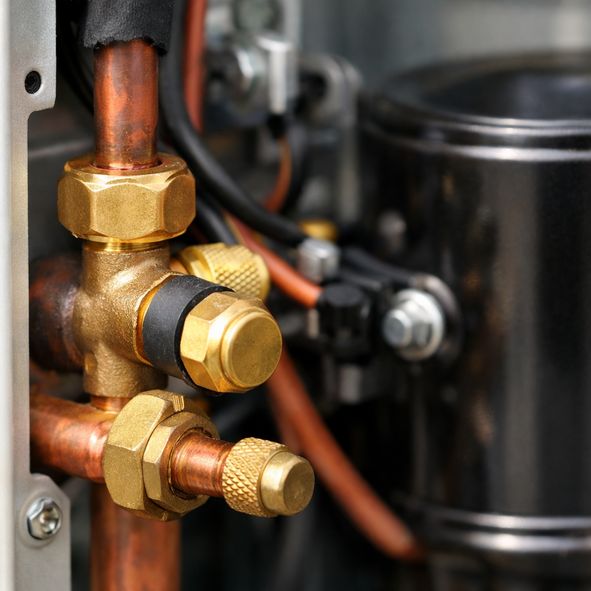
The refrigerant line set — the copper tubing that connects the outdoor and indoor units — must be sized correctly, routed without excessive bends or traps, pressure-tested, evacuated to a deep vacuum of 300 microns or below before charging, and insulated to prevent both thermal loss and condensation. BCRC technicians use digital micron gauge technology for all evacuation verification, a standard that many contractors skip in favour of a quick visual pressure check — a shortcut that leaves moisture and non-condensables in the system, dramatically reducing efficiency and compressor longevity over time.
Annual Maintenance: Protecting Your Investment
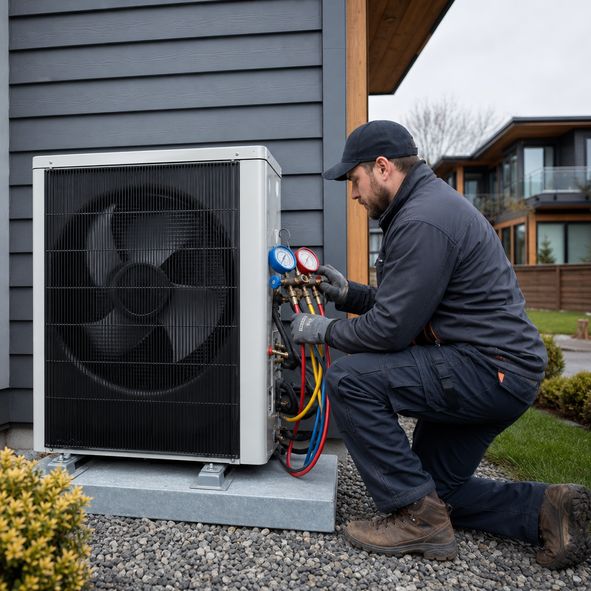
A heat pump is a precision mechanical system operating year-round under conditions that would challenge any equipment. Annual maintenance by a certified BCRC technician includes: cleaning indoor and outdoor coils; checking refrigerant charge using manifold gauge sets and superheat/subcooling calculations rather than estimating by pressure alone; inspecting and lubricating blower motor bearings; verifying defrost board operation and defrost cycle timing; checking electrical connections for corrosion and proper torque; testing capacitor and contactor condition; confirming condensate drain flow; and reviewing control system operation. Homeowners can supplement professional maintenance by cleaning or replacing air filters monthly during peak operation seasons and ensuring the outdoor unit remains clear of fallen leaves, overgrown vegetation, and snow accumulation.
Frequently Asked Questions: Heat Pump Installation in Burnaby
Will a heat pump work effectively during Burnaby’s coldest winter nights?
This is the most common concern we hear from Burnaby homeowners, and it deserves a thorough technical answer. Modern cold-climate inverter heat pumps from manufacturers including Mitsubishi Electric, Daikin, Bosch, and others are engineered and laboratory-certified to deliver their full rated heating capacity at outdoor temperatures as low as -15°C, and to maintain meaningful heating output down to -25°C or below. Burnaby’s Environment and Climate Change Canada climate data shows that average January overnight lows hover around -1°C to -3°C, with extreme cold events below -10°C being relatively infrequent and short in duration. This means a properly specified cold-climate heat pump will operate at high efficiency throughout the overwhelming majority of Burnaby’s heating season. For dual-fuel hybrid installations paired with an existing gas furnace, the furnace backup provides complete protection against any extreme cold event, eliminating any theoretical heating capacity concern entirely.
How long does a professional heat pump installation in Burnaby typically take, and what is involved?
A standard ductless mini-split installation for a single-zone residential system typically requires one full day — approximately six to eight hours — for a two-person BCRC installation crew. A multi-zone system serving three to four indoor units generally requires two full days. A ducted central system replacement, including removal of the old equipment, installation of the new air handler, outdoor unit, line set, electrical connections, and commissioning, typically takes one to two days depending on complexity. The BCRC installation process includes: an initial site assessment and Manual J load calculation to confirm equipment sizing; city permit application where required by Burnaby’s building department; professional installation to BC Gas Safety Regulation and CSA B52 Mechanical Refrigeration Code standards; deep vacuum evacuation verified by digital micron gauge; refrigerant charge verification by superheat and subcooling measurement; full operational test of all operating modes including heating, cooling, fan, and defrost; thermostat or control system configuration; homeowner orientation and documentation handoff; and rebate application assistance.
What size heat pump does my Burnaby home actually need, and why does it matter so much?
Equipment sizing is arguably the most critical technical decision in any heat pump installation, and it is an area where the consequences of getting it wrong are severe and long-lasting. A heat pump that is significantly oversized for the building’s design heating and cooling load will short-cycle — turning on and off rapidly because it reaches setpoint before completing a proper operating cycle. Short-cycling prevents the system from adequately dehumidifying the indoor air during cooling mode (since dehumidification requires extended coil contact time), causes excessive mechanical stress on the compressor and reversing valve, dramatically increases energy consumption per unit of delivered comfort, and reduces equipment lifespan. A heat pump that is significantly undersized will run continuously during design conditions without achieving the thermostat setpoint, leaving occupants uncomfortable during peak demand periods. The correct sizing methodology is a Manual J residential load calculation — a detailed engineering analysis that accounts for the home’s conditioned floor area, ceiling height, wall and ceiling insulation R-values, window area and glazing specifications, orientation and shading, air infiltration rate, local design temperatures, and occupancy — not a rule-of-thumb based solely on square footage. BCRC performs a complete Manual J calculation for every installation project, and we document our load calculation results as part of the project file provided to each client.
What BC rebates and incentives are currently available for heat pump installation in Burnaby, and how does BCRC help clients access them?
As of 2024-2025, Burnaby homeowners replacing a fossil fuel heating system with a qualifying electric heat pump have access to multiple stacked incentive programs. The CleanBC Better Homes program currently offers rebates of up to $6,000 for the installation of a qualifying cold-climate heat pump as a primary heating system, with additional tiered rebates available for homes served by FortisBC natural gas. The Canada Greener Homes Grant has provided federal funding of up to $5,000 for qualifying equipment, though program availability and funding levels are subject to federal budget cycles and should be confirmed at time of application. Additional municipal incentives may be available through the City of Burnaby’s sustainability programs. BCRC’s project management team handles the rebate application process on behalf of our clients as a standard service, preparing all required documentation including equipment specification sheets, proof of installation, and energy advisor report coordination where required. Our goal is to ensure that every eligible Burnaby homeowner receives the maximum available incentive, reducing the net installation cost and improving the return on investment of their heat pump system.
BCRC Heating and Cooling: Burnaby’s Trusted Heat Pump Installation Experts
Choosing the right contractor for your heat pump installation is as important as choosing the right equipment. A heat pump is a sophisticated refrigeration system operating at the intersection of electrical, mechanical, and control system engineering — and the difference between a correctly commissioned installation and a poorly executed one will manifest in energy bills, comfort, and equipment reliability for the entire fifteen-to-twenty-year life of the system. BCRC Heating and Cooling brings Red Seal certified Master Technicians, manufacturer-specific factory training, full BC Safety Authority licensing, and a track record of hundreds of successful heat pump installations across Burnaby and the Greater Vancouver region to every project we undertake. We perform proper Manual J load calculations, deep vacuum evacuation, refrigerant charge verification by measurement, and complete commissioning documentation on every installation — without exception. We handle your CleanBC rebate paperwork, we stand behind our workmanship with a written installation warranty, and we are available for ongoing maintenance and support throughout the life of your system. Whether you are exploring your first heat pump for a Burnaby condo, upgrading an aging ductless system in a Burnaby Heights character home, or designing a whole-home comfort solution for a new Deer Lake property, the BCRC team is ready to deliver a solution engineered specifically for your home and your budget. For reliable, Red Seal certified heat pump installation in Vancouver and Burnaby, contact the local experts at BCRC Heating and Cooling today at (604) 781-7272 — your year-round comfort is our professional commitment.