


Air Conditioner Services in Abbotsford
When the Fraser Valley Heat Hits Hard: Why Your AC System Is Non-Negotiable
There is a particular kind of misery unique to a sweltering Abbotsford summer afternoon — the kind where the temperature climbs past 35°C, the humidity wraps around you like a wet blanket, and your air conditioner decides that today is the day it stops working. The Fraser Valley is no longer a region that gets a polite suggestion of summer warmth. In recent years, atmospheric heat domes have pushed Abbotsford into record-breaking temperature territory, turning properly functioning air conditioning from a luxury into an absolute health and safety necessity. For families with young children, elderly residents, and anyone managing a chronic health condition, a failed cooling system is a genuine crisis. That is the reality that shapes every single service call BCRC Heating and Cooling responds to across Abbotsford and the broader Greater Vancouver region. This comprehensive guide will walk you through everything a modern Abbotsford homeowner needs to know about air conditioning — from the ancient ingenuity that first inspired mechanical cooling to the precision diagnostics and high-efficiency systems available to you right now.
Ancient Roots and Early Engineering: Humanity Has Always Craved Cool Air
The desire to escape oppressive heat is not a modern invention — it is one of the oldest engineering challenges in human history. The Romans, celebrated for their hypocaust underfloor heating systems, also experimented with circulating cool water through the walls of wealthy villas during summer months. Egyptian pharaohs employed servants to fan porous clay pots filled with water, using the principle of evaporative cooling to lower the ambient temperature of royal chambers. Persian architects as far back as 400 BCE designed sophisticated wind-catcher towers — structures called bâdgirs — that captured prevailing breezes at elevation and channelled them down into underground cisterns filled with cold water before distributing the cooled air throughout the building. These were not primitive hacks; they were elegant, physics-informed solutions to thermal comfort that demonstrate the ingenuity of human engineering long before electricity existed. The fundamental thermodynamic principle they all exploited — that moving air across a cooler medium transfers heat energy away from the occupied space — is the exact same principle at the heart of every modern refrigerant-based air conditioner installed in Abbotsford homes today.
The Industrial Breakthroughs That Made Modern Air Conditioning Possible
The leap from passive architectural cooling to active mechanical refrigeration required the convergence of industrial chemistry, mechanical engineering, and visionary entrepreneurship. In 1842, Florida physician John Gorrie built an ice-making machine to cool the rooms of malaria patients, using compressed air to create refrigeration — a concept so ahead of its time that it was largely ridiculed. The genuine turning point came on July 17, 1902, when a 25-year-old engineer named Willis Haviland Carrier commissioned his first electrical air conditioning system for a Brooklyn printing plant. Carrier’s insight was not merely about cooling air — it was about controlling its humidity simultaneously, a dual-function that remains the defining characteristic of every central air conditioning system operating in Abbotsford homes today. His psychrometric chart, developed to map the relationship between air temperature, humidity, and enthalpy, is still a foundational reference document in HVAC engineering. By the 1920s, movie theatres in major American cities were using large-scale cooling systems to attract summer audiences — coining the phrase ‘going to the movies’ as synonymous with escaping the heat. By the 1950s, residential window units were proliferating across North America, and by the 1970s, central ducted split systems had become the standard for new home construction across Canada.
The 20th Century: Standardization, Refrigerants, and the Rise of Residential Cooling
The second half of the twentieth century transformed air conditioning from an industrial novelty into an everyday residential expectation. The development of synthetic refrigerants — beginning with Freon (R-22) in the 1930s — made systems dramatically safer and more reliable than earlier ammonia or sulphur dioxide-based designs. ASHRAE, the American Society of Heating, Refrigerating and Air-Conditioning Engineers, established the performance standards and efficiency benchmarks that gave the industry its technical backbone. In Canada, the introduction of EnerGuide ratings and mandatory SEER (Seasonal Energy Efficiency Ratio) minimums forced manufacturers to continuously improve the efficiency of their equipment. The original R-22 refrigerant, however, was eventually identified as a potent ozone-depleting substance, triggering a phased global elimination under the Montreal Protocol. Canada completed its ban on R-22 imports and manufacturing by 2020, meaning any Abbotsford homeowner still operating a pre-2010 R-22 system is not only running outdated equipment but is also unable to have it properly serviced with new refrigerant. The modern industry standard refrigerant, R-410A, carries zero ozone depletion potential, and the emerging next generation — R-32 and R-454B — delivers even lower global warming potential alongside improved thermodynamic efficiency.
The Modern Era: Variable-Speed Inverter Technology and Smart Wi-Fi Diagnostics
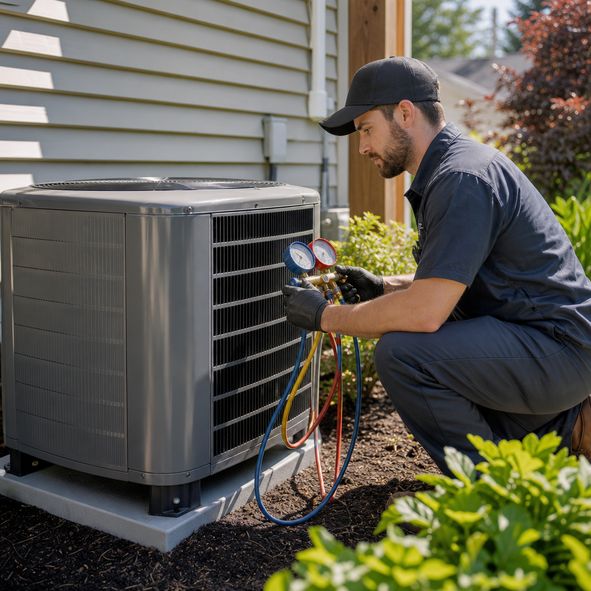
Today’s high-efficiency air conditioning systems bear almost no resemblance to the single-stage, on-off compressors that defined residential cooling through the 1990s. The most significant technological revolution in modern HVAC is the inverter-driven variable-speed compressor. Traditional compressors operate like a light switch — fully on or completely off — causing dramatic temperature swings, high electrical demand spikes at startup, and mechanical stress that accelerates wear. Inverter compressors, by contrast, operate like a dimmer switch. They continuously modulate their output speed to precisely match the actual cooling load of the building at any given moment, maintaining temperature within 0.5°C of setpoint, consuming up to 40% less electricity, and dramatically extending the operational lifespan of the equipment. Premium systems from manufacturers like Lennox, Carrier, and Mitsubishi now achieve SEER2 ratings above 20, compared to the minimum 14 SEER2 required by Canadian efficiency standards. Beyond the mechanical advances, smart thermostat integration and Wi-Fi enabled diagnostic platforms have transformed service and maintenance. Modern communicating systems continuously monitor compressor discharge pressure, suction line temperature, refrigerant subcooling and superheat values, airflow differential, and electrical draw — transmitting this data in real time to both the homeowner’s smartphone and the technician’s diagnostic tablet. At BCRC Heating and Cooling, our Red Seal certified technicians arrive at every Abbotsford service call equipped with digital manifold gauge sets, combustion analyzers, and system-specific diagnostic software that allows us to pinpoint faults with a precision that was simply impossible a decade ago.
Heat Pump Air Conditioners: The Peak Efficiency Paradigm for BC Homeowners
No discussion of modern air conditioning in British Columbia is complete without addressing the heat pump — arguably the most transformative technology available to Abbotsford homeowners right now. A heat pump is, at its mechanical core, an air conditioner that can run in reverse. In cooling mode, it extracts heat from your indoor air and expels it outside — identical to a conventional central AC. In heating mode, it reverses that refrigerant cycle, extracting latent heat energy from outdoor air (even at temperatures as low as -25°C in cold-climate models) and delivering it inside. The efficiency advantage is extraordinary: while a high-efficiency gas furnace converts roughly 97% of combustion energy into heat, a modern cold-climate heat pump delivers between 200% and 400% of the electrical energy it consumes as useful heat — expressed as a Coefficient of Performance (COP) of 2.0 to 4.0. For Abbotsford homeowners, the temperate Fraser Valley climate is essentially ideal heat pump territory. The CleanBC Better Homes program currently offers rebates of up to $6,000 for qualifying heat pump installations, and BC Hydro’s rebate programs stack on top of those provincial incentives. For a homeowner replacing an aging central air conditioner and a gas furnace simultaneously, a ducted heat pump system consolidates both functions into a single, highly efficient, all-electric system — dramatically reducing both energy costs and carbon emissions in one installation.
Deep-Dive Comparison: Air Conditioning and Cooling System Types
| System Type | SEER2 Efficiency | Estimated Lifespan | Fuel / Energy Source | Estimated Install Cost (CAD) | BC Rebate Eligible |
|---|---|---|---|---|---|
| Standard Central AC (Single-Stage) | 14–16 SEER2 | 12–15 years | Electricity (compressor) | $3,500–$5,500 | No |
| High-Efficiency Central AC (Variable-Speed) | 18–26 SEER2 | 15–20 years | Electricity (compressor) | $5,500–$9,000 | Partial (utility rebates) |
| Ductless Mini-Split AC | 18–30 SEER2 | 15–20 years | Electricity (compressor) | $2,800–$6,500 per zone | Partial |
| Ducted Heat Pump (Heating + Cooling) | 18–24 SEER2 / COP 2.5–4.0 | 15–20 years | Electricity (heat pump) | $8,000–$16,000 | Yes — up to $6,000 CleanBC |
| Ductless Heat Pump (Mini-Split) | 20–30 SEER2 / COP 2.8–4.5 | 15–20 years | Electricity (heat pump) | $3,500–$7,500 | Yes — up to $3,000 CleanBC |
Greater Vancouver and Abbotsford Homeowner Buying and Maintenance Guide
Choosing the Right System for Your Abbotsford Home
Selecting the correct air conditioning system for an Abbotsford property requires a proper Manual J load calculation — not a rule-of-thumb square footage estimate. Oversizing an air conditioner is one of the most damaging and costly mistakes a homeowner can make. An oversized system short-cycles, meaning it reaches setpoint temperature too quickly, shuts off, and then restarts almost immediately. This prevents the system from running long enough to properly dehumidify the air, leaving your home feeling cold but clammy — a particularly unpleasant condition during Abbotsford’s humid summer periods. It also causes accelerated mechanical wear on the compressor and fan motors, dramatically shortening the system’s lifespan. BCRC’s Red Seal technicians perform full Manual J calculations on every new installation, accounting for your home’s insulation values, window area and orientation, ceiling height, occupancy patterns, and local design temperatures.
BC Hydro and CleanBC Rebate Programs
British Columbia offers some of the most generous HVAC efficiency incentives in Canada. The CleanBC Better Homes program, administered through BC Hydro and FortisBC, provides direct rebates for qualifying heat pump installations — up to $6,000 for ducted systems and up to $3,000 for ductless mini-split heat pumps. To qualify, equipment must meet minimum efficiency thresholds (typically HSPF2 of 7.5 or above for heat pumps), and installation must be performed by a registered contractor. BCRC Heating and Cooling is a registered CleanBC contractor, meaning we handle the rebate paperwork on your behalf and ensure your installation meets all program requirements from the first visit.
Coastal Climate Durability Considerations
Abbotsford and the broader Fraser Valley present specific durability challenges for outdoor HVAC equipment. The combination of seasonal moisture, occasional freezing temperatures, agricultural particulate in the air, and UV exposure from summer sun requires equipment with robust corrosion-resistant coatings. Look for units featuring spine-fin or micro-channel condenser coils with factory-applied anti-corrosion treatment, and ensure the outdoor unit is installed on a level concrete pad elevated above potential standing water and debris accumulation. BCRC technicians install all outdoor units with manufacturer-specified clearances and can supply and install additional louvred protective enclosures where required by site conditions.
Annual Maintenance: What Should Be Included
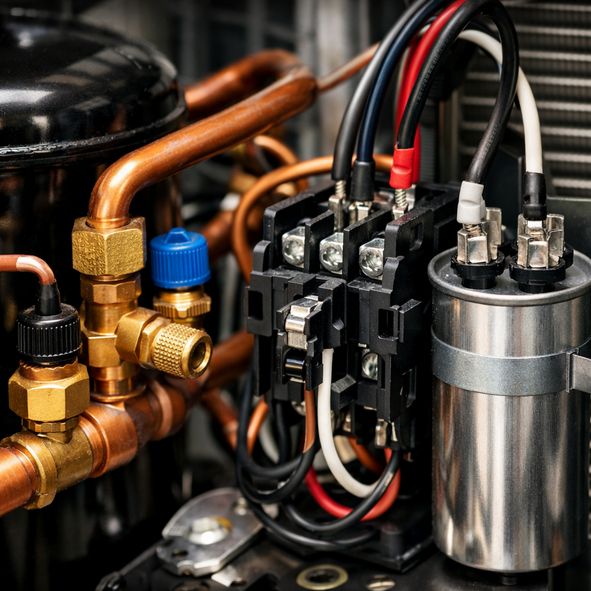
A professional annual air conditioning tune-up performed by a Red Seal technician should encompass the following minimum scope of work: measurement and documentation of refrigerant charge (suction and discharge pressures, superheat, and subcooling); inspection and cleaning of evaporator and condenser coil surfaces; measurement of airflow across the evaporator (temperature differential); inspection of electrical connections, contactors, and capacitors with microamp draw testing; lubrication of fan motor bearings where applicable; cleaning and flushing of the condensate drain pan and drain line; inspection of the air filter and blower wheel; and a full system operational test with documentation of all measured parameters. Homeowners should change or clean air filters every 1–3 months depending on filter type and home conditions, and ensure outdoor condenser units are cleared of vegetation, leaves, and debris at the start of each cooling season.
Frequently Asked Questions: Air Conditioning in Abbotsford
How do I know if my air conditioner needs refrigerant, and can I add it myself?
Refrigerant is not consumed by normal operation — if your system is low on refrigerant charge, it has a leak. Symptoms of low refrigerant include reduced cooling capacity, ice formation on the suction line or evaporator coil, unusually high electricity consumption, and a hissing or bubbling sound near the indoor or outdoor unit. Refrigerant handling in Canada requires a valid refrigerant handling certificate under the Canadian Environmental Protection Act. It is illegal for uncertified individuals to purchase or handle refrigerants such as R-410A. Attempting to add refrigerant without first locating and repairing the leak is both a regulatory violation and a waste of money — the refrigerant will simply escape again. BCRC technicians are fully certified, carry electronic leak detection equipment, and will locate, repair, and properly recharge your system to manufacturer specifications.
My air conditioner is running but not cooling effectively. What are the most common causes?
Reduced cooling performance is one of the most common service complaints and has several potential root causes that require systematic diagnosis. The most frequent culprits include: a severely restricted or completely blocked air filter reducing airflow across the evaporator coil; a dirty evaporator coil insulating the refrigerant from the air stream; low refrigerant charge due to a leak; a failing run capacitor reducing compressor and fan motor efficiency; a dirty condenser coil preventing adequate heat rejection outdoors; a malfunctioning metering device (TXV or orifice) disrupting refrigerant flow; or an oversized or undersized system relative to the building load. A thorough diagnostic process — measuring supply and return air temperatures, checking static pressure, verifying refrigerant pressures against ambient conditions, and testing electrical components — is required to accurately identify the fault rather than guessing and replacing parts unnecessarily.
What is the difference between a single-stage, two-stage, and variable-speed air conditioner, and does it matter for Abbotsford?
The capacity staging of a compressor determines how precisely the system can match cooling output to actual building demand. A single-stage system runs at 100% capacity or not at all — it is the least efficient and least comfortable option. A two-stage system can operate at approximately 65% capacity for mild days and 100% for peak heat, offering improved humidity control and energy efficiency. A variable-speed (inverter-driven) compressor can modulate continuously across a wide range — typically 25% to 100% capacity — providing the most precise temperature control, the best humidity removal, the quietest operation, and the highest energy efficiency. For Abbotsford’s climate, which features long stretches of moderate temperature punctuated by intense heat events, a variable-speed system is particularly well-suited: it runs at low capacity for most of the summer, keeping humidity in check and energy costs low, then ramps to full power during heat dome events when you need maximum performance.
How long should a central air conditioner last in Abbotsford, and when should I replace versus repair?
A well-maintained central air conditioning system in Abbotsford should deliver 15 to 20 years of reliable service. The decision to repair versus replace should be evaluated using a simple but effective formula: multiply the age of the unit by the estimated repair cost. If that number exceeds 50% of the cost of a new system, replacement is typically the more economical long-term decision — particularly when you factor in the dramatically improved energy efficiency of modern equipment. Additional replacement triggers include: the system using R-22 refrigerant (no longer serviceable with new refrigerant in Canada); a failed compressor on a system over 10 years old; multiple component failures within a single season; or a system that is chronically oversized or undersized for your home’s current load. BCRC technicians provide honest, transparent repair-versus-replace assessments with no pressure — our goal is always to give you the information you need to make the right decision for your home and budget.
BCRC Heating and Cooling: Abbotsford’s Trusted Air Conditioning Experts
Abbotsford homeowners deserve air conditioning service that goes beyond showing up with a set of gauges and a service sticker. They deserve Red Seal certified expertise, transparent pricing, honest assessments, and a team that treats their home with the same care and precision they would apply to their own. At BCRC Heating and Cooling, every technician on our team holds a valid refrigerant handling certificate, maintains ongoing manufacturer training certifications, and carries the diagnostic equipment required to service the full spectrum of modern residential cooling systems — from legacy single-stage units to the latest inverter-driven heat pumps. We service all major brands including Lennox, Carrier, Trane, Mitsubishi, Daikin, Bosch, and Goodman. We handle everything from emergency repairs and annual tune-ups to full system replacements with CleanBC rebate processing. Our workmanship is backed by written warranty, and our pricing is transparent and provided upfront — no surprise invoices, no upselling of unnecessary components. Whether you need a quick diagnostic visit, a comprehensive maintenance plan, or are ready to explore a new high-efficiency cooling or heat pump installation, the BCRC team is ready to help. For reliable, Red Seal certified AC installation in Vancouver and throughout the Greater Abbotsford region, contact the local experts at BCRC Heating and Cooling today at (604) 781-7272 — because your family’s comfort is too important to leave to chance.