


Furnace Installation Vancouver | BCRC Heating
When the Heat Stops Working, Everything Else Stops Too
Picture a January morning in Vancouver. Rain hammers the windows, the temperature hovers near zero, and your family wakes up to a home that feels more like a refrigerator than a refuge. You reach for the thermostat, nudge it upward, and wait — nothing. No reassuring click of the igniter, no rush of warm air through the vents, no comforting hum from the mechanical room. That single moment of silence is enough to make any homeowner’s stomach drop.
A reliable, properly sized, and expertly installed furnace is not a luxury in Greater Vancouver’s damp, cool climate — it is an absolute necessity. It is the silent, tireless engine that keeps your family safe, your pipes from freezing, and your home genuinely livable from October through April. At BCRC Heating and Cooling, we have spent over 40 years ensuring that moment of cold silence never happens to the families we serve across Vancouver and the entire Lower Mainland.
The Ancient Roots of Forced-Air Heating
The desire to heat an interior space efficiently is as old as civilization itself. The ancient Romans engineered the hypocaust — a sophisticated underfloor heating system in which hot gases from a wood-burning furnace were channelled through hollow spaces beneath tiled floors and inside cavity walls. Wealthy Roman villas and public bathhouses (thermae) used this principle with remarkable effectiveness, raising floor temperatures and radiating warmth uniformly across large interior spaces. The word furnace itself derives from the Latin fornax, meaning oven or kiln.
Medieval Europe regressed to open hearths and rudimentary fireplaces, losing much of Rome’s thermal engineering sophistication. It was not until the 17th and 18th centuries that European inventors began experimenting with stove designs that could contain and direct heat more intentionally. Benjamin Franklin’s famous Pennsylvania Fireplace of 1741, commonly called the Franklin Stove, was one of the first significant advances — a cast-iron firebox designed to radiate heat into a room far more efficiently than an open fireplace while reducing dangerous smoke accumulation indoors.
Industrial Breakthroughs: From Steam Radiators to Gas Ignition
The Industrial Revolution of the 19th century accelerated heating technology dramatically. Central heating systems using steam — generated by coal-fired boilers and distributed through iron radiators — became the dominant heating method for commercial buildings and large homes across North America and Britain by the 1880s. Alice Parker, an African-American inventor, was granted a landmark US patent in 1919 for a natural gas-powered central heating system that used individual room ducts — a conceptual precursor to the modern forced-air furnace.
The widespread adoption of natural gas infrastructure in the mid-20th century was the true turning point for residential heating in Canada. Gas furnaces offered unprecedented convenience, cleaner combustion than coal, and dramatically higher heat output. The introduction of the induced draft combustion system — which used an electric blower motor to actively push combustion gases through the heat exchanger and out the flue — transformed furnace safety and efficiency. By the 1970s, the standard natural gas furnace was a fixture in virtually every new Canadian home, delivering Annual Fuel Utilization Efficiency (AFUE) ratings of 60–70%.
The 20th-Century Standardization and the Efficiency Revolution
The 1973 oil crisis served as a brutal wake-up call for the North American heating industry. With fuel costs spiking overnight, manufacturers were forced to pursue engineering improvements that had previously been considered economically unnecessary. The result was the rapid evolution of the condensing furnace — a two-stage heat exchanger design that extracts so much thermal energy from combustion gases that the exhaust cools to the point of condensation before exiting the flue. This condensate, primarily water and carbonic acid, is drained away harmlessly, while the combustion efficiency climbs to 90% AFUE and beyond.
By the 1990s, Canadian building codes and Natural Resources Canada’s EnerGuide program began establishing minimum AFUE standards for residential furnaces. Variable-speed ECM (Electronically Commutated Motor) blower technology arrived in this era, allowing furnaces to modulate airflow continuously rather than operating in simple on/off cycles. This advancement delivered not just fuel savings but dramatically improved comfort — no more blasts of excessively hot air followed by cold lulls, but instead a steady, gentle circulation of precisely conditioned warmth.
The Modern Era: Smart Controls, Two-Stage Combustion, and Modulating Technology
Today’s premium high-efficiency gas furnaces represent the pinnacle of over two millennia of heating engineering. Modern condensing furnaces from leading manufacturers such as Lennox, Carrier, Bryant, Trane, and Goodman routinely achieve AFUE ratings of 96–98%, meaning that for every dollar spent on natural gas, 96 to 98 cents worth of heat is delivered directly into your home. Less than four cents escapes up the flue.
Two-stage and modulating burners allow the furnace to operate at a reduced capacity — typically 40–65% of maximum output — during mild weather, ramping up to full capacity only during the coldest days. This modulation delivers three powerful benefits: superior comfort through elimination of temperature swings, dramatically reduced fuel consumption, and significantly quieter operation. Variable-speed ECM blower motors complement this by adjusting airflow in precise increments, maintaining consistent static pressure throughout your duct system regardless of load conditions.
Smart Wi-Fi enabled thermostats — including Ecobee, Nest, and Honeywell Home T9 models — now integrate directly with modern furnace control boards, enabling predictive heating algorithms that learn your family’s schedule and pre-heat your home before you wake up. Remote diagnostics allow BCRC’s Red Seal technicians to identify fault codes and prepare for a service call before they even arrive at your door, reducing repair time and minimizing your inconvenience.
Understanding AFUE: The Number That Matters Most on Your Gas Bill
When evaluating furnace models for your Vancouver home, AFUE is the single most important efficiency metric to understand. Here is what the numbers mean in practical, real-world terms for a typical Metro Vancouver household consuming approximately 90 GJ of natural gas annually for space heating:
- 80% AFUE (mid-efficiency): Standard older technology. 20% of combustion energy is lost up the flue. Estimated annual heating cost approximately $1,200–$1,500.
- 90–92% AFUE (entry-level high-efficiency): Condensing technology. Significant improvement over mid-efficiency. Estimated annual heating cost approximately $1,050–$1,300.
- 96–98% AFUE (premium high-efficiency): Modulating burner, variable-speed ECM blower. Maximum fuel savings and comfort. Estimated annual heating cost approximately $950–$1,150. Eligible for maximum FortisBC rebates.
Upgrading from a 20-year-old 65% AFUE furnace to a modern 97% AFUE condensing unit can reduce your annual natural gas heating costs by as much as 37%, with FortisBC rebates of up to $1,000 available to qualifying homeowners through the CleanBC Better Homes program to help offset the upfront investment.
Furnace Sizing: Why Getting It Right Matters More Than You Think
One of the most critical — and most frequently mishandled — aspects of furnace installation in Vancouver is proper equipment sizing. An oversized furnace will short-cycle: it reaches setpoint temperature so quickly that it shuts off before completing a full heating cycle, causing temperature swings, excessive mechanical wear, increased humidity, and dramatically higher fuel consumption. An undersized furnace will run continuously on the coldest nights, struggling to maintain comfort and burning out components prematurely.
Correct sizing requires a full Manual J Heat Loss Calculation — a detailed engineering analysis that accounts for your home’s square footage, ceiling height, wall and attic insulation values, window glazing type and orientation, air infiltration rate, and local design temperatures. BCRC’s certified technicians perform this calculation on every installation, not simply replacing your old unit with the same size as before.
The following reference table provides general BTU guidance for Greater Vancouver homes, though a proper Manual J calculation remains essential:
| Home Size (Square Feet) | Recommended Furnace Output (BTU/hr) | Recommended Efficiency | Estimated Installed Cost Range |
|---|---|---|---|
| Under 1,000 sq ft | 40,000 – 60,000 BTU/hr | 96%+ AFUE Condensing | $3,800 – $5,200 |
| 1,000 – 1,500 sq ft | 60,000 – 80,000 BTU/hr | 96%+ AFUE Condensing | $4,200 – $5,800 |
| 1,500 – 2,000 sq ft | 80,000 – 100,000 BTU/hr | 96%+ AFUE Condensing | $4,600 – $6,400 |
| 2,000 – 2,500 sq ft | 100,000 – 120,000 BTU/hr | 96%+ AFUE Condensing | $5,200 – $7,200 |
| 2,500 – 3,000 sq ft | 120,000 – 140,000 BTU/hr | 96%+ AFUE Condensing | $5,800 – $8,000 |
| Over 3,000 sq ft | Consult BCRC for Manual J | 96%+ AFUE Condensing | Custom Quote Required |
Note: Costs include equipment, labour, gas line work, venting, and applicable permits. FortisBC rebates of up to $1,000 may apply and are not reflected above. Contact BCRC for a precise, no-obligation quote tailored to your home.
The BCRC Furnace Installation Process: What to Expect From First Call to Final Test
At BCRC Heating and Cooling, we believe that a world-class installation begins long before the first wrench is turned. Here is exactly what our process looks like from the moment you contact us:
- Step 1 — Free In-Home Consultation: A Red Seal certified BCRC technician visits your home to conduct a full Manual J heat loss calculation, inspect your existing ductwork for leaks and sizing issues, evaluate your current venting configuration, and discuss your comfort goals, budget, and rebate eligibility.
- Step 2 — Transparent Written Quote: You receive a detailed, itemized written quote with no hidden fees — covering equipment, labour, permits, venting modifications, gas line work if required, and old system disposal.
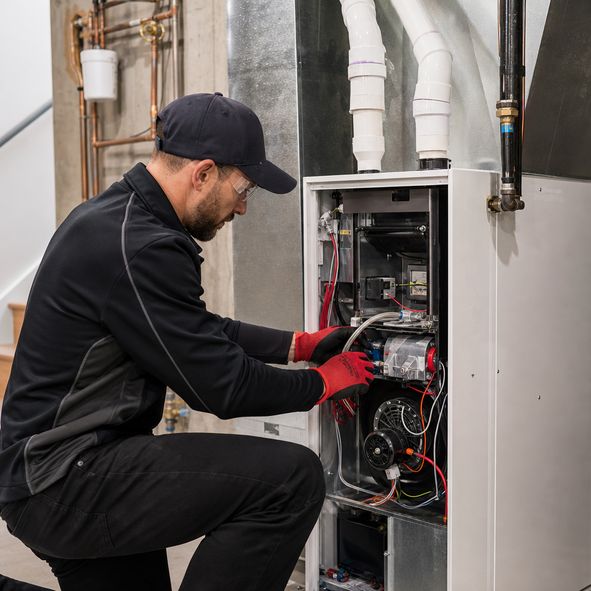
- Step 3 — Expert Equipment Installation: Our licensed Red Seal gas fitters remove and responsibly dispose of your old system, install your new high-efficiency furnace to manufacturer specifications, modify or install venting using sealed PVC condensate exhaust and fresh-air intake piping, and ensure all gas connections are pressure-tested and leak-checked.
- Step 4 — Ductwork Inspection and Sealing: We inspect your existing duct system for leaks, disconnected sections, and undersized runs that could compromise airflow and comfort, recommending sealing or modifications where needed.
- Step 5 — System Commissioning and Safety Testing: We verify ignition, measure gas manifold pressure, check heat exchanger integrity for carbon monoxide risk, confirm proper condensate drainage, test all safety limits and pressure switches, and verify thermostat operation and Wi-Fi connectivity if applicable.
- Step 6 — Homeowner Walkthrough and Documentation: Before we pack up, we walk you through your new system’s operation, filter maintenance schedule, and warranty documentation. We handle all FortisBC rebate paperwork on your behalf.
Seven Warning Signs Your Vancouver Home Needs a New Furnace Now
Not sure whether your existing system deserves another repair bill or whether it is time to invest in a new installation? Watch for these critical indicators:
- Age exceeds 15–18 years: The average lifespan of a residential gas furnace in Greater Vancouver is 18–22 years with proper maintenance. Beyond 15 years, efficiency degrades substantially and repair frequency accelerates.
- Steadily rising gas bills: If your FortisBC bills have been climbing year over year despite similar usage patterns, your heat exchanger and burner assembly are likely losing efficiency.
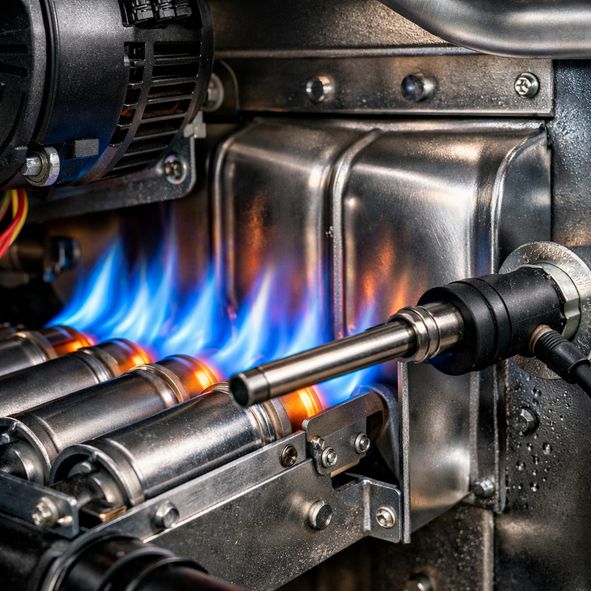
- Yellow or orange pilot flame: A healthy gas flame burns crisp blue. Yellow or orange flame indicates incomplete combustion and potential carbon monoxide production — a serious safety concern requiring immediate professional assessment.
- Uneven room temperatures: Cold bedrooms and warm living areas signal a furnace that can no longer maintain adequate static pressure to distribute heat evenly through your duct system.
- Unusual mechanical noises: Banging, rattling, squealing, or persistent clicking during startup or operation indicate worn heat exchanger panels, failing bearings in the blower motor, or cracked inducer housing — all serious mechanical problems.
- Excessive dust, dryness, or poor indoor air quality: An aging furnace loses its ability to properly filter and humidify recirculated air, contributing to respiratory irritation, static electricity, and airborne particulate levels.
- Frequent repair calls: As a general rule of thumb, if your annual repair costs exceed 50% of the cost of a new installation, replacement is the economically rational choice.
Greater Vancouver Homeowner Guide: FortisBC Rebates, Permits, and Coastal Climate Considerations
Installing a new furnace in British Columbia involves navigating several important regulatory and financial considerations that differ from other Canadian provinces, and BCRC handles all of them on your behalf.
FortisBC and CleanBC Rebates: Qualifying high-efficiency natural gas furnace replacements are currently eligible for rebates of up to $1,000 through FortisBC’s Energy Efficiency Rebate Program, administered under the provincial CleanBC Better Homes initiative. To qualify, the new equipment must meet minimum AFUE thresholds (typically 95%+) and must be installed by a licensed contractor. BCRC manages your entire rebate application from submission to receipt, ensuring you capture every dollar available.
Building Permits: Furnace replacements in Metro Vancouver municipalities — including the City of Vancouver, Burnaby, Richmond, Surrey, Coquitlam, North Vancouver, and West Vancouver — require a mechanical permit issued by the local authority having jurisdiction. BCRC pulls all required permits as part of our standard installation process. Never hire a contractor who offers to skip the permit process — unpermitted work voids your equipment warranty, creates liability during a home sale, and may leave you responsible for carbon monoxide incidents.
Coastal Climate and Condensate Management: Greater Vancouver’s mild but persistently damp climate creates specific installation considerations for high-efficiency condensing furnaces. The acidic condensate produced by a 96%+ AFUE furnace — typically 1 to 3 litres of water per hour of operation — must be properly neutralized before entering your home’s drain system to comply with BC plumbing code and protect cast-iron drain lines from corrosion. BCRC installs condensate neutralizer cartridges filled with limestone chips as a standard part of every high-efficiency installation.
Annual Maintenance — Protecting Your Investment: Even the finest furnace degrades rapidly without systematic annual maintenance. BCRC’s comprehensive 24-point annual inspection includes cleaning and inspecting the burner assembly and flame sensor, lubricating blower motor bearings, verifying heat exchanger integrity with a combustion analyzer, testing all safety controls, inspecting the condensate drain and neutralizer, checking gas manifold pressure, replacing the air filter, and conducting a carbon monoxide safety sweep of the mechanical room. Regular maintenance typically extends furnace lifespan by 5–7 years and maintains peak AFUE efficiency throughout the system’s service life.
Frequently Asked Questions About Furnace Installation in Vancouver
How long does a furnace installation in Vancouver typically take?
A standard furnace replacement — removing the old unit, installing the new high-efficiency condensing furnace, modifying PVC venting, connecting gas and electrical, commissioning, and homeowner walkthrough — typically requires one full working day, between 6 and 8 hours for most residential applications. More complex installations involving significant ductwork modification, gas line extension, or confined mechanical room configurations may require a second day. BCRC always provides a realistic time estimate during your in-home consultation so you can plan accordingly. We protect your floors and work area throughout the process and perform a thorough cleanup before departure.
What is the difference between a single-stage, two-stage, and modulating furnace, and which is right for my Vancouver home?
A single-stage furnace operates at 100% capacity every time it fires — it is either fully on or fully off. This creates the characteristic blast-and-coast heating cycle that leads to temperature swings and higher fuel consumption. A two-stage furnace has two operating levels — typically 65% and 100% capacity — running most of the time at the lower stage and only escalating to full capacity on the coldest days. This delivers meaningfully improved comfort and fuel efficiency. A modulating furnace continuously adjusts its burner output in small increments — often between 40% and 100% of rated capacity — responding dynamically to your home’s actual heat loss in real time. The result is virtually no temperature fluctuation, the quietest operation of any gas furnace technology, and the highest possible fuel efficiency. For Greater Vancouver’s mild but persistent heating season, a two-stage or modulating furnace paired with a variable-speed ECM blower delivers the optimal balance of comfort, efficiency, and long-term value.
Can I keep my existing ductwork when installing a new high-efficiency furnace?
In most cases, yes — but with important caveats. Your existing duct system must be evaluated for two critical factors: static pressure capacity and air leakage. Modern high-efficiency furnaces, particularly those with variable-speed ECM blower motors, are designed to operate within specific static pressure ranges. If your existing ductwork is undersized, too restrictive, or heavily leaking, the new furnace will never perform to its rated efficiency or comfort potential, and blower motor longevity will be compromised. BCRC performs a full ductwork inspection as part of every installation consultation, using a pressure gauge to test for leaks and reviewing trunk and branch sizing against ACCA Manual D airflow calculations. Necessary sealing, minor modifications, or register resizing are addressed as part of the installation scope to ensure your new system performs exactly as engineered.
Are there any carbon monoxide safety requirements specific to British Columbia for new furnace installations?
Yes, and they are critically important. BC’s Fire Code and BC Building Code require functional carbon monoxide (CO) alarms on each storey of a dwelling, and specifically within sleeping areas. High-efficiency condensing furnaces, by virtue of their sealed combustion and positive-pressure PVC venting, are inherently safer than older atmospheric-drafted furnaces — but CO safety remains a non-negotiable priority. BCRC provides a complimentary ULC-certified carbon monoxide detector with every furnace installation or safety inspection. During commissioning, our technicians use a calibrated combustion analyzer to test flue gas composition and verify that CO concentrations in the exhaust stream are within safe limits, and confirm that the heat exchanger shows no signs of cracking that could allow combustion gases to infiltrate the living space air supply. These checks are not optional extras — they are fundamental obligations of responsible HVAC practice.
BCRC Heating and Cooling: Vancouver’s Trusted Furnace Installation Specialists Since 2015
Your home deserves more than a furnace swap — it deserves a complete heating system solution engineered by professionals who understand Greater Vancouver’s unique climate, BC’s regulatory environment, and the technical demands of modern high-efficiency equipment. BCRC Heating and Cooling has been delivering exactly that since 2015, earning the trust of tens of thousands of homeowners across Vancouver, Burnaby, Richmond, Surrey, Coquitlam, Port Coquitlam, North Vancouver, West Vancouver, Abbotsford, New Westminster, Langley, Maple Ridge, and Pitt Meadows.
Our Red Seal certified gas fitters and HVAC technicians bring decades of hands-on expertise to every installation. We carry over $20,000 in parts inventory, offer fully flexible financing to fit any budget, assist with every FortisBC rebate application, and stand behind every installation with comprehensive warranty coverage. We are available 24 hours a day, 7 days a week — because heating emergencies do not wait for business hours.
Do not let another cold morning catch your family off guard. Whether you need to replace an aging system before winter arrives or you are facing a heating emergency right now, the team at BCRC is ready to help. For dependable, Red Seal certified furnace installation in Metro Vancouver backed by 40 years of local expertise and a commitment to your family’s comfort and safety, call BCRC Heating and Cooling today at (604) 781-7272 or book your free in-home consultation online. Warm, comfortable, and efficient heating is one phone call away.