


Carbon Monoxide Safety: Detectors & Emergency Steps
Why Carbon Monoxide Safety Is a Critical Priority for Lower Mainland Homeowners
Carbon monoxide safety — including where to put detectors and what to do if they go off — is the single most urgent life-safety topic for any home running a gas furnace, boiler, fireplace, or water heater in Vancouver, Burnaby, Richmond, Coquitlam, Surrey, or anywhere across the Lower Mainland. CO is colourless, odourless, and lethal. Every homeowner needs a clear, technically sound plan before heating season begins.
The Lower Mainland’s coastal climate creates unique risk factors: damp cold snaps drive extended furnace run times, condensation can accelerate heat exchanger corrosion, and tightly sealed modern homes trap combustion gases with alarming efficiency. This guide gives you the field-engineer-level knowledge you need to protect your household.
What Exactly Is Carbon Monoxide and Why Is It So Dangerous?
Quick Answer: Carbon monoxide is a toxic combustion byproduct produced when fuel burns incompletely. It displaces oxygen in the bloodstream, causing rapid incapacitation and death at concentrations above 150–200 ppm. Even low-level chronic exposure causes neurological damage — and you cannot smell, see, or taste it.
CO is generated by every fossil-fuel appliance in your home: natural gas furnaces, boilers, fireplaces, gas ranges, hot water heaters, and even attached garages with idling vehicles. High-efficiency condensing furnaces (those with AFUE ratings of 90%+) are engineered to minimize CO production through sealed combustion and secondary heat exchangers, but a cracked primary heat exchanger on any system — even a well-maintained variable-speed modulating unit — can leak CO directly into your living space through the air distribution system.
Technical Safety BC mandates that all residential gas appliances be installed and maintained in accordance with the BC Gas Safety Regulation. A compromised heat exchanger is not merely an efficiency concern — it is a Technical Safety BC violation and a life-threatening hazard requiring immediate shutdown and professional assessment.
Where Should You Place Carbon Monoxide Detectors in Your Home?
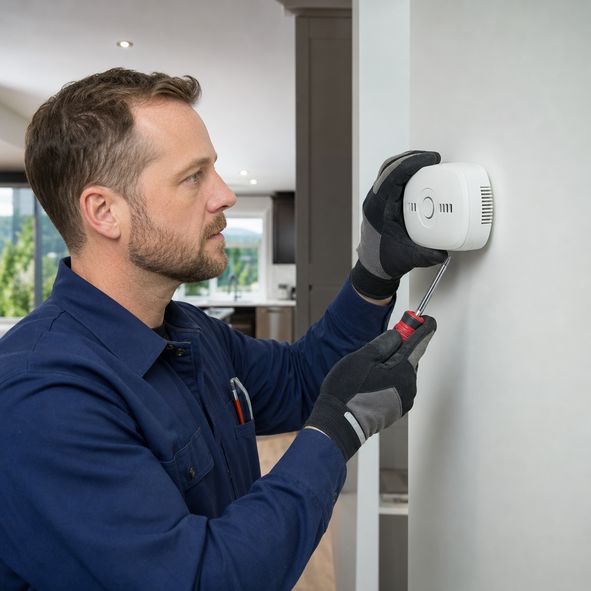
Quick Answer: Install CO detectors on every level of your home, including the basement, and within 5 metres of each sleeping area. Place units at breathing height (roughly 1–1.5 metres) on walls, never directly above combustion appliances, and follow CSA 6.19 standards for positioning.
- Basement mechanical room: Mount a detector within 3 metres of your furnace, boiler, or water heater — this is the most likely point of initial CO release from a failed heat exchanger or blocked flue.
- Main floor living area: One detector centrally located, away from cooking appliances (which can cause nuisance alarms from minor combustion) but within reach of the primary living zone.
- Each bedroom hallway: CO incapacitates people in their sleep. A detector within 5 metres of sleeping areas ensures the alarm is audible and response time is maximized.
- Attached garage entry: If your home has an attached garage, a detector immediately inside the door leading to living space is critical — vehicle exhaust is a leading source of residential CO poisoning.
- Upper floors: CO is roughly the same density as air, unlike propane (which sinks) or natural gas (which rises). Place detectors at breathing height, not at ceiling level, for most reliable detection.
In a typical Vancouver two-storey with basement, this means a minimum of four detectors. Interconnected units — either hardwired or wireless — are strongly recommended so that an alarm in the basement triggers every unit in the home simultaneously, giving sleeping occupants maximum warning time.
What Should You Do If Your Carbon Monoxide Detector Goes Off?
Quick Answer: If your CO alarm sounds, immediately evacuate everyone (including pets) to fresh outdoor air, call 911 from outside, do not re-enter the building, and contact a licensed HVAC technician for a full combustion safety inspection before returning home. Speed saves lives.
- Evacuate immediately — do not investigate first. Every second of continued exposure increases the risk of incapacitation. Do not stop to gather belongings.
- Call 911 from outside. Emergency responders carry calibrated CO meters and will verify safe levels before clearing re-entry. Never trust your own senses to determine when it is safe.
- Do not ventilate and assume the problem is solved. Opening windows may drop CO levels temporarily, but the source — a cracked heat exchanger, blocked flue, backdrafting appliance, or failed inducer motor — remains active.
- Contact a licensed HVAC technician before re-entering. A qualified technician will perform a combustion analysis using a calibrated flue gas analyser, inspect the heat exchanger for cracks (via visual, pressure test, or camera inspection), verify flue integrity, and confirm Technical Safety BC compliance before the system is returned to service.
- Document everything. Note the time the alarm triggered, which unit activated first, and any symptoms experienced. This information helps your technician pinpoint the source quickly.
How Do You Choose the Right Carbon Monoxide Detector?
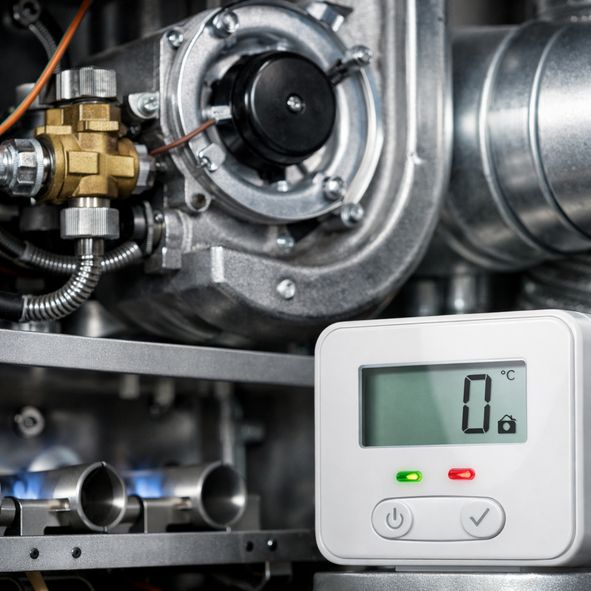
Quick Answer: Select detectors certified to CSA 6.19 or UL 2034 standards, with electrochemical sensors (not metal oxide semiconductor for primary life-safety), a digital display showing real-time ppm readings, a minimum 7-year sensor lifespan, and interconnect capability. Combination CO/smoke units are acceptable only as supplements, not replacements.
| Detector Feature | Recommended Specification | Why It Matters |
|---|---|---|
| Sensor Technology | Electrochemical | Superior accuracy, fewer false alarms, CSA-preferred for life-safety |
| Certification Standard | CSA 6.19 / UL 2034 | Required for Technical Safety BC compliance |
| Digital ppm Display | Yes — real-time readout | Allows technicians to assess severity and trend without guessing |
| Interconnect Capability | Hardwired or wireless RF | Whole-home simultaneous alarm ensures sleeping occupants are warned |
| Sensor Lifespan | 7–10 years minimum | Electrochemical cells degrade; expired sensors may not alarm at lethal levels |
| Power Source | Hardwired with battery backup | Maintains protection during power outages — critical in BC storm season |
| Combination CO/Smoke | Supplement only | Dual-function units involve placement compromises; dedicated CO units perform better |
What HVAC Conditions Increase Carbon Monoxide Risk in Lower Mainland Homes?
Quick Answer: Cracked heat exchangers in mid-efficiency furnaces, blocked or corroded flue venting, negative pressure backdrafting in tightly sealed homes, and neglected annual maintenance are the top CO risk factors in Vancouver-area homes. Coastal humidity accelerates corrosion in metal heat exchangers significantly.
Single-stage furnaces running at full capacity during cold snaps undergo more thermal stress cycling than two-stage or variable-speed modulating systems, which ramp output to match load — a principle aligned with Manual J load calculation methodology. A properly sized modulating furnace running at 40–60% capacity during a typical Lower Mainland damp-cold night produces less thermal fatigue on the heat exchanger than an oversized single-stage unit short-cycling at 100%. Oversizing is not just a comfort and efficiency problem — it is a long-term CO safety risk factor.
High-efficiency condensing furnaces (AFUE 96%+) with sealed PVC combustion air intake and exhaust eliminate many traditional chimney backdrafting risks. However, blocked or incorrectly sloped condensate drains, cracked PVC vent joints, and improperly sized intake/exhaust terminations can still create hazardous conditions. Annual inspection by a Red Seal HVAC technician is not optional — it is the foundation of CO safety.
Frequently Asked Questions: Carbon Monoxide Safety in Vancouver-Area Homes
Q1: My CO detector is beeping intermittently but not sounding a full alarm — is that still dangerous?
Intermittent chirping typically signals a low battery or end-of-life sensor rather than an active CO event — but never assume. Check the manual for your specific unit’s alarm patterns. A digital ppm display reading above zero even at low levels (9 ppm sustained, 35 ppm for one hour) warrants a professional combustion safety inspection. Do not dismiss low-level readings; chronic low-level CO exposure causes serious neurological damage over time.
Q2: How often should I replace my carbon monoxide detectors?
Electrochemical CO sensors have a functional lifespan of 7–10 years from manufacture date (not purchase date — check the label). Beyond this point, the electrochemical cell degrades and may fail to alarm at dangerous concentrations. Replace all units at the manufacturer’s specified end-of-life date. Additionally, schedule annual HVAC inspections so detector placement and appliance combustion safety are assessed together by a qualified technician.
Q3: My furnace was installed recently — do I still need CO detectors?
Absolutely. Even a new, properly installed high-efficiency furnace can develop CO risks from blocked intake venting, incorrect flue slope, negative pressure caused by exhaust fans, or a manufacturing defect. Technical Safety BC regulations and CSA B149.1 require CO detectors regardless of appliance age. New construction in BC mandates interconnected CO alarms — the same standard should be applied to all existing homes.
Q4: Can I place my CO detector near the ceiling like a smoke detector?
For CO specifically, wall-mounted placement at breathing height (1–1.5 metres) is more effective than ceiling placement. CO is nearly the same density as air, so it distributes relatively evenly — but ceiling-only placement adds unnecessary detection delay. Many combination smoke/CO units are ceiling-mounted as a compromise. For dedicated CO life-safety protection, follow CSA 6.19 positioning guidelines and consult your HVAC technician during your next annual inspection.
Protect Your Lower Mainland Home: Schedule a Combustion Safety Inspection Today
Carbon monoxide safety is not a seasonal checkbox — it is a year-round engineering responsibility. From cracked heat exchangers in aging single-stage furnaces to negative-pressure backdrafting in newer airtight Burnaby townhomes, the BCRC Heating and Cooling team has diagnosed and resolved every CO risk scenario across Vancouver, Richmond, Coquitlam, Surrey, and the entire Lower Mainland.
Our Red Seal certified technicians perform calibrated combustion analysis, heat exchanger integrity testing, flue and venting assessment, and full Technical Safety BC compliance verification on every inspection visit. We also advise on optimal CO detector placement specific to your home’s layout, appliance configuration, and ventilation dynamics.
Do not wait for an alarm to tell you there is a problem. Call BCRC Heating and Cooling at (604) 781-7272 to book your on-site combustion safety inspection and CO detector assessment today. Your family’s safety is the only metric that matters.