



Heat Pump Not Working in Cold Weather: Myths vs Facts
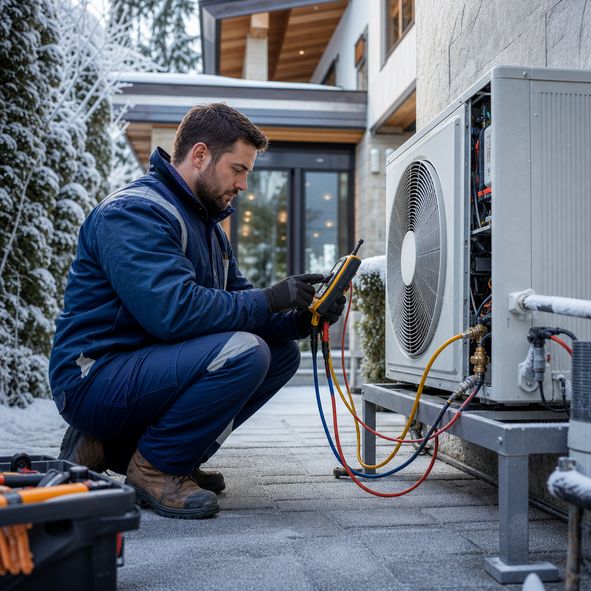
Why Your Heat Pump Isn’t Working in Cold Weather: Myths vs. Facts
If your heat pump isn’t working in cold weather, you’re not alone — and you’re probably being misled by outdated advice. Across Vancouver, Burnaby, Richmond, Coquitlam, Surrey, and the wider Lower Mainland, homeowners are discovering that heat pump performance myths can lead to costly comfort failures. This guide separates engineering fact from fiction so you can make smarter decisions about your HVAC system.
Myth #1: Heat Pumps Stop Working Below Freezing
Fact in 40–50 words: Modern cold-climate heat pumps operate efficiently well below 0°C. Units rated to –25°C or –30°C are now standard. In Metro Vancouver’s coastal climate — where temperatures rarely drop below –5°C to –10°C — a properly sized cold-climate heat pump should deliver reliable, consistent heating all winter long.
Older single-stage heat pumps from the 1990s and early 2000s did struggle below 5°C, relying heavily on electric resistance backup strips. That’s where the myth was born. Today’s variable-speed modulating compressors — particularly inverter-driven systems from manufacturers engineering for Nordic climates — maintain Heating Seasonal Performance Factor 2 (HSPF2) ratings of 9 to 14+ even in sustained cold snaps. These systems modulate compressor speed continuously, extracting latent heat from outdoor air with remarkable efficiency even when that air feels bitterly cold to human skin. The Lower Mainland’s damp maritime cold — think 2°C and saturated — is actually a condition where modern heat pumps perform exceptionally well compared to dry continental cold at the same temperature.
Myth #2: Frost on the Outdoor Unit Means It’s Broken
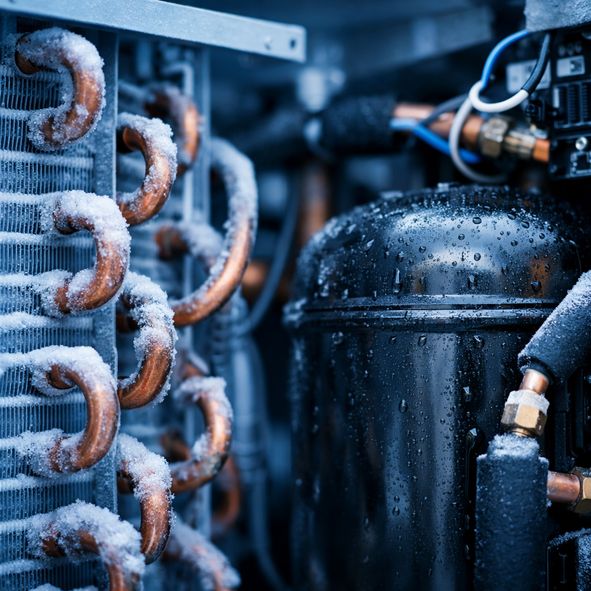
Fact in 40–50 words: Frost accumulation on an outdoor heat pump coil is completely normal and expected. All modern heat pumps have an automated defrost cycle that periodically reverses refrigerant flow to melt ice buildup. Seeing steam rising from your outdoor unit during defrost is a sign the system is working correctly.
What IS a problem is ice encasing the entire outdoor unit — top, sides, and base — for extended periods without clearing. This indicates a defrost board failure, low refrigerant charge, a failed reversing valve, or a blocked drain pan. In coastal Lower Mainland conditions where humidity is consistently high, defrost cycles may run more frequently than in drier climates. A qualified Red Seal refrigeration technician should inspect refrigerant pressures, defrost sensor calibration, and control board function if ice persists beyond 90 minutes. Technical Safety BC requires all refrigerant handling to be performed by licensed B-Pressure ticket holders — never attempt to self-diagnose refrigerant issues.
Myth #3: Bigger Heat Pumps Always Heat Better in Cold Weather
Fact in 40–50 words: Oversized heat pumps short-cycle, causing temperature swings, excessive humidity, compressor wear, and premature failure. Proper sizing requires a Manual J load calculation accounting for your home’s insulation, window area, air leakage rate, ceiling height, and local design temperature — not just square footage or a rough rule of thumb.
Manual J load calculations are the engineering standard mandated by ASHRAE and referenced in BC’s Step Code compliance pathway. A properly executed Manual J for a typical Lower Mainland home accounts for the region’s design heating temperature (approximately –7°C to –10°C for Metro Vancouver), coastal humidity levels, and the prevalence of older housing stock with varying insulation values. The result determines the precise BTU capacity required at design conditions. A variable-speed modulating system matched to this calculated load will operate at low speed 80–90% of the time — maintaining precise comfort, managing indoor humidity, and extending equipment lifespan — rather than blasting on and off at full capacity like an oversized single-stage unit.
Single-Stage vs. Two-Stage vs. Variable-Speed: What Actually Works in BC’s Climate
Not all heat pumps are engineered equally for cold-weather performance. Understanding the mechanical differences is essential before any purchase or replacement decision.
| Feature | Single-Stage | Two-Stage | Variable-Speed Modulating |
|---|---|---|---|
| Compressor Operation | 100% on or off | 65% or 100% capacity | 10%–100% continuous modulation |
| Cold Weather Performance | Degrades significantly below 5°C | Improved but limited below –5°C | Rated to –25°C to –30°C |
| HSPF2 Rating Range | 7.0–8.5 | 8.5–10.0 | 10.0–14.0+ |
| SEER2 Rating Range | 14–16 | 16–18 | 18–30+ |
| Humidity Control | Poor (short cycles) | Moderate | Excellent (long low-speed runs) |
| Defrost Frequency | Higher (less adaptive) | Moderate | Optimized (demand-based) |
| Backup Heat Requirement | Often required below 0°C | Sometimes required below –5°C | Minimal or none in Lower Mainland |
| Warranty Duration (typical) | 5–7 years compressor | 7–10 years compressor | 10–12 years compressor |
| Technical Safety BC Compliance | Standard installation | Standard installation | Requires commissioning verification |
| Best Fit for Lower Mainland | Mild-climate secondary use only | Moderate cold snaps | Year-round primary heating system |
Myth #4: Your Heat Pump Just Needs a Simple Tune-Up
Fact in 40–50 words: Cold-weather heat pump failures are rarely resolved by a basic filter change or thermostat reset. Root causes commonly include low refrigerant charge, failed TXV or EEV metering devices, faulty defrost controls, degraded compressor valves, or undersized electrical supply. A proper diagnostic requires licensed refrigeration instruments and Technical Safety BC-compliant procedures.
Lower Mainland homeowners frequently call after attempting DIY fixes or hiring unlicensed contractors who lack B-Pressure refrigeration tickets. The result is often a misdiagnosed system, improperly charged refrigerant, and a voided manufacturer warranty. Reputable manufacturers including Mitsubishi, Daikin, Bosch, and Trane require factory-authorized installation and commissioning to validate extended warranty terms. A Red Seal HVAC technician with active Technical Safety BC certification will perform a full system commissioning check: refrigerant superheat and subcooling measurements, airflow verification (typically 350–400 CFM per ton), electrical amperage draw verification, defrost cycle confirmation, and thermostat calibration — all documented for warranty compliance.
Lower Mainland-Specific Considerations: Coastal Humidity and Air Quality
Metro Vancouver’s climate presents unique HVAC challenges. The region’s sustained relative humidity — often 80–95% during winter months — accelerates coil frosting, promotes microbial growth in poorly maintained air handlers, and demands higher-grade filtration than dry-climate installations. BCRC Heating and Cooling’s field technicians regularly encounter heat pumps in Burnaby, Richmond, and Coquitlam where inadequate airflow caused by dirty coils and undersized filter media is misdiagnosed as a refrigerant or compressor problem. Clean air requirements in the Lower Mainland also mean that MERV-11 to MERV-13 filtration is increasingly standard in residential installations — but only when static pressure calculations confirm the air handler can support the added resistance without starving airflow across the evaporator coil.
Frequently Asked Questions
Q1: My heat pump keeps switching to emergency heat mode — is that normal in Vancouver winters?
A: Emergency heat mode should not activate automatically on a functioning cold-climate heat pump in Metro Vancouver conditions. If your system is defaulting to EM heat, the outdoor unit is either failing to transfer heat efficiently — due to low refrigerant, a failed reversing valve, or compressor degradation — or your thermostat’s outdoor temperature lockout is set too high. A licensed technician should perform refrigerant pressure testing and a full controls inspection before winter deepens.
Q2: How do I know if my heat pump is properly sized for my home?
A: Ask your installer to provide the completed Manual J load calculation report. This document specifies your home’s calculated heating and cooling load in BTUs, accounting for insulation R-values, window U-factors, infiltration rates, and local design temperatures. If no Manual J was performed, your system may be oversized or undersized — both conditions reduce efficiency, comfort, and equipment lifespan significantly.
Q3: Why is my heat pump blowing cool air instead of warm air in winter?
A: Several technical causes exist: a stuck or failed reversing valve (the component that switches the system between heating and cooling mode), a defrost cycle in progress (normal, lasts 5–15 minutes), low refrigerant charge reducing heat transfer capacity, or a faulty compressor unable to generate adequate pressure differential. Do not operate the system continuously if airflow is consistently cold — contact a Red Seal technician for diagnosis.
Q4: Does Technical Safety BC require permits for heat pump installations in the Lower Mainland?
A: Yes. Heat pump installations in British Columbia require a mechanical permit pulled through your local municipality and inspection by Technical Safety BC for the electrical and refrigeration work. Unpermitted installations void manufacturer warranties, create liability issues during home sales, and may leave homeowners responsible for any resulting property damage or safety incidents. Always verify your contractor holds active Technical Safety BC credentials.
Get Expert Cold-Weather Heat Pump Diagnostics in the Lower Mainland
Don’t let outdated myths or unqualified guesswork leave your family without reliable heat during a Lower Mainland cold snap. Whether you’re troubleshooting a struggling existing system or evaluating a new variable-speed cold-climate installation for your Vancouver, Burnaby, Richmond, Coquitlam, or Surrey home, BCRC Heating and Cooling’s Red Seal certified technicians bring the diagnostic instruments, licensing credentials, and local climate expertise to get it right the first time. Every inspection is performed in full compliance with Technical Safety BC requirements, and every recommendation is backed by Manual J engineering — not guesswork.
Call BCRC Heating and Cooling today at (604) 781-7272 to schedule your on-site technical inspection and heat pump assessment. Serving Vancouver, Burnaby, Richmond, Coquitlam, Surrey, and the entire Lower Mainland. Visit us at bcrcheating.com.