


Furnace Not Heating? 10 Quick Fixes First
Furnace Not Heating? Start Here Before Calling Anyone
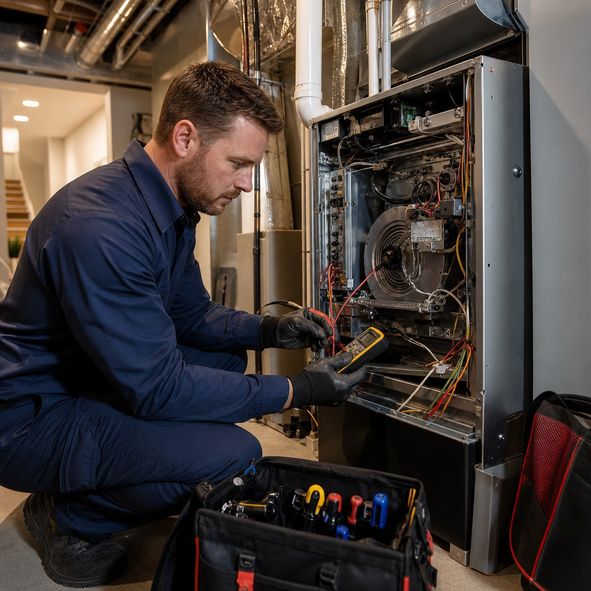
If your furnace is not heating your home on a damp, grey Lower Mainland morning, the instinct is to call for help immediately — and sometimes that is absolutely the right move. But a surprising number of service calls in Vancouver, Burnaby, Richmond, Coquitlam, and Surrey turn out to be simple, homeowner-fixable issues. This guide walks you through 10 structured diagnostic steps that a Red Seal HVAC technician would check first, so you can restore comfort fast and confidently.
Fix 1: Is Your Thermostat Actually Set to HEAT?
Quick Answer: A thermostat accidentally left on COOL or FAN-ONLY is the single most common reason a furnace appears to fail. Verify the mode selector reads HEAT and the set temperature is at least 3°C above the current room reading before any further diagnosis.
Modern programmable and smart thermostats — popular in Lower Mainland high-efficiency homes — can experience software glitches or scheduling conflicts after a power blip. Reset the thermostat to manual HEAT mode, raise the setpoint by 5°C, and wait 60–90 seconds for the furnace to initiate a call for heat. If you have a two-stage or variable-speed modulating system (which communicates digitally with the thermostat via a proprietary protocol), a communication fault can mimic a thermostat error. Check the display for any fault codes.
Fix 2: Check the Furnace Power Switch and Circuit Breaker
Quick Answer: Furnaces require a dedicated 120V circuit. A tripped breaker or an accidentally flipped service switch — often mistaken for a light switch near the unit — will completely cut power and prevent ignition. Reset or restore power before assuming mechanical failure.
In many Burnaby and Coquitlam basements, the furnace service switch is mounted on a nearby wall or ceiling joist and is frequently confused with a general lighting switch. Confirm the switch is ON. At the electrical panel, look for a tripped breaker (positioned between ON and OFF) and reset it once. If it trips again immediately, stop — this signals a wiring fault requiring a licensed technician and Technical Safety BC compliance review.
Fix 3: Inspect and Replace the Air Filter
Quick Answer: A clogged air filter is the leading cause of furnace overheating and safety-switch shutdown in coastal BC homes. Coastal humidity accelerates dust and mould binding to filter media. A severely restricted filter triggers the high-limit switch, forcing the furnace to shut down as a safety measure.
The Lower Mainland’s coastal climate introduces elevated particulate and humidity loads into your filter. High-efficiency pleated filters with a MERV 11–13 rating — recommended for Vancouver air quality — can load up in as little as 4–6 weeks during peak heating season. Remove the filter, hold it to a light source: if you cannot see light through it, replace it immediately. For variable-speed modulating systems, airflow restriction is especially damaging because the ECM blower motor compensates by drawing more current, stressing the motor windings.
Fix 4: Confirm the Furnace Drain Line Is Clear
Quick Answer: High-efficiency condensing furnaces (90%+ AFUE) produce acidic condensate. In Vancouver’s cool climate, these furnaces run in condensing mode almost all season. A blocked drain line triggers the pressure switch or float switch, locking out the furnace entirely.
Locate the white PVC condensate drain tubing running from the secondary heat exchanger to a floor drain or condensate pump. Inspect for kinks, ice blockages (possible in exposed garage installations), or algae buildup. Flush the line with warm water. If a condensate pump is installed, verify it is powered and the float moves freely. This step alone resolves a significant percentage of no-heat calls on high-AFUE equipment in Richmond and Surrey installations.
Fix 5: Look at the Inducer Motor and Pressure Switch
Quick Answer: The inducer motor creates the negative pressure needed to prove combustion venting before ignition. If the inducer fails to spin or the pressure switch hose develops a crack, the furnace control board reads a fault and locks out the ignition sequence for safety.
With the furnace access panel removed (and power confirmed ON), initiate a heat call and watch for the inducer wheel to spin within 30–60 seconds. Listen for unusual grinding or a high-pitched squeal indicating worn inducer bearings — common after 8–10 years of service in humid coastal environments. Inspect the small rubber hose connecting the inducer housing to the pressure switch for cracks or moisture blockage. A blocked pressure switch port is a straightforward fix; a failed inducer motor requires professional replacement.
Fix 6: Verify the Igniter and Flame Sensor
Quick Answer: A cracked hot-surface igniter or a coated flame sensor are the top two ignition-related causes of furnace lockout. The flame sensor, a small metal rod in the burner flame, must detect ionization current to keep the gas valve open — a layer of oxidation disrupts this signal completely.
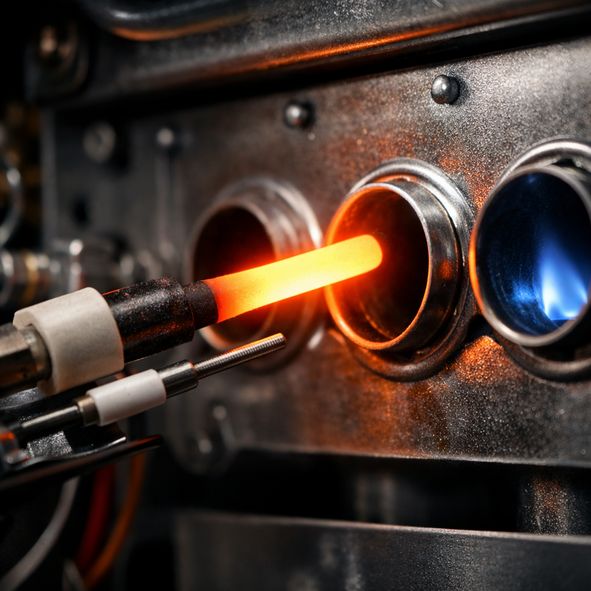
Silicon nitride igniters glow orange-yellow when functioning. If you observe the inducer running, the gas valve clicking, but no ignition, the igniter is the prime suspect. Flame sensors can often be carefully cleaned with fine steel wool or emery cloth by a knowledgeable homeowner — but use caution and disconnect power first. If cleaning does not resolve intermittent ignition, the sensor requires replacement. Note: repeated ignition failures should prompt a combustion analysis and heat exchanger inspection by a Red Seal technician.
Fix 7: Check All Supply and Return Vents for Blockage
Quick Answer: Closed or blocked supply registers and obstructed return-air grilles reduce system airflow, causing the heat exchanger to overheat and trip the high-limit safety switch. Ensure all registers are open and unobstructed, especially in recently renovated Lower Mainland homes where furniture placement changes frequently.
Walk every room and confirm supply registers are open at least 80%. Closing too many registers in a forced-air system does not save energy — it creates static pressure imbalance, forcing a single-stage or two-stage furnace to operate outside its design parameters. For variable-speed modulating systems, the ECM blower compensates partially, but sustained restriction degrades heat exchanger longevity. Return grilles, typically located in hallways, must be completely unobstructed.
Fix 8: Reset the Furnace High-Limit Switch
Quick Answer: The high-limit switch is a thermal safety device that shuts down the burner if the heat exchanger surpasses a critical temperature threshold. After correcting the root airflow cause, a manual-reset high-limit switch requires deliberate physical reset using the reset button on the switch body.
Some furnace models — particularly older 80% AFUE single-stage units still common in pre-2000 Burnaby and Vancouver homes — feature a manual-reset high-limit switch. With power OFF, locate the switch on the supply plenum, press the reset button firmly, restore power, and initiate a heat call. If the limit trips again within minutes, do not continue resetting — this indicates an unresolved overheating condition requiring professional combustion and airflow analysis.
Fix 9: Inspect the Flue and Exhaust Venting
Quick Answer: Blocked or disconnected flue pipes prevent safe exhaust of combustion gases. In coastal BC storms, wind-driven debris, bird nests, or ice can partially block PVC exhaust terminations on high-efficiency furnaces, triggering pressure switch lockout or dangerous carbon monoxide risk.
For 90%+ AFUE condensing furnaces, the PVC intake and exhaust pipes typically terminate through a side wall. After a Lower Mainland wind or rain event, visually inspect the terminations for debris, bird activity, or ice formation. Ensure clearances from grade and adjacent surfaces meet manufacturer specifications. For 80% AFUE units with B-vent or single-wall metal flues, inspect for disconnected joints, rust-through, or backdrafting signs. Any flue abnormality requires immediate professional intervention — carbon monoxide safety is non-negotiable.
Fix 10: Restore Gas Supply and Check the Pilot (Older Units)
Quick Answer: An interrupted gas supply — caused by a closed shutoff valve, a gas meter issue, or pilot outage on older standing-pilot furnaces — prevents any heat production. Verify the manual gas shutoff valve upstream of the furnace is fully open (handle parallel to the pipe).
On older standing-pilot furnaces still operating in parts of the Lower Mainland, the pilot can extinguish due to drafts, thermocouple failure, or gas pressure fluctuations. Follow the manufacturer’s relight procedure printed on the furnace label. If the pilot will not stay lit after three attempts, the thermocouple requires replacement. For all modern electronic-ignition furnaces, verify the main gas shutoff is open, then check whether other gas appliances (range, water heater) are functioning — if none work, contact your gas utility provider.
Furnace System Comparison: Single-Stage vs Two-Stage vs Variable-Speed Modulating
| Feature | Single-Stage (80% AFUE) | Two-Stage (90–96% AFUE) | Variable-Speed Modulating (96–98.5% AFUE) |
|---|---|---|---|
| Firing Capacity | 100% only | 65% / 100% | 40–100% in fine increments |
| Humidity Control | Poor (short cycles) | Moderate | Excellent (long low-fire runs) |
| Lower Mainland Climate Suitability | Moderate | Good | Excellent for coastal damp cold |
| Manual J Sizing Sensitivity | Low | Moderate | High — precise load matching critical |
| Blower Motor Type | PSC (fixed speed) | PSC or ECM | ECM variable-speed |
| Heat Exchanger Stress | High (on/off cycling) | Moderate | Low (sustained modulation) |
| Technical Safety BC Compliance | Standard requirements | Standard + venting specifics | Standard + advanced venting + controls |
| Warranty (Typical) | 10–20 yr heat exchanger | 10–20 yr heat exchanger | 10–20 yr heat exchanger; lifetime on select models |
| Ideal Application | Budget replacement, older homes | Mid-range upgrade | New builds, high-performance retrofits |
Frequently Asked Questions
Why does my furnace turn on but blow cold air in my Vancouver home?
Cold air from a running furnace almost always indicates an ignition failure or a tripped high-limit switch. The inducer and blower may activate, but if the burners fail to light — due to a faulty igniter, coated flame sensor, or gas supply interruption — only unconditioned air circulates. A secondary cause is a cracked heat exchanger diverting combustion bypass airflow. Any suspicion of a cracked heat exchanger demands immediate professional inspection: it is both a carbon monoxide hazard and a Technical Safety BC compliance issue.
How often should I replace my furnace filter in Burnaby or Richmond?
In the Lower Mainland’s coastal environment, MERV 11–13 pleated filters should be inspected monthly during the October–April heating season and replaced every 4–8 weeks depending on household occupancy, pets, and renovation activity. Variable-speed modulating furnaces are especially sensitive to filter loading — restricted airflow forces the ECM motor to compensate, increasing current draw and shortening motor life. Never run a high-efficiency furnace without a filter installed; dust accumulation on the heat exchanger fins significantly reduces thermal transfer efficiency.
Is it safe to reset my furnace repeatedly if it keeps shutting off?
No. Resetting a furnace more than twice when it continues to lockout is unsafe and potentially dangerous. Repeated lockouts signal an unresolved safety condition — commonly a cracked heat exchanger, sustained high-limit tripping from airflow restriction, or an intermittent gas valve fault. Each unauthorized reset bypasses the engineered safety sequence designed to prevent carbon monoxide exposure and fire risk. Contact a Red Seal HVAC technician for a proper combustion analysis, heat exchanger inspection, and control board fault-code retrieval.
What AFUE rating should I look for in a new furnace for the Lower Mainland climate?
For Vancouver, Burnaby, Surrey, Coquitlam, and Richmond — where the heating season runs approximately 6–7 months with sustained damp cold — a minimum 95% AFUE condensing furnace is the practical baseline for meaningful efficiency. The top-tier variable-speed modulating units reaching 96–98.5% AFUE deliver superior humidity management through extended low-fire run cycles, directly addressing the coastal climate’s persistent moisture challenge. Always require a Manual J load calculation to ensure BTU output is correctly matched to your home’s envelope — oversized furnaces short-cycle, undermining both comfort and heat exchanger longevity regardless of rated AFUE.
Conclusion: When to Stop Diagnosing and Call the Experts
These 10 diagnostic steps resolve the majority of straightforward furnace faults safely at the homeowner level. However, when you encounter repeated lockouts, suspected heat exchanger cracks, gas valve anomalies, flue integrity concerns, or any carbon monoxide detector activation — stop immediately and call a licensed Red Seal HVAC technician. Technical Safety BC regulations exist for critical reasons, and no DIY repair is worth compromising your family’s safety.
BCRC Heating and Cooling serves homeowners across Vancouver, Burnaby, Richmond, Coquitlam, Surrey, and the broader Lower Mainland with certified, experienced HVAC technicians who carry out thorough on-site combustion analysis, heat exchanger inspection, Manual J load verification, and complete system diagnostics. Whether your furnace needs a quick fix or a full technical evaluation, our team delivers precise, code-compliant workmanship backed by manufacturer warranty requirements.
Do not leave your family’s comfort and safety to chance. Call BCRC Heating and Cooling at (604) 781-7272 today to schedule your on-site technical inspection and get your home heating system performing at its full, reliable potential — before the next Lower Mainland cold snap hits.