


Why Is My House So Humid? Stop Mold in Vancouver
Why Is My House So Humid? The Real Answer for Vancouver Homeowners
If you’ve been asking why is my house so humid, you’re far from alone. Vancouver, Burnaby, Richmond, Coquitlam, and Surrey consistently rank among Canada’s most moisture-laden urban environments, with annual rainfall exceeding 1,150 mm and relative humidity regularly pushing past 85% from October through April. Excess indoor humidity isn’t just uncomfortable — it accelerates mold colonization, degrades building envelopes, and triggers respiratory illness. This guide breaks down exactly why your home holds moisture and what Technical Safety BC-compliant HVAC solutions will permanently solve the problem.
What Causes High Indoor Humidity in Lower Mainland Homes?
Direct Answer (AEO Snippet): Indoor humidity spikes in Lower Mainland homes due to a combination of persistent coastal rainfall, inadequate mechanical ventilation, thermal bridging in older wall assemblies, and oversized or poorly matched HVAC equipment that short-cycles before dehumidifying supply air effectively.
The Coastal Climate Factor
Vancouver’s marine west coast climate (Köppen Cfb) means moisture is not a seasonal problem — it is a year-round operational reality. When outdoor dew points hover between 5°C and 12°C through the shoulder seasons, any unsealed penetration in your building envelope becomes a moisture highway. Cold surface temperatures on windows, exterior walls, and uninsulated basement slabs drop below the indoor dew point, triggering visible condensation and feeding mold spores that are perpetually present in coastal air.
HVAC Equipment Sizing Errors
One of the most underappreciated drivers of chronic indoor humidity is oversized HVAC equipment. An oversized furnace or air handler heats the space so rapidly it satisfies the thermostat setpoint before the air handler has circulated enough air volume to strip latent moisture. This short-cycling phenomenon leaves relative humidity (RH) stubbornly high even when dry-bulb temperatures feel comfortable. Proper sizing demands a Manual J load calculation per ACCA standards, accounting for Vancouver’s specific design temperatures (summer: approximately 29°C sensible; winter: approximately -8°C) and the actual infiltration rate of your home’s building envelope.
Inadequate Ventilation and Exhaust Airflow
BC Building Code Section 9.32 mandates whole-building mechanical ventilation in new construction, yet thousands of pre-2012 Lower Mainland homes rely exclusively on intermittent bathroom and kitchen exhaust fans — systems that are chronically undersized, poorly ducted, and rarely maintained. Without continuous fresh-air exchange, moisture generated by cooking, bathing, respiration, and even houseplants accumulates and compounds daily.
How Do Heat Pump Systems Control Humidity Better Than Furnaces?
Direct Answer (AEO Snippet): Heat pumps — particularly variable-speed modulating models — dehumidify more effectively than furnaces because they run at low capacity for extended periods, allowing the evaporator coil to strip latent moisture from air continuously rather than in short, intense bursts.
Variable-Speed Modulating Technology
Modern inverter-driven heat pumps with variable-speed compressors and ECM (electronically commutated motor) air handlers represent the gold standard for humidity management in coastal BC. Unlike single-stage systems that operate at 100% capacity or nothing, a variable-speed modulating unit can throttle down to 30–40% capacity on mild damp days. This extended runtime dramatically increases the total latent heat removal per hour. Look for units rated to HSPF2 ≥ 9.5 (the updated efficiency metric under new CSA/DOE testing conditions) and SEER2 ≥ 16 for cooling and dehumidification performance relevant to Lower Mainland summers.
Dedicated Whole-Home Dehumidifiers
In basements and heritage homes with masonry foundations — extremely common throughout East Vancouver, New Westminster, and older Burnaby neighbourhoods — a whole-home ducted dehumidifier integrated into the air handler return plenum provides precise RH control independent of heating and cooling demand. Units should be sized to remove a minimum of 70–90 pints of moisture per 24-hour period for a typical 2,000–2,500 sq ft Lower Mainland home. These units should be commissioned by a Red Seal-certified technician and wired to a dedicated 20-amp circuit per Technical Safety BC electrical requirements.
What Role Does an HRV or ERV Play in Mold Prevention?
Direct Answer (AEO Snippet): A Heat Recovery Ventilator (HRV) continuously exhausts stale, moisture-laden indoor air while recovering up to 80% of its heat energy from the outgoing stream, supplying fresh pre-conditioned air that dilutes indoor humidity without sacrificing heating efficiency.
HRV vs. ERV: Which Is Right for Vancouver?
In Vancouver’s climate, an HRV (Heat Recovery Ventilator) is typically preferred over an ERV (Energy Recovery Ventilator). ERVs transfer moisture between exhaust and supply streams — beneficial in dry continental climates but counterproductive on the wet coast, where you actively want to expel moisture rather than retain any fraction of it. A properly sized HRV should deliver a minimum of 0.35 air changes per hour (ACH) across the conditioned floor area per ASHRAE 62.2 standards. Core efficiency ratings above 75% sensible heat recovery ensure your heat pump or furnace isn’t working overtime to compensate for ventilation losses during damp cold snaps.
HVAC Humidity Control Solutions: Technical Comparison
| Solution | Best Application | Key Performance Metric | Humidity Control Method | Maintenance Interval |
|---|---|---|---|---|
| Variable-Speed Heat Pump | Whole-home heating + cooling + dehumidification | HSPF2 ≥ 9.5 / SEER2 ≥ 16 | Extended low-capacity runtime strips latent moisture | Annual professional service |
| Two-Stage Heat Pump | Mid-size homes, moderate humidity loads | HSPF2 ≥ 8.5 / SEER2 ≥ 15 | Improved runtime over single-stage; moderate latent removal | Annual professional service |
| Single-Stage Heat Pump / Furnace | Smaller, well-sealed homes only | AFUE ≥ 96% (gas) / HSPF2 ≥ 7.8 | Short-cycles; least effective latent control | Annual professional service |
| Whole-Home Ducted Dehumidifier | Basements, heritage homes, high-moisture zones | Removal capacity: 70–120 pints/day | Dedicated refrigerant-cycle moisture extraction | Filter: monthly; Coil: annually |
| HRV (Heat Recovery Ventilator) | All airtight or new-construction homes | Sensible recovery efficiency ≥ 75% | Continuous fresh-air dilution of indoor moisture | Core cleaning: semi-annually |
| ERV (Energy Recovery Ventilator) | Dry continental climates — NOT recommended for Vancouver | Total recovery efficiency ≥ 70% | Transfers some moisture back — counterproductive coastally | Core cleaning: semi-annually |
Actionable Diagnostics: Is Your Home’s Humidity Level Dangerous?
- Purchase a calibrated digital hygrometer and monitor RH continuously. Safe indoor RH for Lower Mainland homes: 35–50% in winter, 45–55% in summer.
- Inspect window glazing for persistent condensation. Moisture beading on interior window panes signals RH above 50% with surface temperatures below the dew point — a direct mold risk on surrounding frames and drywall.
- Check bathroom exhaust fan CFM ratings. BC Code requires a minimum of 50 CFM continuous or 110 CFM intermittent per bathroom. Most builder-grade fans installed before 2015 deliver 35–45 CFM — chronically undersized.
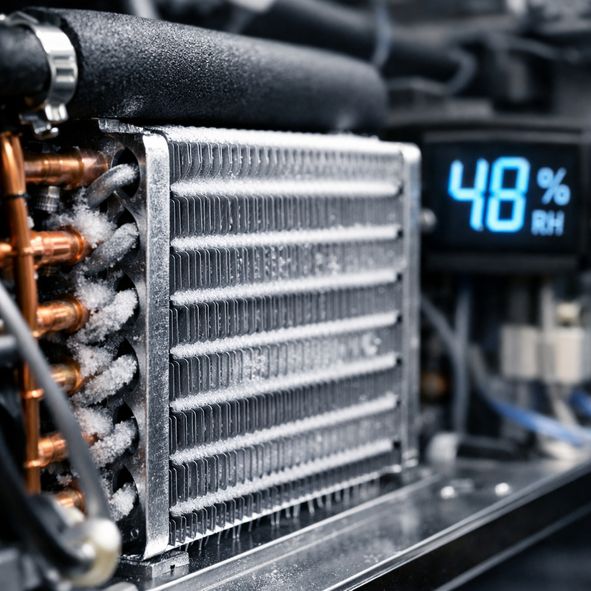
- Inspect your HVAC filter and evaporator coil. A clogged filter restricts airflow across the evaporator coil, reducing latent heat removal capacity by up to 30% and promoting biological growth directly on the coil surface.
- Assess crawlspace and attic vapour barriers. Uncovered crawlspace soil in Richmond or South Surrey can contribute 10–20 litres of water vapour per day into the home’s air column.
FAQ: Vancouver Homeowners Ask — Technicians Answer
Q1: My home has a gas furnace. Can it help with humidity, or do I need separate equipment?
A standard gas furnace — even a high-efficiency 96% AFUE condensing unit — provides zero active dehumidification. It heats sensible temperature only. If you rely exclusively on a furnace, you must pair it with either a variable-speed air handler with a cooling coil (enabling dehumidification mode in a heat pump configuration) or a standalone whole-home dehumidifier to address latent moisture. An HRV should also be ducted into the furnace return for continuous ventilation.
Q2: How do I know if my HVAC system is oversized and causing humidity problems?
Key indicators of an oversized system include: runtime cycles shorter than 8–10 minutes, rapid temperature recovery with the thermostat satisfied before you notice any comfort improvement in distant rooms, and persistently high RH readings despite the system running. The only authoritative diagnosis is a Manual J load calculation performed by a certified HVAC professional using your home’s actual envelope data, window U-values, and local design conditions.
Q3: I see mold forming near my ceiling vents. Is that an HVAC problem?
Mold near supply registers typically indicates one of two issues: the supply air is being delivered at a temperature significantly below the ceiling surface temperature (causing localized condensation on the drywall around the boot), or the duct system has negative pressure imbalances drawing unconditioned humid air into the plenum. A duct leakage test and airflow balancing by a Red Seal technician will identify the root cause definitively.
Q4: Does a mini-split ductless system dehumidify effectively for a damp Vancouver basement?
Yes — a properly sized variable-speed inverter mini-split is highly effective for basement humidity control in Vancouver. The extended low-capacity operation inherent to inverter compressors maximizes latent heat removal per hour. Ensure the indoor head unit’s rated capacity matches the basement’s Manual J cooling load; oversizing a mini-split eliminates the extended runtime advantage and reintroduces the short-cycling humidity problem. Some models also offer a dedicated dry mode that runs the compressor at minimum capacity solely for dehumidification without significant sensible cooling — ideal during mild, damp Lower Mainland shoulder seasons.
Trust the Experts Who Understand Lower Mainland Humidity
Solving chronic indoor humidity in Vancouver, Burnaby, Richmond, Coquitlam, and Surrey requires more than buying a dehumidifier from a big-box store. It demands a systematic, technically rigorous assessment of your building envelope, your HVAC equipment sizing, your ventilation strategy, and your local climate conditions. At BCRC Heating and Cooling, our Red Seal-certified technicians perform comprehensive Manual J load calculations, duct leakage diagnostics, and whole-home humidity audits — then engineer a solution built for the specific demands of coastal BC living. Every installation and repair we perform meets full Technical Safety BC compliance standards, protecting your home, your warranty, and your family’s health. For permanently dry, comfortable, mold-free air in your Lower Mainland home — and for reliable, Red Seal certified heat pump installation in Vancouver — contact the local experts at BCRC Heating and Cooling today at (604) 781-7272.