



Why Is My AC Freezing Up? Causes & Fixes
Why Is My AC Freezing Up? The Short Answer
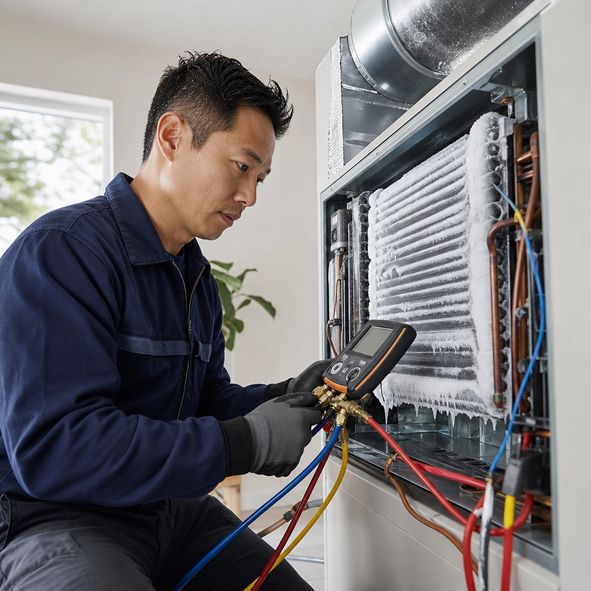
A frozen air conditioner is one of the most disruptive cooling failures a Lower Mainland homeowner can experience — especially during Vancouver’s increasingly humid summer stretches. Your AC freezes up when refrigerant pressure drops, airflow becomes restricted, or outdoor temperatures fall too low, causing moisture on the evaporator coil to ice over and block the entire cooling cycle. Left unaddressed, a frozen AC can damage the compressor — the most expensive component in the system.
This guide breaks down every root cause, walks you through safe at-home diagnostics, and explains when you need a Technical Safety BC–compliant certified technician from BCRC Heating and Cooling on-site.
What Causes an AC Unit to Freeze Up?
Direct Answer (40–50 words): The most common causes of a freezing AC are restricted airflow from a dirty filter or blocked vents, low refrigerant charge, a failing blower motor, or operating the system when outdoor temperatures drop below 15°C — all of which cause the evaporator coil to ice over.
1. Restricted Airflow — The #1 Culprit in Metro Vancouver Homes
The evaporator coil must have a continuous, balanced airflow to maintain its operating temperature above freezing. When airflow drops — due to a clogged air filter, collapsed flex duct, closed supply registers, or a failing variable-speed blower motor — the coil surface temperature plummets. Moisture in the air (and coastal BC air is perpetually humid) condenses and instantly freezes on the coil surface.
- Dirty air filter: A filter left unchanged beyond 60–90 days in a coastal environment accumulates particulate and biofilm rapidly. MERV 8–13 filters are recommended for Lower Mainland air quality, but they must be checked monthly during cooling season.
- Blocked or closed registers: Closing registers in unused rooms does not reduce system load — it creates static pressure imbalances that starve the evaporator of return airflow.
- Undersized ductwork: Many pre-2000 Metro Vancouver homes were ducted for single-stage furnaces. Retrofitting a high-capacity cooling system without a Manual J load calculation and accompanying duct sizing study creates chronic airflow deficits.
- Blower motor failure: Variable-speed ECM motors in modern two-stage and modulating systems can develop faults that reduce airflow to 30–40% of rated capacity before the homeowner notices — yet the compressor keeps running, freezing the coil silently.
2. Low Refrigerant Charge
Refrigerant is not a consumable — it does not get used up. If your system is low on refrigerant (R-410A in most modern units, or the newer R-454B in next-generation systems), it means there is a leak. A low charge reduces the pressure on the suction side of the refrigerant circuit, dropping the evaporator coil temperature well below 0°C and causing rapid ice formation.
Diagnosing refrigerant charge requires calibrated manifold gauges and a licensed refrigeration mechanic. Under Technical Safety BC regulations and federal refrigerant handling rules, refrigerant work must be performed by a certified tradesperson. Do not attempt to add refrigerant yourself — an overcharge is equally damaging and can rupture high-side components.
3. Operating the AC in Low Outdoor Temperatures
Standard split-system air conditioners are designed to operate with outdoor ambient temperatures above approximately 15°C (60°F). During shoulder seasons in Burnaby, Coquitlam, or Surrey — where cool coastal nights are common even in June and September — running the AC when it is 10–12°C outside will cause the refrigerant suction pressure to drop below design parameters, freezing the evaporator coil within minutes of startup.
4. Dirty Evaporator or Condenser Coils
Coil fouling is endemic in the Lower Mainland’s damp, pollen-heavy environment. A layer of biofilm, dust, and cottonwood debris on the evaporator coil acts as an insulating blanket, preventing proper heat absorption. The refrigerant stays cold, the coil drops below freezing, and ice forms. Annual professional coil cleaning — using appropriate coil-safe foaming agents — is not optional; it is a manufacturer warranty requirement for virtually every major OEM including Carrier, Lennox, Trane, and Daikin.
5. Thermostat and Controls Issues
A thermostat set to FAN ON (continuous fan) rather than AUTO can push humid air over a cold coil even after the compressor shuts off, building up ice between cooling cycles. Additionally, a faulty thermistor or control board commanding abnormally long compressor run times can over-cool the coil past its design limit.
How to Safely Thaw a Frozen AC Unit
Direct Answer (40–50 words): Turn the thermostat to OFF and switch the fan to ON to circulate warm air over the coil. Never chip or scrape ice. Allow 2–4 hours for full thaw, then inspect the drain pan for overflow. Call a certified technician before restarting to find the root cause.
- Shut down the compressor immediately. Set your thermostat to OFF or COOL → OFF. Continuing to run a frozen compressor risks liquid refrigerant slugging back to the compressor, causing catastrophic valve damage.
- Run only the blower fan. Switch fan mode to ON (not AUTO). The warm return air will accelerate ice melt over 2–4 hours.
- Check and protect the drain pan. A large ice mass melting quickly can overflow the condensate drain pan. Place towels around the air handler and monitor the drain line for blockages.
- Inspect the air filter. If the filter is visibly clogged, replace it before calling for service — the technician will confirm whether this was the sole cause or a contributing factor.
- Do not restart the system until diagnosed. Restarting without identifying the root cause will re-freeze the coil within the hour.
Single-Stage vs. Two-Stage vs. Variable-Speed: Which Systems Are Most Freeze-Resistant?
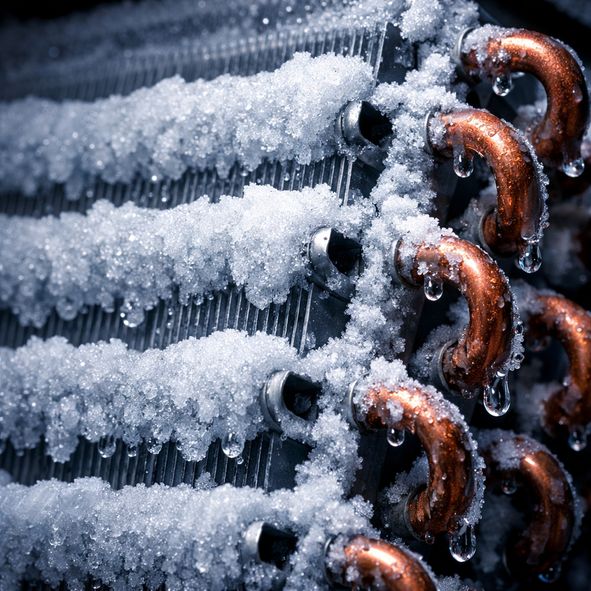
Direct Answer (40–50 words): Variable-speed modulating systems with ECM blowers and demand-controlled staging are the most freeze-resistant because they continuously modulate refrigerant flow and airflow to match actual load — preventing the low-load, low-pressure conditions that cause freeze-up in single-stage systems operating at 100% capacity on mild days.
| System Type | Freeze-Up Risk | SEER2 Range | Humidity Control | Best For |
|---|---|---|---|---|
| Single-Stage | Highest — runs at 100% or off | 13–16 SEER2 | Basic | Smaller, well-insulated homes with consistent load |
| Two-Stage | Moderate — low stage reduces freeze risk on mild days | 16–19 SEER2 | Improved | Mid-size Lower Mainland homes with variable summer loads |
| Variable-Speed Modulating | Lowest — modulates 40–100% to match real-time load | 20–26 SEER2 | Excellent — extended runtimes dehumidify coastal air | Larger homes, high-humidity zones (Richmond, Delta, coastal areas) |
Preventive Maintenance: Stop Freeze-Ups Before They Start
In the Lower Mainland’s climate — characterized by coastal humidity, wildfire smoke events, and pollen seasons that run March through October — reactive maintenance is a false economy. A Technical Safety BC–compliant annual cooling tune-up from BCRC Heating and Cooling includes:
- Refrigerant pressure and superheat/subcooling verification with calibrated digital manifold gauges
- Evaporator and condenser coil inspection and cleaning
- Blower wheel and motor amp draw testing
- Condensate drain flush and pan treatment
- Static pressure testing to identify ductwork airflow deficits
- Thermostat calibration and controls verification
- Filter inspection and MERV rating recommendation based on your specific indoor air quality needs
Frequently Asked Questions
FAQ 1: Can I run my AC if it is partially frozen?
No — and here is why. Running a partially frozen system forces the compressor to work against abnormal suction pressures. The liquid refrigerant returning to the compressor (a condition called flood-back) washes out the compressor’s lubricating oil, scoring the cylinder walls. This can transform a minor freeze-up into a compressor replacement scenario. Shut it down, let it thaw completely, and call BCRC at (604) 781-7272 for a same-day diagnostic.
FAQ 2: How long does it take for a frozen AC to thaw?
With the compressor off and the blower fan running on AUTO or ON, most residential evaporator coils fully thaw within 2 to 4 hours. Larger commercial units or systems that have been running frozen for extended periods may take up to 8 hours. Do not use heat guns, hair dryers, or any open-flame devices to accelerate thawing — you risk damaging the aluminum fins and copper tubing.
FAQ 3: My AC froze up last summer too. Is this a sign I need a new system?
Recurring freeze-ups are a serious diagnostic flag. In most cases, they point to one of three underlying issues: a persistent refrigerant leak that was topped up without leak repair (a Technical Safety BC violation), a chronically undersized or improperly ducted system that was never correctly commissioned with a Manual J load calculation, or a degrading blower motor that has never been caught because the system still cools eventually. A BCRC technician will perform a full system audit — including duct static pressure mapping — to determine whether repair or replacement is the right engineering decision for your home.
FAQ 4: Does a frozen AC cause water damage?
Absolutely. When a heavily iced evaporator coil thaws rapidly, it can produce several litres of meltwater in a short period. If the condensate drain pan is already carrying biological growth (a common issue in humid Burnaby and Richmond basements), the drain line may be blocked, causing the pan to overflow onto your ceiling, insulation, or finished flooring. Always check the drain pan during a thaw event and have the drain line professionally flushed as part of your annual maintenance.
Trust BCRC Heating and Cooling for Lower Mainland AC Diagnostics
A frozen air conditioner is never a minor inconvenience — it is a symptom of an underlying mechanical or airflow issue that will worsen with each cooling season if left unresolved. At BCRC Heating and Cooling, our Red Seal–certified technicians serving Vancouver, Burnaby, Richmond, Coquitlam, Surrey, and the greater Lower Mainland carry full Technical Safety BC compliance credentials and the diagnostic equipment to identify the root cause of your freeze-up on the first visit — not the third.
Do not let a frozen coil escalate into a compressor failure. Call BCRC Heating and Cooling at (604) 781-7272 today to schedule your on-site technical inspection and AC diagnostic assessment. We are here to keep your system running at peak efficiency, comfort, and reliability through every coastal BC summer.