


Is a Smart Thermostat Worth It? Features & Top Picks
Is a Smart Thermostat Worth It for Lower Mainland Homeowners?
Direct Answer: Yes — for most Vancouver and Lower Mainland homes, a smart thermostat is absolutely worth it. It delivers precise temperature control, system-health diagnostics, and adaptive scheduling that align perfectly with BC’s coastal climate: damp cold snaps, variable humidity, and the need for responsive, efficient heating performance.
If you’ve been asking yourself is a smart thermostat worth it, you’re not alone. Across Burnaby, Richmond, Coquitlam, and Surrey, homeowners are upgrading from outdated manual or basic programmable thermostats to intelligent, connected devices that actively communicate with their HVAC systems. But not every smart thermostat works well with every system — and incorrect pairing can undermine performance, comfort, and equipment longevity. Let’s break it down from a field technician’s perspective.
How Does a Smart Thermostat Actually Work?
Direct Answer: A smart thermostat uses occupancy sensors, machine-learning algorithms, and Wi-Fi connectivity to optimize your heating and cooling cycles in real time. It communicates with your HVAC system via low-voltage control wiring, adapting run times to actual thermal load conditions rather than fixed schedules.
Unlike basic programmable models, smart thermostats continuously sample indoor temperature, humidity, and occupancy data. Premium models use proprietary algorithms — Google Nest’s Farsight, Ecobee’s SmartSensor network — to predict heating and cooling demand before it occurs. In the Lower Mainland’s coastal climate, where ambient humidity fluctuates dramatically between dry summer periods and wet winter months, this real-time sensing is particularly valuable. Humidity directly affects perceived comfort and can mask HVAC inefficiency if not properly monitored.
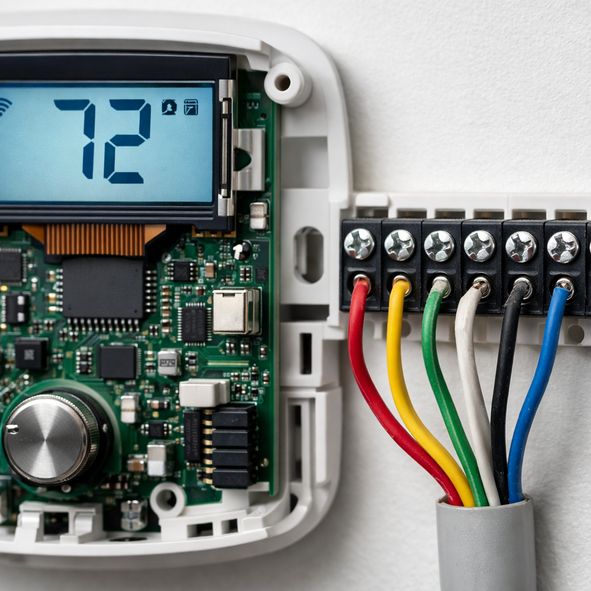
On the technical side, smart thermostats communicate across standard low-voltage wiring (typically 18/5 or 18/8 thermostat cable). Systems with a C-wire (common wire) provide continuous 24V power, which most smart thermostats require. Homes without a C-wire may need an adapter kit or minor wiring modification — something a licensed HVAC technician should assess before installation to avoid nuisance tripping or communication faults.
Are Smart Thermostats Compatible With All HVAC Systems?
Direct Answer: No. Compatibility depends on your system type — single-stage, two-stage, or variable-speed modulating — and your wiring configuration. High-voltage systems (electric baseboard heaters at 120V/240V) require specialized smart thermostats with line-voltage ratings, not standard low-voltage models.
This is where compatibility due diligence becomes critical:
- Single-Stage Systems: The most common setup across older Lower Mainland homes. The furnace or air handler operates at 100% capacity or not at all. Any smart thermostat handles this configuration, but you won’t unlock the full efficiency benefits of advanced load modulation.
- Two-Stage Systems: These units operate at a reduced capacity (typically 65–70%) during mild conditions and ramp to full capacity during peak demand. Smart thermostats must support dual-stage signaling (Y1/Y2 or W1/W2 terminals) to coordinate properly. Mismatched control can cause short-cycling, reducing equipment lifespan.
- Variable-Speed Modulating Systems: Found in premium gas furnaces (AFUE 96%+) and high-efficiency heat pumps (HSPF2 8.5+), these systems modulate output in fine increments — sometimes 40% to 100% capacity in tiny steps. Only communicating thermostats (using proprietary protocols like Honeywell’s TrueZONE, Carrier’s Infinity, or Lennox’s iComfort) can fully harness this capability. A generic smart thermostat connected to a modulating system will revert it to single-stage behavior, wasting the system’s primary engineering advantage.
- Heat Pumps with Auxiliary Heat: Extremely common in BC’s mild but occasionally cold climate. The thermostat must intelligently manage the switchover between heat pump operation and auxiliary/backup heat based on outdoor temperature lockout settings — a nuanced function that not all smart thermostats handle correctly.
What Technical Features Should You Prioritize?
Direct Answer: Prioritize occupancy sensing, humidity monitoring, multi-stage system compatibility, remote diagnostics, and filter-change alerts. For Lower Mainland homes with variable coastal weather, outdoor temperature integration and humidity-based fan control add significant real-world comfort value.
Here’s what separates a competent smart thermostat from a premium one in a field context:
- Occupancy Detection: Passive infrared (PIR) sensors or remote room sensors prevent heating empty spaces — critical in multi-zone homes across larger Coquitlam and Surrey properties.
- Humidity Sensing and Control: The Lower Mainland’s coastal humidity makes this non-negotiable. A thermostat that can trigger dehumidification cycles or adjust fan speed to manage relative humidity prevents mould growth, protects hardwood flooring, and improves indoor air quality (IAQ).
- HVAC System Health Alerts: Premium models send alerts for unusually long run times, short-cycling patterns, or repeated calls for heat that go unanswered — early diagnostic signals that something is wrong with your equipment.
- Geo-Fencing: Uses your smartphone’s GPS to trigger pre-conditioning before you arrive home, eliminating comfort lag without running the system unnecessarily while you’re away.
- Ventilation Integration: Homes with HRV (Heat Recovery Ventilator) systems — highly recommended in BC’s tightly built modern homes — benefit from thermostats that can coordinate with ventilation schedules to maintain fresh air standards without over-conditioning.
Smart Thermostat Comparison: Top Picks for BC Homes
| Model | System Compatibility | Key Technical Features | Best For | C-Wire Required? |
|---|---|---|---|---|
| Ecobee SmartThermostat Premium | Single, two-stage, heat pumps, HRV | Remote room sensors, built-in air quality monitor, Alexa integration, humidity control | Multi-room homes, heat pump systems | Yes (adapter included) |
| Google Nest Learning Thermostat (4th Gen) | Single, two-stage, heat pumps | Machine learning schedules, Farsight display, energy history, remote diagnostics | Tech-forward homeowners wanting auto-scheduling | Yes (Power Connector included) |
| Honeywell Home T10 Pro | Single, two-stage, multi-zone | RedLINK room sensors, professional-grade zoning, humidity control, contractor-configurable | Zoned systems, contractor-installed setups | Yes |
| Carrier Infinity Touch Control | Carrier variable-speed modulating systems only | Full communicating protocol, precise modulation control, IAQ integration, system diagnostics | Carrier Infinity system owners | Communicating system wiring |
| Lennox S40 Smart Thermostat | Lennox iComfort systems, multi-stage | 4K touchscreen, full system diagnostics, humidity zoning, IAQ monitoring | Lennox high-efficiency system owners | Communicating system wiring |
Does Professional Installation Actually Matter?
Direct Answer: Yes, significantly. Incorrect wiring, improper system configuration, or incompatible pairing can void manufacturer warranties, cause short-cycling, and trigger Technical Safety BC compliance issues — especially on gas appliances where thermostat settings interact with burner sequencing and safety lockouts.
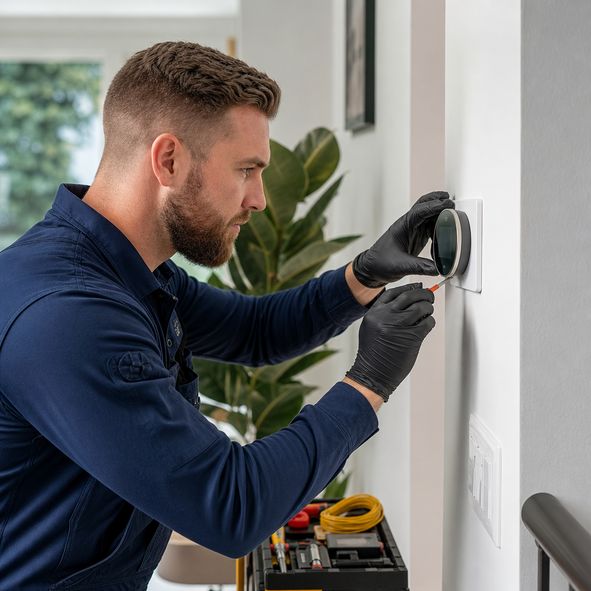
In BC, gas appliance installations and modifications fall under Technical Safety BC jurisdiction. While a smart thermostat itself is a low-voltage device, its interaction with gas furnace controls, ignition sequencers, and safety circuits means incorrect installation can create real operational hazards. A licensed gas fitter or HVAC technician will verify that thermostat configuration settings — heat anticipator values, stage differentials, minimum run times, and auxiliary heat lockout temperatures — are correctly programmed for your specific equipment model and your home’s Manual J thermal load profile.
Manual J load calculation matters here: if your furnace is correctly sized for your home’s square footage, insulation values, window orientation, and BC’s coastal heating degree days, your smart thermostat’s scheduling algorithms will deliver far superior comfort than in an oversized or undersized system where the equipment short-cycles regardless of thermostat intelligence.
Frequently Asked Questions
Will a smart thermostat work with my older oil or gas furnace?
Most smart thermostats are compatible with conventional gas furnaces using standard low-voltage wiring, including older single-stage units common in Richmond and Burnaby homes. However, oil furnaces and older systems may require a C-wire installation or compatibility verification. A technician will check your furnace control board terminals, verify transformer output, and confirm the thermostat won’t overload the control circuit before installation.
Can a smart thermostat help with the humidity problems common in Vancouver homes?
Absolutely. Smart thermostats with built-in or sensor-based humidity monitoring can trigger your air handler’s fan to run in circulation mode, coordinate with a whole-home humidifier or dehumidifier, and alert you when indoor humidity exceeds healthy thresholds (ideally 30–50% RH). In Vancouver’s wet winters, this function actively prevents condensation on windows, mould formation in wall cavities, and deterioration of wood framing — all real concerns in coastal BC construction.
Do smart thermostats affect my HVAC system warranty?
They can. Many manufacturers — including Carrier, Lennox, Trane, and Goodman — specify in their warranty terms that the system must be installed and commissioned by a licensed contractor using compatible controls. Using a non-communicating thermostat with a communicating variable-speed system, or improperly configuring staging parameters, may constitute a warranty violation. Always have a Red Seal HVAC technician perform the installation and retain documentation of the commissioning report.
How do I know if my home needs a communicating thermostat versus a standard smart model?
If your HVAC system is a variable-speed or modulating unit — identifiable by an ECM blower motor, a two-stage or modulating gas valve, and a proprietary control board (Carrier Infinity, Lennox iComfort, Daikin ONE) — you need a communicating thermostat matched to that brand’s protocol. Standard smart thermostats will work but will downgrade the system to single-stage behavior, eliminating the quiet, precise comfort modulation those systems are engineered to deliver. A field inspection of your equipment labels and control board terminals will confirm which category your system falls into.
The Verdict: Smart Thermostat Installation in the Lower Mainland
For homeowners across Vancouver, Burnaby, Richmond, Coquitlam, Surrey, and the broader Lower Mainland, upgrading to a properly matched and professionally installed smart thermostat is one of the highest-return improvements you can make to your home’s comfort infrastructure. The combination of adaptive scheduling, humidity intelligence, multi-stage system coordination, and real-time diagnostics addresses nearly every comfort challenge unique to BC’s coastal climate — from damp winter cold snaps to humid summer shoulder seasons.
The key word is properly matched. The wrong thermostat paired with the wrong system delivers none of these benefits and may actively harm your equipment’s performance and warranty standing. Get it right the first time with a professional on-site assessment.
Ready to upgrade? Call BCRC Heating and Cooling at (604) 781-7272 to schedule your on-site technical inspection and smart thermostat compatibility assessment. Our Red Seal HVAC technicians serve Vancouver, Burnaby, Richmond, Coquitlam, Surrey, and all of the Lower Mainland — ensuring your smart thermostat is paired, wired, and commissioned correctly for maximum performance, comfort, and equipment longevity. Visit us at bcrcheating.com to learn more.