



HVAC for Condos & Strata Units: What You Can Install
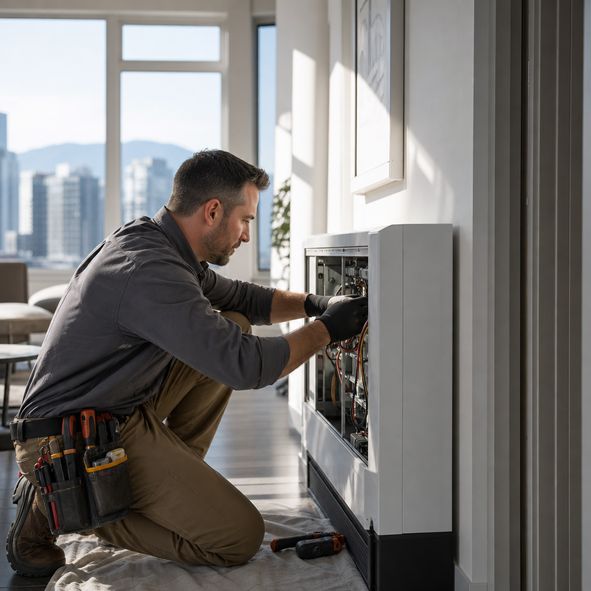
Can You Install Your Own HVAC System in a Vancouver Condo or Strata Unit?
Short answer: You can upgrade or replace certain HVAC components within your strata lot, but shared systems, structural penetrations, and any work affecting common property require strata council approval, licensed contractors, and Technical Safety BC compliance. Understanding the boundaries protects your warranty and your neighbours.
Living in a condo or strata unit in Vancouver, Burnaby, Richmond, or Coquitlam means navigating a unique intersection of building bylaws, strata regulations, and BC mechanical codes. The Lower Mainland’s coastal humidity, damp cold snaps, and air quality concerns make reliable climate control essential — yet many strata owners don’t realize how tightly regulated HVAC modifications actually are. This guide breaks down exactly what you can install, what requires approval, and what is off-limits entirely.
What HVAC Equipment Is Entirely Within Your Strata Lot?
Direct answer: Equipment fully within your unit’s boundaries — including fan coil units, ductless mini-splits on interior walls, in-suite heat recovery ventilators, and thermostats — typically falls under owner responsibility, though any penetrations or electrical upgrades still require permits and strata notification.
Ductless Mini-Split Heat Pumps (Most Popular Strata Upgrade)
Variable-speed, inverter-driven mini-split heat pumps are the dominant choice for strata retrofits across the Lower Mainland. Modern units achieve HSPF2 ratings of 9.0 to 12.5 and SEER2 ratings above 18, delivering efficient heating even during Vancouver’s damp 2–7°C cold snaps without fossil fuel combustion. Key installation considerations include:
- Refrigerant line penetrations: Any wall or floor penetration through a party wall or exterior structural surface requires strata approval and a Technical Safety BC permit. Never assume this is cosmetic work.
- Outdoor condenser placement: Condensers on balconies, rooftops, or exterior walls are almost universally classified as common property or limited common property. Strata approval — often a 3/4 vote at an SGM — is mandatory.
- Electrical capacity: Single-zone mini-splits (9,000–24,000 BTU) typically require a dedicated 15–20A, 240V circuit. Multi-zone systems may require panel upgrades coordinated with BC Hydro-certified electricians.
- Sizing via Manual J: Never size by square footage alone. A proper Manual J load calculation accounts for Vancouver’s heating design temperature (around -7°C), window-to-wall ratio, insulation values, and floor level exposure. Oversized units short-cycle, increasing humidity and reducing equipment lifespan.
Fan Coil Unit Replacements
Many high-rise condos in Burnaby and Richmond use a central hydronic system with in-suite fan coil units (FCUs). Replacing an FCU requires matching the coil capacity (measured in MBH), fan speed, and connections to the building’s chilled/hot water loop. Unauthorized modifications to hydronic connections affect building system pressure and are a strata bylaw violation in virtually every complex.
In-Suite Heat Recovery Ventilators (HRVs)
Coastal humidity makes ventilation critical. A properly sized HRV — matched to your suite’s volume using ASHRAE 62.2 calculations — recovers 70–80% of exhaust heat while delivering fresh filtered air. Critically, HRV exhaust and intake must terminate to the exterior, which again triggers the penetration and strata approval process.
What Requires Strata Approval Before Any Work Begins?
Direct answer: Any HVAC modification that penetrates common property, affects shared systems, requires exterior mounting, or alters the building envelope requires written strata council approval — and in many cases a special general meeting resolution — before a contractor can legally begin work.
- Exterior wall penetrations for refrigerant lines, HRV ducts, or exhaust vents
- Balcony or rooftop condenser installation
- Connections to common hydronic, chilled water, or ventilation systems
- Electrical panel upgrades that affect common area wiring or metering
- Any structural modifications (concrete cutting, beam penetrations)
Always obtain strata approval in writing before scheduling contractor work. BCRC Heating and Cooling routinely assists strata owners in preparing technical specification packages for council submission, including load calculations, equipment datasheets, and Technical Safety BC permit documentation.
What Is Completely Off-Limits in Most Strata Buildings?
Direct answer: Combustion appliances (gas furnaces, boilers) requiring new gas lines or flues, central ducted forced-air systems requiring ceiling or floor plenum space, and any modification to shared mechanical rooms or rooftop equipment are almost universally prohibited for individual strata owners.
- New gas furnaces or boilers: Installing combustion equipment in a condo requires dedicated flue venting, gas line extensions, and combustion air supply — all of which inevitably affect common property or other units. Most strata bylaws explicitly prohibit this.
- Centralized ducted systems: High-rise condos are not built with duct chases. Attempting to retrofit forced-air ductwork means cutting through concrete slabs or fire-rated assemblies — a Technical Safety BC and Fire Code violation.
- Shared mechanical room equipment: Boilers, cooling towers, and central air handlers serving multiple units are common property. Individual owners have zero authority to modify, replace, or adjust this equipment.
Technical Comparison: HVAC Options for Lower Mainland Strata Units
| System Type | Strata Approval Needed | Efficiency Metric | Best For | Key Limitation |
|---|---|---|---|---|
| Ductless Mini-Split Heat Pump | Yes (penetrations/condenser) | HSPF2 up to 12.5 / SEER2 up to 22 | Heating & cooling, single or multi-zone | Condenser placement on common property |
| Fan Coil Unit Replacement | Yes (hydronic connections) | Matched to building loop specs | High-rise hydronic buildings | Must match building system parameters |
| In-Suite HRV | Yes (exterior penetrations) | 70–80% heat recovery efficiency | Ventilation & humidity control | Exterior termination requires approval |
| Electric Baseboard Upgrade | Typically No (in-suite only) | 100% conversion efficiency | Supplemental heat, low disruption | Resistance heating, highest energy use |
| Gas Furnace / Boiler | Prohibited in most stratas | AFUE up to 98% | Not applicable — strata restricted | Flue, gas line through common property |
Frequently Asked Questions: HVAC in Vancouver Strata Units
Q1: Can I install a mini-split myself to avoid contractor fees?
A: No. In British Columbia, refrigerant handling requires a valid Refrigeration Mechanic (Refrigeration & Air Conditioning) Red Seal trade certificate. All refrigerant work must be performed by a licensed tradesperson. DIY installation also voids manufacturer warranties — which on quality inverter units extend to 10–12 years on compressors — and creates liability exposure if equipment causes property damage to neighbouring units. Technical Safety BC requires permits for all HVAC mechanical work beyond simple thermostat swaps.
Q2: My strata building has a central HVAC system that never heats my corner unit properly. What can I do?
A: Corner units in Lower Mainland high-rises frequently suffer from thermal bridging through concrete columns and elevated heat loss through two exposed facades. A licensed HVAC technician can conduct an in-suite Manual J calculation to quantify the actual heat load deficit, then specify a supplemental mini-split or electric heating solution within strata rules. Document everything in writing before approaching your strata council with a technical proposal.
Q3: Does a new mini-split heat pump require a Technical Safety BC permit in a condo?
A: Yes, in virtually all cases. Any HVAC installation involving refrigerant piping, new electrical circuits, or structural penetrations requires a mechanical permit from Technical Safety BC and must be performed by licensed contractors. Unpermitted work can result in fines, mandatory removal orders, and — critically — voided homeowner’s insurance and strata loss assessment coverage. Always insist your contractor pulls permits before work begins.
Q4: How do I know what size mini-split is right for my condo suite?
A: Proper sizing requires a Manual J heat load calculation — not a square footage estimate. A correctly sized system for a typical 650–900 sq ft Lower Mainland condo suite often falls in the 9,000–15,000 BTU range, but variables like ceiling height, window exposure, suite orientation, and building insulation standards can shift this significantly. An undersized unit struggles during cold snaps; an oversized unit short-cycles and fails to dehumidify effectively in Vancouver’s humid coastal climate. Both scenarios reduce equipment life and comfort.
Work With HVAC Specialists Who Understand Strata Rules
Navigating strata bylaws, Technical Safety BC permits, and the technical demands of Lower Mainland condo buildings requires a contractor with direct field experience in multi-family residential HVAC — not a generalist running residential furnace calls. At BCRC Heating and Cooling, our Red Seal certified technicians have completed HVAC installations and upgrades across Vancouver, Burnaby, Richmond, Coquitlam, Surrey, and the broader Lower Mainland. We handle the full scope: load calculations, strata submission packages, permit applications, and clean, code-compliant installation backed by manufacturer warranty requirements.
If you’re unsure what your strata bylaws allow, what system will actually perform in your suite, or how to get council approval, the first step is an on-site technical assessment. Don’t risk an unpermitted install that could cost you far more in strata fines and remediation than the original project.
Call BCRC Heating and Cooling at (604) 781-7272 today for Expert HVAC Service in Vancouver or to schedule your on-site technical inspection and get a precise, strata-compliant HVAC recommendation for your Lower Mainland condo or strata unit.