



HVAC Allergy Relief: Filters & Purifiers That Help Most
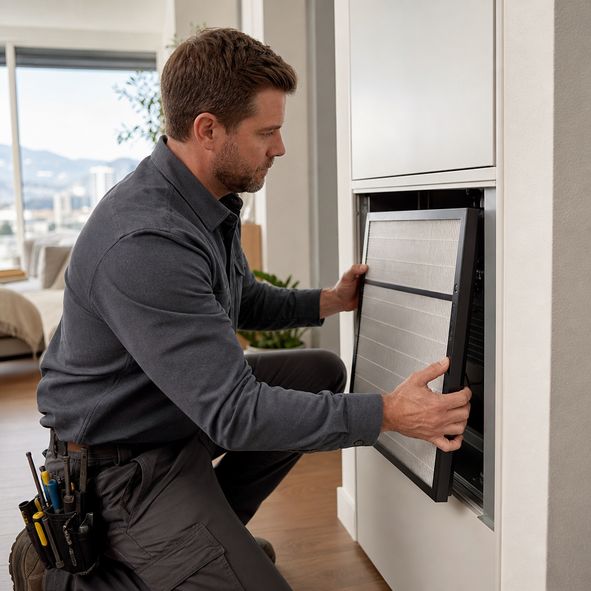
Why Does Indoor Air Quality Matter So Much for Allergy Sufferers in the Lower Mainland?
Short Answer: Vancouver’s coastal humidity creates ideal breeding conditions for mold spores, dust mites, and airborne allergens year-round. The right HVAC allergy relief strategy — combining high-efficiency filters and purifiers — can reduce indoor allergen concentrations by up to 99%, delivering measurable respiratory relief for sensitive households.
If you’ve been struggling with persistent sneezing, congestion, or worsening asthma inside your own home, your HVAC system may be the problem — or the solution. The Lower Mainland’s damp climate, with relative humidity regularly exceeding 70% during fall and winter, creates a perfect environment for microscopic allergens to thrive inside ductwork, air handlers, and living spaces. For allergy sufferers in Vancouver, Burnaby, Richmond, Coquitlam, and Surrey, understanding how your heating and cooling system interacts with indoor air quality is not optional — it’s essential. This guide breaks down the most effective HVAC allergy relief tools available today, from MERV-rated filters to UV-C germicidal systems, with the technical depth you need to make a genuinely informed decision.
What MERV Rating Do You Actually Need for Allergy Relief?
Short Answer: For allergy relief, a MERV 11–13 filter captures particles between 0.3–1.0 microns, including pollen, pet dander, mold spores, and fine dust. MERV 8 is insufficient for sensitive individuals; MERV 14–16 is typically reserved for medical-grade environments and can restrict airflow in residential systems.
The Minimum Efficiency Reporting Value (MERV) scale runs from 1 to 20. Most builder-grade fiberglass filters sit at MERV 1–4 — adequate for protecting equipment, completely inadequate for allergy protection. Here’s what matters in a residential Lower Mainland context:
- MERV 8: Captures larger particles like lint and dust. Insufficient for pollen or pet dander.
- MERV 11: The practical entry point for allergy relief — captures mold spores, pet dander, and most pollen.
- MERV 13: Captures fine particles including tobacco smoke, bacteria carriers, and virus-sized particles. Recommended for households with moderate-to-severe allergies or asthma.
- MERV 16+: HEPA-equivalent performance, but significantly restricts static pressure in standard residential ductwork — requires a system designed or retrofitted to handle the increased resistance.
Critical technical note: upgrading to MERV 13 without verifying your air handler’s static pressure tolerance can reduce airflow across your heat exchanger or evaporator coil, reducing efficiency and potentially causing premature equipment failure. A qualified Red Seal HVAC technician should perform a static pressure test before any filter upgrade above MERV 11.
How Do Whole-Home Air Purifiers Compare to Portable Units?
Short Answer: Whole-home purifiers integrated into your HVAC system treat 100% of circulated air across all rooms simultaneously. Portable units treat only one room at a time and cannot address allergens in ductwork. For whole-home allergy relief in Vancouver’s multi-room layouts, ducted systems are substantially more effective.
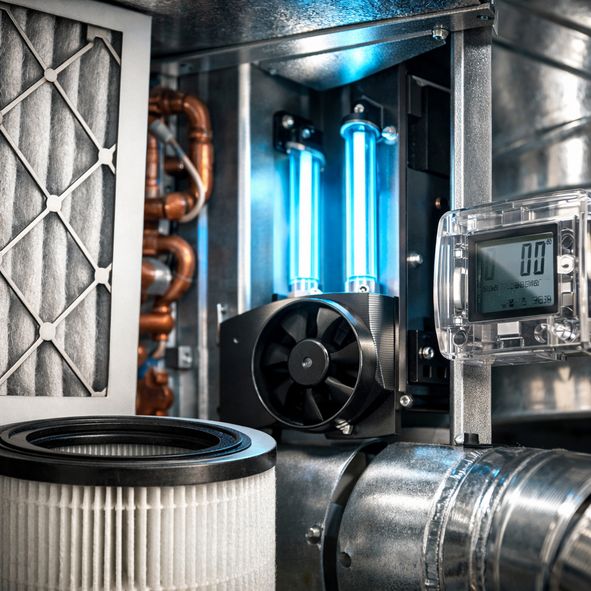
There are four primary whole-home purification technologies worth evaluating for Lower Mainland homes:
- Electronic Air Cleaners (EAC): Use electrostatic precipitation to charge and capture particles as small as 0.01 microns. Models like the Honeywell F300 or Carrier Infinity Air Purifier achieve MERV 15+ performance with significantly lower airflow restriction than passive high-MERV filters. Washable collection cells reduce ongoing maintenance. Ideal for two-stage or variable-speed systems where consistent airflow is maintained.
- Media Air Cleaners (5-inch Filter Systems): Use deep-pleated MERV 11–13 media with dramatically larger surface area than standard 1-inch filters, reducing static pressure impact. Brands like Lennox Healthy Climate or AprilAire 2210 offer proven reliability with annual or bi-annual media replacement.
- UV-C Germicidal Irradiation Systems: Installed at the coil or in the return air plenum, UV-C systems neutralize mold, bacteria, and viruses at the DNA level. They do not remove particles — they deactivate biological contaminants. Best deployed as a complement to high-MERV filtration, not a standalone solution. Particularly valuable in coastal BC where mold colonization on evaporator coils is a documented concern.
- Bipolar Ionization / NPBI Systems: Emit positive and negative ions that cluster around fine particles, increasing their size for easier capture. iWave-R and similar units install directly in the air stream. Emerging technology with strong performance data, though long-term independent peer-reviewed studies are still accumulating.
Does Your HVAC System’s Fan Speed Affect Allergen Removal?
Short Answer: Yes — significantly. Variable-speed ECM blower motors run continuously at low speed, providing constant air filtration even when no heating or cooling is needed. Single-stage systems cycle on and off, leaving air stagnant between cycles. For allergy sufferers, variable-speed systems deliver measurably better air quality outcomes.
This is where system selection directly intersects with allergy management. Single-stage furnaces and air conditioners run at 100% capacity or off — no middle ground. Two-stage systems offer a low-fire/low-speed setting that runs approximately 65–70% of operating time at reduced capacity, improving comfort and filtration frequency. Variable-speed modulating systems — such as those using communicating ECM technology found in Lennox XC21, Carrier Infinity 24, or Daikin DX16TC platforms — maintain nearly continuous airflow at minimal energy draw. This continuous circulation means your filter and purifier are actively cleaning air around the clock, not just when the thermostat demands a temperature change. For families in Burnaby or Richmond where coastal humidity keeps allergen loads elevated all year, this distinction is clinically meaningful.
HVAC Air Filtration & Purification: Technical Comparison
| Technology | Particle Size Targeted | Biological Contaminants | Airflow Impact | Maintenance Interval | Best System Pairing |
|---|---|---|---|---|---|
| Standard MERV 8 Filter | >3 microns | Minimal | Low | Monthly | Any system |
| MERV 11–13 Media Filter | 0.3–3 microns | Moderate | Moderate | Every 3 months | Two-stage or variable-speed |
| 5-Inch Deep-Media Cleaner | 0.3–1 micron | Moderate-High | Low | Annually | All system types |
| Electronic Air Cleaner (EAC) | 0.01 microns | High | Very Low | Every 3–6 months (wash) | Variable-speed preferred |
| UV-C Germicidal System | N/A (biological only) | Very High | None | Annual bulb replacement | All system types |
| Bipolar Ionization (NPBI) | 0.1–1 micron | High | None | Low (self-cleaning models) | Variable-speed preferred |
Frequently Asked Questions: HVAC Allergy Relief in Vancouver
Q1: Can I just install a HEPA filter in my existing furnace to get the best air quality?
Standard residential HVAC systems are not designed to handle true HEPA (MERV 17–20) passive filters. The airflow restriction is severe enough to damage heat exchangers and evaporator coils in most equipment. The correct approach is an electronic air cleaner or a properly sized deep-media system that achieves near-HEPA performance without the static pressure penalty. Always verify compatibility with a Red Seal technician before retrofitting any high-efficiency filtration.
Q2: How often should I change my filter if I have cats and live in a damp area like Richmond?
In Richmond’s high-humidity environment with one or more cats, a MERV 11 filter typically reaches saturation within 4–6 weeks — far faster than the 90-day label suggests. We recommend monthly visual inspections and replacement at first signs of grey discolouration. Electronic air cleaners with washable cells may be more economical in this scenario, as collection plates can be rinsed clean rather than replaced.
Q3: Does a heat pump filter air differently than a gas furnace?
Both systems move air through the same filtration infrastructure — the air handler and ductwork. The filtration performance is determined by the filter or purifier installed, not the heat source. However, heat pumps run their blower fans more frequently and at lower speeds year-round (especially variable-speed cold-climate models), which means air passes through filtration more often per day, providing an inherent air quality advantage over seasonal gas furnace operation.
Q4: Is UV-C light safe for my family and pets if installed inside the HVAC system?
Yes — when installed correctly inside the air handler or plenum by a certified technician, UV-C light is completely contained within the system and poses no exposure risk to occupants or pets. UV-C is only dangerous with direct eye or skin exposure. Technical Safety BC installation standards require proper containment and labelling. Never attempt a DIY UV-C installation — improper placement can result in ozone generation or inadequate germicidal effect.
The BCRC Recommendation: Building a Layered Allergy Defence Strategy
The most effective HVAC allergy relief systems don’t rely on a single technology — they use a layered approach. For a typical Lower Mainland home, our recommended configuration combines a 5-inch deep-media cleaner at MERV 13 as the primary particle barrier, a UV-C coil purifier for biological contaminant control, and a variable-speed ECM blower motor to ensure continuous air cycling. This combination addresses the full spectrum of allergens — particulate, biological, and chemical — without compromising equipment integrity or system airflow. All installations must comply with Technical Safety BC requirements and manufacturer warranty specifications, which mandate professional installation and commissioning for warranty validity on most major brands including Lennox, Carrier, Trane, and Daikin.
If your household is dealing with persistent allergy symptoms, don’t settle for a 1-inch filter and hope for the best. The indoor air quality solutions available today — when properly matched to your home’s square footage, duct configuration, and existing equipment — can transform your living environment. BCRC Heating and Cooling’s Red Seal certified technicians serve Vancouver, Burnaby, Richmond, Coquitlam, Surrey, and the entire Lower Mainland with professional HVAC air quality assessments, system retrofits, and full installations. For expert advice and professional AC installation in Vancouver or any indoor air quality upgrade across the Lower Mainland, call BCRC Heating and Cooling directly at (604) 781-7272 for expert HVAC service in Vancouver — because cleaner air inside your home starts with the right team outside your door.