

Indoor Air Quality Guide: Wildfire Smoke Protection
Why Wildfire Smoke Is a Serious Indoor Air Quality Threat in the Lower Mainland
Every summer and fall, wildfire smoke blankets Metro Vancouver, Burnaby, Richmond, Coquitlam, Surrey, and the wider Lower Mainland with fine particulate matter — PM2.5 particles so small they penetrate deep into lung tissue. If you want to know how to improve indoor air quality at home during wildfire smoke events, you need a systematic, technically sound approach that goes far beyond cracking a window. This guide delivers exactly that — straight from the field.
BC’s coastal climate adds a compounding challenge: high ambient humidity accelerates mould growth on filter media and HVAC components when systems aren’t properly sized or maintained, turning your air handler into a contamination source rather than a solution. Understanding the interplay between smoke infiltration, humidity control, and mechanical ventilation is the foundation of real indoor air quality management.
What Are PM2.5 Particles and Why Do They Overwhelm Standard Filters?
PM2.5 particles measure 2.5 microns or smaller — roughly 30 times finer than a human hair. Standard fibreglass filters (MERV 1–4) capture less than 20% of these particles. Wildfire smoke is almost entirely composed of PM2.5, making upgraded filtration and source-control ventilation non-negotiable during smoke events.
Most Lower Mainland homes built before 2010 ship with MERV 4–6 filters — adequate for large dust but essentially invisible to smoke particles. The American Society of Heating, Refrigerating and Air-Conditioning Engineers (ASHRAE) recommends a minimum MERV 13 rating for residential smoke protection, which captures approximately 85–90% of particles in the 0.3–1.0 micron range. HEPA-grade filtration (MERV 17+) reaches 99.97% efficiency at 0.3 microns.
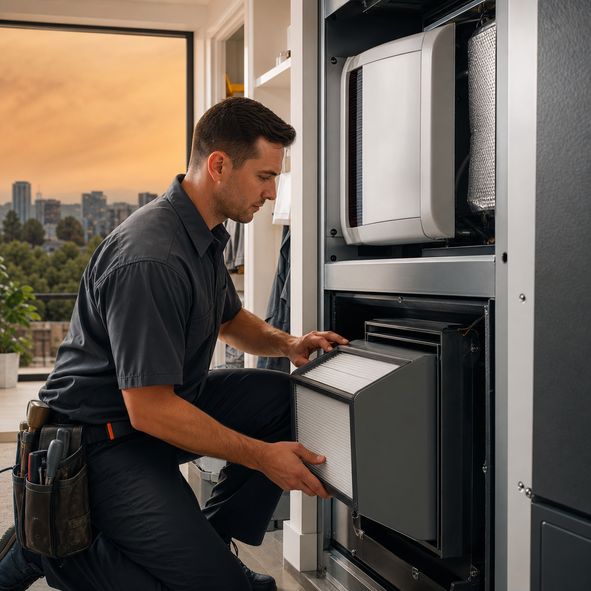
Critical field note: jumping from MERV 6 to MERV 13 without verifying your air handler’s static pressure tolerance is a common mistake. A high-MERV filter creates greater airflow resistance (measured in inches of water column, in. w.c.). If your blower motor cannot compensate — particularly on older single-stage PSC motors — you risk coil freeze-up, reduced airflow, and accelerated heat exchanger fatigue. Always have a technician perform a static pressure test before upgrading filter ratings.
How Do You Choose the Right Air Filtration System for Wildfire Smoke?
Choose filtration based on your existing HVAC system’s static pressure capacity, your home’s square footage, and air change rate requirements. For wildfire smoke, a media air cleaner rated MERV 13–16 paired with a whole-home UV-C purifier delivers the most consistent, maintenance-friendly protection without straining your blower.
Media Air Cleaners vs. Electronic Air Cleaners vs. Portable HEPA Units
| Technology | Filtration Efficiency | Best Application | Maintenance Interval | Smoke Performance |
|---|---|---|---|---|
| Standard 1-inch Filter (MERV 6) | ~20% PM2.5 capture | Basic dust control | Monthly | Poor |
| Media Air Cleaner (MERV 13–16) | 85–95% PM2.5 capture | Whole-home integration | Every 6–12 months | Excellent |
| Electronic/Electrostatic Cleaner | Up to 95% (when clean) | Whole-home, low restriction | Monthly wash required | Good (degrades if neglected) |
| Portable HEPA Unit | 99.97% at 0.3 microns | Single-room spot treatment | Filter per manufacturer | Excellent (limited coverage) |
| Whole-Home HEPA Bypass | 99.97% at 0.3 microns | Full ducted systems | Annual filter change | Outstanding |
Should You Run Your HRV or ERV During a Wildfire Smoke Event?
No — during active wildfire smoke events, set your Heat Recovery Ventilator (HRV) or Energy Recovery Ventilator (ERV) to recirculation mode only. Bringing in unfiltered outdoor air during smoke events defeats the purpose of your filtration system and rapidly degrades indoor air quality.
This is one of the most misunderstood points among Lower Mainland homeowners. HRVs and ERVs are engineered to provide fresh air ventilation per ASHRAE 62.2 standards — approximately 0.35 air changes per hour or 7.5 CFM per occupant. During normal coastal BC conditions, this is essential for controlling the region’s characteristically high indoor humidity. However, when the Air Quality Health Index (AQHI) exceeds 7 (a High Risk rating), the outdoor air you’re recovering is laden with PM2.5, VOCs, and combustion byproducts.
Modern HRV controllers from manufacturers like Venmar, Lifebreath, and Fantech include a recirculation or bypass mode — engage it immediately when wildfire smoke is present. Once outdoor air quality normalizes, return to scheduled ventilation to prevent moisture accumulation and maintain CO2 dilution. If your HRV lacks smart controls or occupancy-based ventilation logic, a Technical Safety BC-certified technician can retrofit a more capable control module.
How Does a Variable-Speed Air Handler Improve Smoke Filtration Performance?
Variable-speed ECM blower motors maintain consistent airflow across high-MERV filters by automatically compensating for increased static pressure. This ensures your filtration system operates at rated efficiency even as filters load with particulate, unlike single-stage PSC motors that lose airflow as filter resistance rises.
Single-stage PSC (Permanent Split Capacitor) motors operate at fixed speeds — when filter resistance climbs, airflow simply drops. This creates a false sense of security: your MERV 16 filter looks clean but is delivering 40% less conditioned, filtered air than designed. Two-stage and variable-speed (modulating) ECM motors — common in premium systems from Lennox, Carrier, and Trane — adjust RPM to maintain target CFM. In the Lower Mainland’s mixed climate, variable-speed systems also deliver superior dehumidification on low-speed cooling cycles, addressing the humidity component of indoor air quality simultaneously.
From a sizing standpoint, your air handler must be matched to your home using Manual J load calculations — a room-by-room analysis of thermal envelope, window area, insulation R-values, and occupancy. Oversized equipment short-cycles, failing to run long enough to filter and dehumidify effectively. Undersized equipment runs continuously without meeting design conditions. Proper sizing is not optional — it is the technical prerequisite for any filtration upgrade to perform as specified.
What Additional Steps Reduce Wildfire Smoke Infiltration in Lower Mainland Homes?
Beyond filtration, reduce smoke infiltration by sealing duct leakage (target less than 6% total leakage per ASHRAE 152), weatherstripping doors and windows, and ensuring combustion appliances are properly sealed-combustion or power-vented to prevent back-drafting smoke into living spaces.
- Duct Sealing: Leaky ductwork in attics or crawlspaces draws smoke-laden unconditioned air directly into your supply stream. Duct blaster testing quantifies leakage; mastic sealant or UL-181-rated tape corrects it.
- Building Envelope Tightening: Weatherstripping, door sweeps, and caulking around penetrations reduce the natural infiltration rate (measured in Air Changes per Hour at 50 Pascals — ACH50). Lower Mainland homes tested above 5 ACH50 benefit significantly from envelope improvements during smoke events.
- UV-C Germicidal Irradiation: Installed in the supply plenum downstream of the filter, UV-C systems neutralize biological contaminants that may accompany smoke particles — mould spores, bacteria, and viruses — adding a secondary layer of protection relevant to BC’s humid coastal conditions.
- Carbon Filtration: Activated carbon modules adsorb VOCs and odour compounds from wildfire smoke that HEPA-grade particle filters cannot capture. Pair a carbon stage with your MERV 13+ media filter for comprehensive protection.
Frequently Asked Questions: Wildfire Smoke and Home HVAC Systems
Can I just seal my home completely and use a portable air purifier during smoke events?
Portable HEPA units are a valid spot-treatment tool, but complete home sealing creates a CO2 buildup problem within hours in occupied homes. The correct approach is controlled recirculation through your HVAC system’s MERV 13+ filter, with your HRV in recirculation mode — maintaining air movement and filtration without introducing contaminated outdoor air. Portable units should supplement, not replace, your central system.
How often should I change my filter during an extended wildfire smoke event?
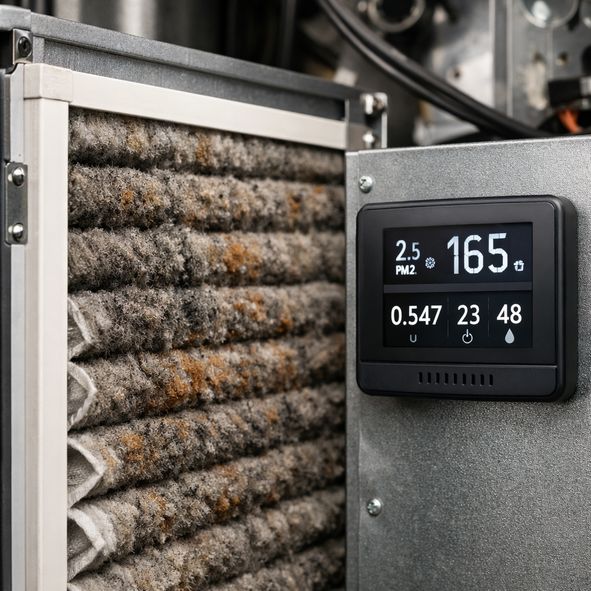
Check your filter visually every 2–3 weeks during smoke season. A MERV 13 filter in a standard 4-inch media cabinet will typically load significantly faster during heavy smoke events — potentially requiring replacement every 4–6 weeks versus the normal 6–12 month cycle. Monitor your system’s static pressure differential if you have a smart thermostat with airflow diagnostics, or ask your technician to install a magnehelic gauge on your air handler.
Is my gas furnace safe to run when wildfire smoke is present outside?
Yes, provided your furnace uses a sealed combustion (two-pipe) or induced-draft power-vent configuration — which accounts for most Lower Mainland furnaces installed after 2000. These designs draw combustion air from outside via a dedicated PVC pipe and exhaust separately, completely isolating the combustion process from indoor air. Older natural-draft furnaces that draw combustion air from the mechanical room require inspection to ensure no smoke backdrafting occurs. Technical Safety BC requires all gas appliances to meet current venting standards — if you’re unsure of your furnace’s combustion air configuration, a licensed gas technician should verify it.
Will adding a whole-home air purifier void my HVAC manufacturer’s warranty?
Not if the accessory is properly installed by a licensed HVAC technician and is compatible with your system’s airflow specifications. Most major manufacturers — including Lennox, Carrier, Bryant, and Trane — offer approved indoor air quality accessories designed for their platforms. Third-party accessories installed without verifying static pressure compatibility can cause coil freeze-up or heat exchanger stress, which may create warranty disputes. Always have accessories installed by a certified technician who documents the installation against your system’s design specifications.
Protect Your Family’s Health — Get a Professional IAQ Assessment Today
Wildfire smoke season in Metro Vancouver and the Lower Mainland is not a temporary inconvenience — it is a recurring, intensifying annual reality that demands a permanent, engineered response built into your home’s HVAC infrastructure. From properly sized media filtration and UV-C purification to HRV control strategies and duct sealing, every element of your indoor air quality system must work together as a cohesive, tested assembly.
The team at BCRC Heating and Cooling brings certified field expertise across Vancouver, Burnaby, Richmond, Coquitlam, Surrey, and the entire Lower Mainland. We perform comprehensive on-site IAQ assessments — including static pressure testing, filter compatibility analysis, HRV control calibration, and duct leakage evaluation — to engineer a solution matched precisely to your home, your family’s health needs, and BC’s coastal climate demands.
Call BCRC Heating and Cooling today at (604) 781-7272 to schedule your on-site technical inspection. Breathe cleaner, safer air — starting now.