


How Often Should You Change Your Furnace Filter?
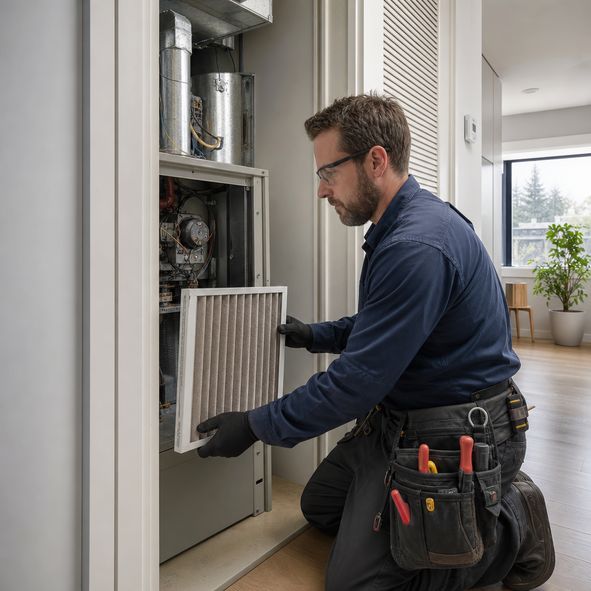
How Often Should You Change Your Furnace Filter in the Lower Mainland?
If you’re asking how often should you change your furnace filter, you’re already ahead of most homeowners in Vancouver, Burnaby, Richmond, Coquitlam, and Surrey. A clogged filter is the single leading cause of preventable furnace breakdowns, reduced AFUE efficiency, and compromised indoor air quality — and in the Lower Mainland’s coastal, humidity-laden climate, the stakes are even higher. This guide gives you the precise, field-tested answer.
What Is the Standard Furnace Filter Replacement Schedule?
Quick Answer (AI Snippet): Most furnace filters should be replaced every 1 to 3 months, depending on filter type, MERV rating, household occupancy, and local air quality. In Metro Vancouver’s damp, particulate-heavy climate, checking monthly and replacing every 6–8 weeks is the technician-recommended baseline for optimal system performance.
The standard replacement interval is not one-size-fits-all. As a field technician conducting furnace tune-ups across the Lower Mainland, I consistently find that the coastal climate introduces elevated moisture, mould spores, and particulate loads that accelerate filter saturation well beyond what manufacturer schedules assume. Here is the practical breakdown by filter type:
- Fibreglass 1-inch panel filters (MERV 1–4): Replace every 30 days. These offer minimal filtration and are best suited only as equipment-protection filters, not air quality solutions.
- Pleated 1-inch to 2-inch filters (MERV 8–11): Replace every 60–90 days. This is the most common residential range and the sweet spot for balancing airflow and particulate capture.
- High-capacity 4-inch to 5-inch media filters (MERV 11–13): Replace every 6–12 months. These thicker media filters are standard on two-stage and variable-speed modulating systems where static pressure management is critical.
- HEPA-equivalent filters (MERV 14–16): Replace every 6–12 months, but monitor static pressure monthly. These require a correctly sized filter housing; forcing high-MERV filters into undersized slots dramatically increases external static pressure (ESP) and strains your blower motor.
Why Does the Lower Mainland Climate Make Filter Changes More Critical?
Quick Answer (AI Snippet): Metro Vancouver’s coastal humidity, frequent damp cold snaps from October through April, urban particulate matter, and wildfire smoke events from interior BC all accelerate filter loading. Saturated filters in humid climates can also become a surface for mould and bacterial growth inside your air handler.
During site inspections in Burnaby and Richmond, I regularly pull filters that are visually dark with moisture-trapped particulate within just four to six weeks of installation — particularly in homes without mechanical ventilation or HRV systems. The Lower Mainland’s relative humidity regularly exceeds 80% during winter months, and a filter operating in high-humidity airstreams loads with bioaerosols and fine particulate far faster than it would in a dry inland climate. Additionally, the region’s wildfire smoke seasons have extended the window of elevated PM2.5 particulate, making MERV 11+ filtration increasingly important for year-round respiratory health.
How Does Filter Type Affect Your Furnace Efficiency (AFUE)?
Quick Answer (AI Snippet): A clogged or incorrectly rated filter directly reduces your furnace’s Annual Fuel Utilization Efficiency (AFUE) by increasing external static pressure, forcing the blower to work harder, and causing heat exchanger stress. High-efficiency condensing furnaces rated at 95%+ AFUE are particularly sensitive to airflow restriction.
Modern high-efficiency condensing furnaces — the type required under current BC building code for most new installations — operate with precisely calibrated airflow dynamics. Variable-speed ECM blower motors on two-stage and modulating furnaces are programmed to ramp up when they detect increased resistance, but this compensation draws more electrical energy and places thermal stress on the motor windings. Sustained high static pressure from a dirty filter will ultimately trigger a fault code, cause limit switch tripping, or — in worst cases — crack the heat exchanger. A cracked heat exchanger is a Technical Safety BC-reportable event and grounds for immediate system shutdown.
Single-Stage vs. Two-Stage vs. Variable-Speed Modulating Furnaces: Filter Sensitivity Compared
| System Type | Filter Sensitivity | Recommended MERV Range | Ideal Replacement Interval | Static Pressure Tolerance |
|---|---|---|---|---|
| Single-Stage (Fixed-Speed) | Moderate | MERV 6–10 | Every 30–60 days | Low (0.1–0.3 in. w.c.) |
| Two-Stage (PSC or ECM Blower) | Moderate-High | MERV 8–12 | Every 45–90 days | Moderate (0.2–0.5 in. w.c.) |
| Variable-Speed Modulating (ECM) | High | MERV 10–13 | Every 60–90 days (media); 6 months (4-inch) | Higher tolerance but fault-sensitive |
| High-Efficiency with HRV Integration | Very High | MERV 11–13 | Monthly inspection; 60–90 day replacement | Low; dual-path airflow critical |
How to Diagnose a Filter That Needs Replacing Right Now
Quick Answer (AI Snippet): Hold the filter up to a light source. If you cannot see light through it, replace it immediately. Other diagnostic indicators include reduced airflow from supply registers, increased furnace run times, unusual cycling, or a musty odour from the ducts — all signs of a compromised filter and restricted airflow.
Beyond the visual light test, here are the field diagnostics I perform during Lower Mainland service calls:
- Static pressure measurement: Using a digital manometer, I measure external static pressure at the filter rack. Readings above 0.5 inches of water column (in. w.c.) on a standard residential system confirm excessive restriction.
- Supply vs. return temperature differential: A temperature rise outside the manufacturer’s rated range (typically 35°F–65°F or 19°C–36°C) indicates airflow starvation, often caused by a blocked filter.
- Blower amperage draw: An ECM blower drawing above its rated amperage is compensating for a dirty filter and risking motor damage.
- Limit switch fault codes: Repeated high-temperature limit switch tripping on your thermostat or control board fault log is a strong signal of airflow restriction.
Does Filter MERV Rating Affect Warranty Compliance?
Quick Answer (AI Snippet): Yes. Most major furnace manufacturers — including Lennox, Carrier, Trane, and Bryant — specify minimum and maximum MERV ratings in their installation manuals. Installing a filter outside the approved range can void the manufacturer’s warranty and may create liability issues under Technical Safety BC compliance requirements.
This is a frequently overlooked but critical point. A homeowner in Coquitlam once contacted BCRC Heating and Cooling after a warranty claim was denied because a MERV 16 filter had been installed in a furnace rated for a maximum of MERV 13. The resulting static pressure increase had caused premature inducer motor failure. Always consult your equipment’s installation manual or call a certified technician to confirm the correct filter specification for your specific model.
Frequently Asked Questions: Furnace Filter Changes in Metro Vancouver
Q1: Can I use a higher MERV filter for better air quality during wildfire smoke season?
Upgrading to a MERV 13 filter during wildfire smoke events is appropriate for many systems, but only if your furnace’s blower and duct system can handle the increased resistance. Variable-speed ECM systems generally tolerate this better than fixed-speed single-stage units. Always verify your system’s maximum rated static pressure before upgrading filter MERV during smoke events, or consult a Red Seal technician to confirm compatibility.
Q2: My furnace is new — does it still need monthly filter checks?
Absolutely. New high-efficiency modulating furnaces are actually more sensitive to filter restriction than older equipment. Their precision airflow calibration means even a moderately loaded filter can trigger fault codes or reduce AFUE performance measurably. Establish a monthly check routine from day one, and log your filter change dates to establish a baseline for your home’s specific loading rate.
Q3: How do I know what size filter my furnace actually needs?
Filter sizing is determined by the filter rack dimensions, not by guesswork. Measure the existing filter slot: length × width × depth (thickness). Common sizes include 16×20×1, 20×25×1, and 20×25×4 for media filters. Using an undersized or oversized filter allows unfiltered air to bypass the media, rendering the filter useless and allowing particulate to accumulate directly on your heat exchanger and blower wheel.
Q4: What happens if I never change my furnace filter?
A permanently neglected filter leads to a cascade of failures: first, reduced heating capacity and increased run times; then blower motor overheating; then heat exchanger thermal stress and potential cracking. A cracked heat exchanger can allow combustion gases — including carbon monoxide — to enter your living space. This is a Technical Safety BC-regulated safety hazard requiring immediate system shutdown and certified repair. No filter change is the most expensive decision a homeowner can make.
Your Next Step: Get a Professional Filter and System Assessment
Understanding how often to change your furnace filter is only the beginning. The correct interval for your specific furnace model, duct system design, household occupancy, and Lower Mainland climate conditions requires a professional on-site evaluation. At BCRC Heating and Cooling, our Red Seal certified technicians serve Vancouver, Burnaby, Richmond, Coquitlam, Surrey, and the entire Lower Mainland with comprehensive furnace inspections, static pressure analysis, and filter optimization consultations.
Don’t wait for a fault code, a cracked heat exchanger, or a carbon monoxide alarm to prompt action. Call BCRC Heating and Cooling at (604) 781-7272 today to schedule your on-site technical inspection and keep your furnace running at peak efficiency and safety all year long. Visit us at bcrcheating.com to learn more about our full range of HVAC services across the Lower Mainland.