



How Loud Should Your HVAC Be? Strange Noises Decoded
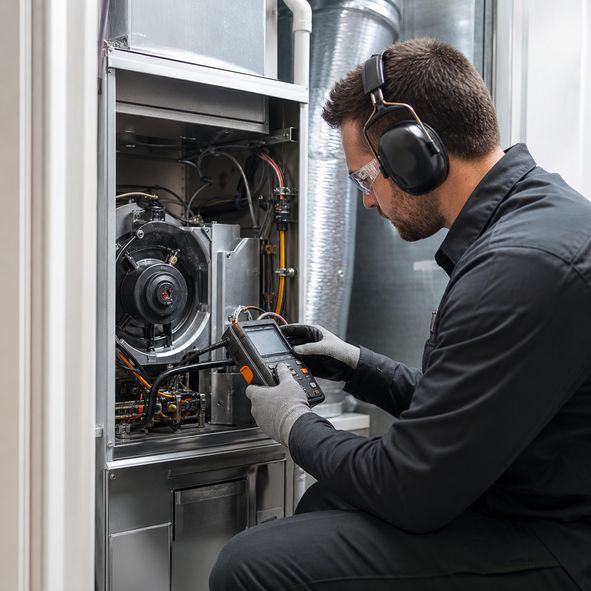
How Loud Should Your HVAC System Actually Be?
A properly functioning HVAC system should operate between 40–60 decibels — roughly the volume of a quiet conversation. Anything louder, or any new, unfamiliar sound, signals a mechanical issue that demands immediate professional diagnosis before it escalates into a full system failure.
If you’ve started noticing strange sounds coming from your furnace, heat pump, or air handler in your Vancouver or Lower Mainland home, you’re not imagining things. How loud should your HVAC system be is one of the most common questions our Red Seal technicians field — and the answer reveals a great deal about your equipment’s health, efficiency, and remaining lifespan. In the damp, coastal climate of Metro Vancouver and the Fraser Valley, where systems run hard through long heating seasons and increasingly intense summers, abnormal HVAC noise is almost always an early warning sign worth taking seriously.
What Is a Normal HVAC Operating Sound Level?
Normal HVAC operation produces a consistent, low-level hum or airflow whoosh between 40–60 dB. Variable-speed modulating systems run even quieter — sometimes as low as 30 dB at minimum capacity. Any sharp, rhythmic, or intermittent noise outside this range requires investigation.
System type matters significantly here. Single-stage furnaces and air conditioners cycle on at full capacity every time, creating noticeable startup sounds. Two-stage systems ramp between high and low fire, reducing acoustic peaks. Modern variable-speed modulating systems — which are increasingly recommended for the Lower Mainland’s mix of mild shoulder seasons and cold snaps — maintain near-constant low-output operation, making them dramatically quieter and more efficient. When evaluating efficiency metrics like AFUE (Annual Fuel Utilization Efficiency) and HSPF2 (Heating Seasonal Performance Factor), higher-rated variable-speed equipment almost universally delivers superior acoustic performance alongside its thermal efficiency gains.
Banging or Clanking: What Does It Mean?
Banging or clanking from your HVAC typically indicates a loose or broken component — most commonly a cracked heat exchanger, a disconnected blower wheel, or debris inside the cabinet. This is a safety-critical noise. Shut the system down and call a technician immediately.
A cracked heat exchanger is the most dangerous scenario: combustion gases including carbon monoxide can enter your home’s airstream. In older furnaces operating under Technical Safety BC regulations, a confirmed heat exchanger crack is grounds for mandatory condemnation of the appliance. Don’t delay. Loose blower wheels cause metal-on-metal clanking that worsens rapidly and can destroy the motor housing. During a Manual J load calculation assessment, our technicians also check for oversized equipment — a furnace sized too large for a home short-cycles aggressively, causing repeated thermal expansion and contraction that cracks heat exchangers prematurely.
Squealing or Screeching: Bearings, Belts, and Blowers
High-pitched squealing from an HVAC system almost always points to a failing blower motor bearing, a worn belt (in older belt-drive systems), or a malfunctioning inducer motor. Left unaddressed in Vancouver’s humid coastal environment, bearing corrosion accelerates quickly — turning a minor repair into a full motor replacement.
Direct-drive blower motors in modern high-efficiency furnaces (95%+ AFUE) eliminate belts entirely, but their sealed bearings still wear. Variable-speed ECM (Electronically Commutated Motor) blowers are more resistant to bearing failure and offer significant energy savings, but when they do develop noise, the pitch is distinctive. Heat pump systems screeching at startup often indicate refrigerant flooding the compressor — a refrigerant charge issue requiring immediate correction to avoid compressor damage. Compressor replacement is one of the most resource-intensive repairs in HVAC service, making early intervention critical for system longevity.
Rattling: Loose Panels, Ductwork, and Refrigerant Lines
Rattling during HVAC operation commonly originates from loose access panels, unsecured ductwork joints, vibrating refrigerant line sets, or debris in return air grilles. While often less urgent than banging, persistent rattling can indicate duct leakage — a major efficiency loss in any Lower Mainland home.
Duct leakage in Metro Vancouver homes is a chronic efficiency problem. Leaky ducts in unconditioned spaces — crawlspaces, attics — allow conditioned air to escape and draw in the region’s characteristically damp, particulate-laden outside air. This degrades indoor air quality, overworks the blower, and skews system static pressure beyond design parameters. During a professional diagnostic, technicians assess static pressure against equipment specifications, identify unsealed duct connections, and verify that refrigerant line insulation and hangers are intact. Rattling refrigerant lines on a heat pump or mini-split system can also indicate incorrect line set sizing during installation — a Technical Safety BC compliance issue on permitted work.
Clicking, Popping, and Humming: Normal or Not?
A single click at startup and shutdown is normal ignition and pressure equalization. Repeated clicking without ignition signals a failed igniter or gas valve issue. Constant humming may indicate electrical problems — a failing capacitor, contactor, or transformer. Popping ductwork is usually thermal expansion but can signal undersized duct design.
Repeated clicking on a gas furnace without ignition is a lockout condition — the control board attempts ignition three times and shuts down for safety. This protects against unburned gas accumulation and is a Technical Safety BC-compliant protective function. Never attempt to bypass ignition lockout controls. A failing capacitor on an air conditioning unit or heat pump produces a distinct low hum and often causes hard-start conditions that stress the compressor. Capacitors are inexpensive to replace proactively but costly to ignore — a failed start capacitor on a hot Burnaby or Surrey summer day means no cooling until a technician arrives.
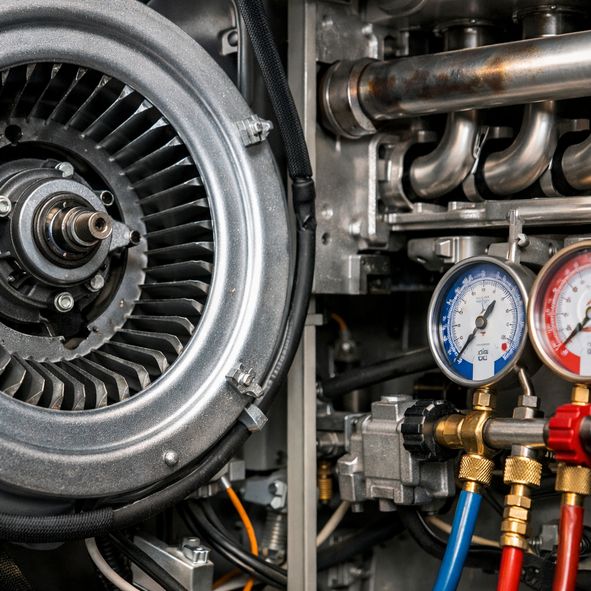
HVAC Noise Comparison: System Types at a Glance
| System Type | Typical Noise Level | Common Noise Issues | Efficiency Rating | Best For |
|---|---|---|---|---|
| Single-Stage Gas Furnace | 55–65 dB | Loud startup bang, duct pop | 80–96% AFUE | Budget-focused installs, larger homes |
| Two-Stage Gas Furnace | 50–60 dB | Moderate startup, less duct stress | 95–98% AFUE | Mixed climates, mid-size homes |
| Variable-Speed Modulating Furnace | 40–55 dB | Bearing wear over time | 96–98.5% AFUE | Comfort-focused, air quality priority |
| Central Heat Pump (ASHP) | 45–60 dB (outdoor) | Compressor hum, refrigerant noise | HSPF2 8.5–14+ | Mild climates, year-round efficiency |
| Ductless Mini-Split | 19–45 dB (indoor) | Refrigerant gurgle, coil frost | SEER2 18–33+ | Zoned comfort, heritage homes, additions |
| Hydronic Boiler System | 40–55 dB | Kettling, pipe knock, pump cavitation | 85–98% AFUE | Radiant heat, older Vancouver homes |
Frequently Asked Questions: HVAC Noises Decoded
Why does my furnace make a loud bang when it starts up?
This is called delayed ignition — gas accumulates briefly before igniting, causing a small combustion explosion. It stresses the heat exchanger with every cycle and accelerates cracking. Causes include a dirty burner, low gas pressure, or a failing igniter. Have a Red Seal technician inspect and clean the burner assembly immediately. In older furnaces, this symptom often precedes heat exchanger failure.
My heat pump makes a gurgling noise — is that normal?
A mild gurgling or refrigerant flow sound during defrost cycles is normal for heat pumps operating in Burnaby, Richmond, or Coquitlam during damp winter conditions. However, persistent loud gurgling or bubbling at the indoor air handler may indicate low refrigerant charge or a refrigerant leak — both requiring certified technician diagnosis. Refrigerant work in BC must be performed by certified gas fitters and refrigeration mechanics under Technical Safety BC jurisdiction.
How do I know if my HVAC noise is a safety emergency?
Treat these sounds as immediate emergencies: loud banging (possible heat exchanger crack or blower failure), repeated clicking without ignition (gas valve or igniter failure with potential gas accumulation), screeching on startup (compressor or motor failure), and any noise accompanied by burning smells or visible sparks. Shut the system off at the disconnect and call a licensed HVAC technician. Never attempt to operate a gas appliance you suspect is malfunctioning.
Can an oversized furnace cause more noise?
Absolutely. Oversized furnaces — a common problem in older Lower Mainland homes where equipment was replaced without a proper Manual J load calculation — short-cycle aggressively. This creates repeated hard startups, excessive duct pressure pops, and thermal stress on the heat exchanger. A correctly sized system based on your home’s actual heat loss calculation runs longer, quieter cycles, maintains more even temperatures, and lasts significantly longer than an oversized unit hammering on and off all day.
Protect Your Home’s Comfort and Safety — Contact BCRC Heating and Cooling
Strange HVAC noises are never just an inconvenience — they are your system’s way of communicating real mechanical, safety, or efficiency problems. From coastal humidity accelerating bearing corrosion in Burnaby and Richmond, to cold snap-induced heat exchanger stress in Coquitlam and Surrey, Lower Mainland homes demand HVAC systems that are correctly sized, professionally installed, and maintained to Technical Safety BC standards. Whether you’re diagnosing a rattling furnace, investigating a squealing heat pump, or evaluating whether your aging system deserves repair or replacement, the answer always starts with a thorough diagnostic by a Red Seal certified technician who understands your local climate and your equipment’s specific demands.
For trusted, Red Seal certified furnace repair in Vancouver and throughout the entire Lower Mainland, contact the local experts at BCRC Heating and Cooling today at (604) 781-7272. Our team is standing by to diagnose your system, restore your comfort, and ensure your home meets every applicable safety standard — before a small noise becomes a major failure.