



Do HEPA Filters & UV Lights in Furnaces Work?
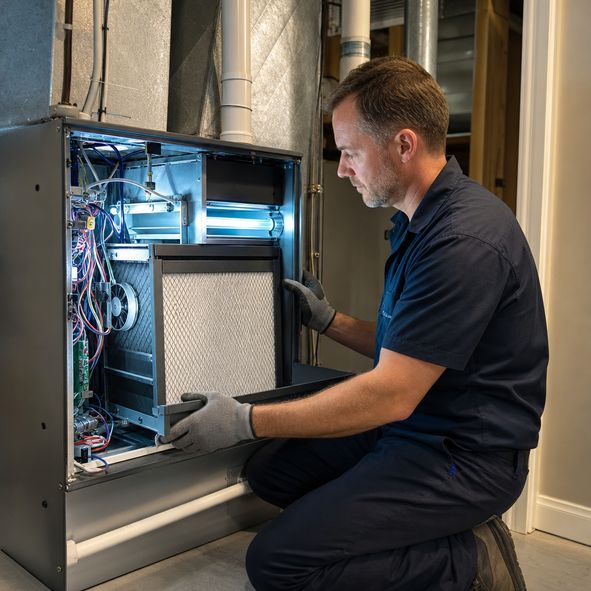
Do HEPA Filters and UV Lights in Your Furnace Really Work?
Short answer: Yes — but only when properly sized, correctly installed, and matched to your specific HVAC system. In Vancouver and the Lower Mainland, where coastal humidity, damp cold snaps, and dense urban air quality create unique indoor air challenges, HEPA filtration and UV-C germicidal technology can deliver measurable improvements in air quality. However, selecting the wrong product or skipping professional installation turns these powerful tools into expensive liabilities that can damage your furnace and void your warranty.
This guide breaks down the real-world performance, technical requirements, and practical buying criteria for both technologies — straight from the field.
What Exactly Is a HEPA Filter, and Can It Work in a Residential Furnace?
True HEPA filters capture 99.97% of airborne particles at 0.3 microns, including mould spores, pet dander, dust mite debris, and fine particulate matter. However, most residential furnaces cannot physically accommodate a true HEPA filter without significant duct modifications due to severe airflow restriction.
This is the single most misunderstood point in residential HVAC. True HEPA media has a MERV rating equivalent of approximately MERV 17, which creates enormous static pressure resistance. Standard residential furnace blower motors — particularly single-stage PSC motors — are not engineered to overcome this resistance. Forcing a true HEPA filter into an undersized return plenum will cause the following cascade of problems:
- Reduced airflow across the heat exchanger, leading to overheating and cracked heat exchanger risk
- Increased blower motor amperage draw and premature motor burnout
- Coil freeze-up on cooling systems
- Voided manufacturer warranty due to operating outside design specifications
The practical solution used by certified technicians is a high-efficiency media filter system rated MERV 11–13, installed in a dedicated filter cabinet with expanded media surface area. This approach achieves near-HEPA performance while maintaining adequate airflow — typically 350–450 CFM per tonne of cooling capacity — across variable-speed and two-stage furnace systems. Modulating variable-speed ECM blower motors, found in premium two-stage and fully modulating furnaces, are significantly better suited for higher MERV filtration because they automatically compensate for increased static pressure by ramping up fan speed.
In the Lower Mainland’s climate, mould spore counts are elevated year-round due to coastal moisture. A properly installed MERV 13 media cabinet captures the vast majority of biological particulates that contribute to respiratory irritation and HVAC coil contamination.
How Do UV-C Germicidal Lights Work Inside an HVAC System?
UV-C lights installed in your furnace or air handler emit ultraviolet radiation at 253.7 nanometres, the optimal wavelength for disrupting the DNA of bacteria, viruses, mould, and fungi. When correctly positioned and sized for your system’s airflow volume, they are scientifically validated to reduce biological contaminants on coil surfaces and in circulated air.
There are two distinct installation configurations, and choosing the wrong one dramatically reduces effectiveness:
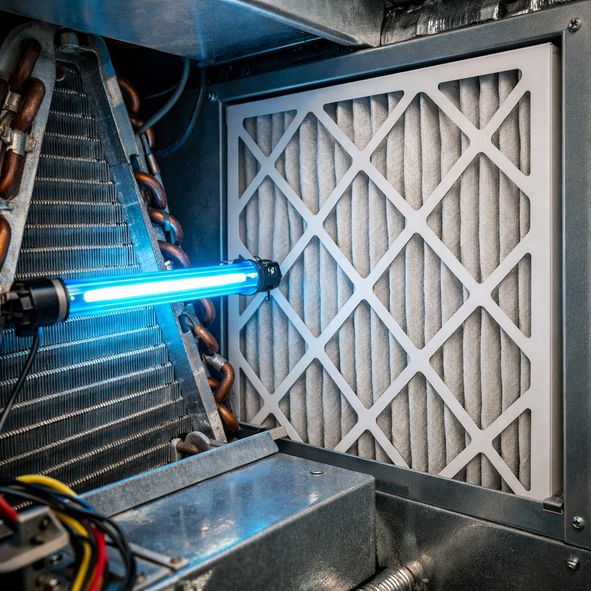
- Coil-Sterilization (Static) UV Lamps: Mounted to shine continuously on the evaporator coil and drain pan. This is the most proven application. Coils are breeding grounds for mould and biofilm in humid Vancouver summers. A properly sized coil sterilization lamp prevents biological buildup, maintains heat transfer efficiency, and reduces musty odours. This configuration does not sterilize moving air.
- Air-Sterilization (In-Duct) UV Systems: Installed in the return or supply duct to irradiate passing airflow. Effectiveness depends critically on air dwell time — the duration air is exposed to UV-C radiation. At typical residential airflow rates of 400–500 CFM, standard single-lamp systems provide insufficient exposure time for complete pathogen kill. High-output dual-lamp systems or systems with reflective duct liners significantly improve germicidal dosage.
UV-C lamp output degrades over time. Most lamps lose approximately 40% of their germicidal output within 9,000 to 12,000 operating hours — roughly one to two years of continuous operation. Lamp replacement is not optional maintenance; it is a Technical Safety BC compliance and performance requirement. Lamps that appear to glow blue-white may still be operating at severely reduced UV-C output, as visible light output does not correlate with germicidal wavelength intensity.
HEPA-Grade Filtration vs. UV-C: Side-by-Side Technical Comparison
| Feature | High-Efficiency Media Filter (MERV 11–13) | UV-C Germicidal System |
|---|---|---|
| Primary Function | Captures particulate matter physically | Neutralizes biological contaminants chemically/biologically |
| Targets | Dust, pollen, dander, mould spores, fine PM2.5 | Live bacteria, viruses, mould colonies, biofilm |
| Airflow Impact | Moderate — requires proper cabinet sizing | Minimal — no restriction to airflow |
| Effectiveness on Viruses | Captures if particle-bound; misses airborne viral aerosols | High — disrupts viral RNA/DNA directly |
| Maintenance Interval | Media replacement every 6–12 months | Lamp replacement every 12–24 months |
| Compatible Systems | Best with variable-speed ECM or two-stage furnaces | Compatible with virtually all forced-air systems |
| Warranty Considerations | Must be OEM-approved or warranty may be voided | Must be installed per manufacturer specs |
| Lower Mainland Benefit | Critical for mould spore and wildfire smoke PM2.5 capture | Critical for coil mould prevention in humid coastal climate |
Which System Is Right for Your Lower Mainland Home?
The honest field answer: the best performing systems combine both technologies. A high-efficiency media cabinet addresses particulate loading while UV-C handles the biological contamination that filters cannot kill. This layered indoor air quality strategy is especially relevant in Burnaby, Richmond, and Coquitlam, where older housing stock tends to have tighter building envelopes, reduced natural ventilation, and elevated indoor humidity levels that accelerate mould growth on HVAC components.
System compatibility must be verified before any installation. Key technical checkpoints include:
- Static pressure audit: Confirm your existing ductwork and blower can support increased filter resistance without compromising design airflow.
- Furnace type: Single-stage furnaces with PSC motors are the least adaptable. Two-stage and variable-speed modulating furnaces with ECM blower motors offer the best compatibility with high-MERV filtration.
- AFUE rating protection: Improper filtration installations that cause heat exchanger stress can degrade the operational efficiency of even a 96% AFUE furnace, eliminating any efficiency advantage.
- Technical Safety BC compliance: All electrical connections for UV lamp ballasts and media cabinet installations must meet BC Electrical Code requirements and be performed by a licensed tradesperson.
Frequently Asked Questions
Can I install a HEPA filter in my existing furnace without modifications?
In nearly all residential applications, no. True HEPA media creates static pressure that standard residential blowers cannot overcome safely. The correct approach is a professionally installed MERV 11–13 expanded media cabinet, which delivers comparable particulate capture without airflow restriction. Attempting to force a HEPA filter into a standard 1-inch filter slot can cause heat exchanger overheating and blower motor failure within a single heating season.
How often do UV-C lamps need to be replaced, and what happens if I skip it?
UV-C lamps should be replaced every 12 to 24 months regardless of visible appearance. After 9,000 to 12,000 hours of operation, germicidal output at the critical 253.7 nm wavelength drops dramatically even though the lamp appears to function normally. Skipping replacement means your system is consuming power while providing zero biological protection — and coil mould contamination will resume unchecked.
Will a UV light or HEPA-grade filter affect my furnace’s AFUE efficiency rating?
A UV-C coil lamp has negligible impact on AFUE because it does not restrict airflow. However, improperly sized high-MERV filtration absolutely can degrade effective AFUE. Restricted airflow across the heat exchanger increases operating temperatures, triggers high-limit safety switches, and forces the furnace into short-cycling — dramatically reducing real-world efficiency below the nameplate AFUE rating, whether that is 80%, 92%, or 96% AFUE.
Are these systems worth installing in a newer home with a variable-speed furnace?
Absolutely. Variable-speed modulating furnaces with ECM blower motors are the ideal platform for indoor air quality upgrades. The ECM motor dynamically adjusts airflow to compensate for increased static pressure from higher-MERV media, maintaining design CFM across all operating stages. Combined with a UV-C coil lamp, a variable-speed system in a Richmond or Surrey home can deliver hospital-grade air quality management while preserving full manufacturer warranty compliance when installed by a Red Seal certified technician.
The BCRC Verdict: Real Performance Requires Proper Installation
HEPA-grade filtration and UV-C germicidal technology are not marketing gimmicks — they are legitimate, scientifically validated tools for improving indoor air quality in Lower Mainland homes. But their effectiveness is entirely dependent on correct system sizing, compatible equipment matching, and professional installation that meets both manufacturer specifications and Technical Safety BC standards. A poorly sized media filter or an underpowered UV lamp installed in the wrong location delivers almost none of the promised benefits while adding real risk to your furnace’s mechanical components and warranty status. For Red Seal certified furnace installation in Vancouver and expert indoor air quality upgrades across the Lower Mainland, contact the local professionals at BCRC Heating and Cooling today at (604) 781-7272 — because your family’s comfort and health deserve more than a guesswork installation.