



Heat Pump vs. Furnace in Vancouver: Which Wins?
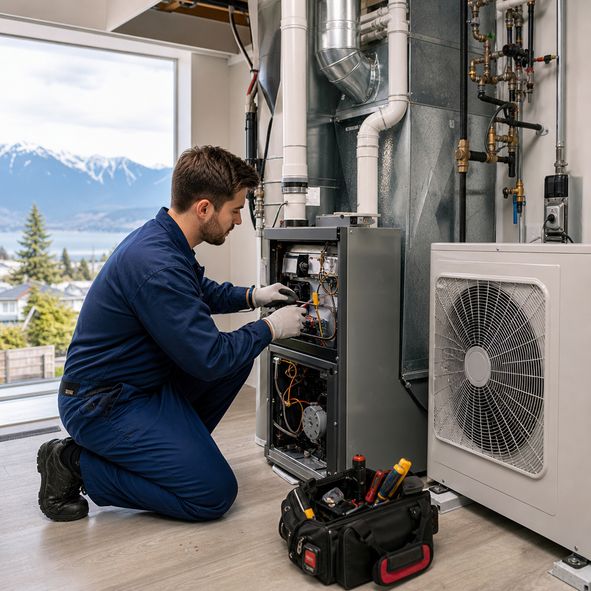
Heat Pump vs. Furnace in Vancouver: Which Is Right for Your Home?
If you’re evaluating heat pump vs. furnace in Vancouver, you’re asking exactly the right question. The Lower Mainland’s coastal climate — damp winters, mild cold snaps, and high humidity — creates unique demands that make this choice far more technical than it appears. This guide gives you the field-engineer perspective so you can make a confident, informed decision.
How Does Vancouver’s Climate Affect Your Heating System Choice?
Vancouver’s coastal climate — with winters averaging 3°C–7°C and frequent damp cold snaps dropping to -5°C — strongly favours heat pump performance. However, systems must handle high relative humidity and occasional sub-zero events, making proper sizing and system selection absolutely critical for year-round comfort.
Unlike Calgary or Edmonton, Metro Vancouver rarely sustains extreme cold. The Lower Mainland typically sees design temperatures around -7°C to -10°C at worst. This matters enormously because a heat pump’s coefficient of performance (COP) degrades as outdoor temperatures fall. Modern cold-climate heat pumps (CCHPs) rated to -25°C maintain strong heating capacity right through a Vancouver winter without requiring heavy auxiliary backup — a key advantage in our specific geography.
The coastal humidity is a separate engineering concern. High ambient moisture accelerates corrosion on outdoor coil fins, carbon steel heat exchanger components, and flue systems. Any system installed in Burnaby, Richmond, or Coquitlam should use corrosion-resistant coatings, marine-grade fasteners, and be commissioned to Technical Safety BC’s Gas Safety and Electrical Safety standards.
What Are the Core Technical Differences Between a Heat Pump and a Furnace?
A furnace generates heat by combusting fuel (natural gas or propane), rated by AFUE. A heat pump moves heat via refrigerant, rated by HSPF2 and SEER2. Heat pumps provide both heating and cooling; furnaces only heat. Each technology has distinct sizing, installation, and performance engineering requirements.
Furnace Efficiency — Understanding AFUE
Annual Fuel Utilization Efficiency (AFUE) measures what percentage of fuel energy is converted to usable heat. Standard units run at 80% AFUE; high-efficiency condensing furnaces achieve 96%–98% AFUE. The difference is captured heat from flue gases — a condensing furnace extracts so much energy it exhausts cool water vapour rather than hot combustion gases, which is why it requires a dedicated PVC flue rather than a metal chimney liner.
Furnaces are available in three capacity stages: single-stage (full blast or off), two-stage (low and high fire), and variable-speed modulating. In Vancouver’s moderate climate, a modulating furnace that can run at 40%–100% capacity provides dramatically improved humidity control, quieter operation, and more even temperature distribution — a major comfort upgrade over single-stage units.
Heat Pump Efficiency — Understanding HSPF2 and SEER2
Heating Seasonal Performance Factor 2 (HSPF2) governs heating efficiency under the updated DOE 2023 test procedure, while Seasonal Energy Efficiency Ratio 2 (SEER2) governs cooling. Look for heat pumps with a minimum HSPF2 of 9.5 and SEER2 of 16+ for meaningful performance in our climate. Variable-speed inverter-driven compressors are the gold standard — they modulate output continuously, maintain precise setpoint temperatures, and dramatically outperform single-stage compressors in comfort and efficiency across Vancouver’s shoulder seasons.
How Do You Properly Size a Heat Pump or Furnace for a Vancouver Home?
Proper sizing requires a Manual J load calculation — a room-by-room engineering analysis of insulation R-values, window U-factors, air infiltration rates, occupancy, and local design temperatures. Oversizing causes short-cycling, humidity problems, and premature wear. Undersizing leaves you cold. Neither is acceptable.
A qualified HVAC contractor in Surrey or Richmond will perform Manual J using software like Wrightsoft or Elite RHVAC. For a typical Lower Mainland home of 1,800–2,400 sq ft, this process accounts for:
- Local heating design temperature (ASHRAE 99% condition for your municipality)
- Wall and attic insulation levels (often mixed in Metro Vancouver’s aging housing stock)
- Window area, orientation, and glazing type
- Duct system leakage and static pressure
- Infiltration rate (ACH50 from a blower door test, if available)
For heat pumps specifically, the balance point temperature — the outdoor temperature at which the heat pump’s output exactly matches the home’s heat loss — must be calculated. A well-sized cold-climate heat pump in Coquitlam or Burnaby should have a balance point below -5°C, ensuring the system handles 95%+ of annual heating hours without relying on backup resistance strips.
Heat Pump vs. Furnace: Head-to-Head Technical Comparison
| Specification / Factor | Cold-Climate Heat Pump | High-Efficiency Gas Furnace |
|---|---|---|
| Primary Efficiency Metric | HSPF2 (target ≥ 9.5), COP 2.5–4.0 at 0°C | AFUE (target ≥ 96%) |
| Cooling Capability | Yes — SEER2 rated, year-round comfort | No — requires separate A/C unit |
| Performance at -10°C | Strong with inverter compressor; COP drops but remains above 1.5 | Consistent — unaffected by outdoor temp |
| Capacity Modulation | Continuous inverter modulation (10%–100%) | Single, two-stage, or modulating (40%–100%) |
| Humidity Control | Excellent at low load — dehumidifies during cooling | Good with variable-speed air handler |
| Fuel Source | Electricity only | Natural gas or propane |
| Technical Safety BC Compliance | Electrical permit required; refrigerant handling by certified tech | Gas permit required; CO safety inspection mandatory |
| Typical Equipment Lifespan | 15–20 years (compressor is the key component) | 20–25 years (heat exchanger is the key component) |
| Maintenance Requirements | Annual coil cleaning, filter changes, refrigerant check | Annual combustion analysis, heat exchanger inspection, flue check |
| Best Application (Lower Mainland) | Homes without existing gas service; new builds; efficiency-first priorities | Homes with existing gas infrastructure; extreme cold resilience priority |
Which System Is More Reliable and Safer for Lower Mainland Homeowners?
Both systems are highly reliable when properly installed and maintained. Furnaces carry carbon monoxide risks requiring annual heat exchanger inspections. Heat pumps eliminate combustion risks but require certified refrigerant handling. Technical Safety BC mandates permits for both — never accept an unpermitted installation.
A cracked furnace heat exchanger is one of the most dangerous residential HVAC failures — it allows combustion gases, including carbon monoxide, to enter the living space. Annual combustion analysis by a Red Seal gasfitter is non-negotiable. All installations in BC must comply with BC Gas Safety Regulation and the BC Electrical Safety Act, with permits pulled through Technical Safety BC before work begins.
Heat pumps use refrigerants (commonly R-410A or the newer R-32/R-454B in current models) that must only be handled by EPA 608 / TECA-certified technicians. Improper refrigerant charging — even by a fraction of an ounce — directly impacts system efficiency and longevity. Always verify your contractor’s certifications.
What About Dual-Fuel and Hybrid Systems?
For homeowners in Surrey or Coquitlam who want maximum flexibility, a dual-fuel hybrid system — pairing a cold-climate heat pump with a gas furnace — delivers the best of both worlds. The heat pump handles the majority of heating load efficiently during mild weather, while the furnace takes over seamlessly during deep cold snaps. This configuration requires sophisticated thermostat integration (typically a communicating smart thermostat with a user-defined switchover point, commonly set around -5°C to -8°C) and precise duct system balancing.
Frequently Asked Questions
Can a heat pump handle a Vancouver winter without a backup furnace?
Yes — a properly sized cold-climate inverter heat pump rated to -25°C can handle virtually all of Vancouver’s heating season without backup. The key is correct Manual J sizing and selecting a unit with a rated heating capacity at -15°C that meets or exceeds your home’s calculated heat loss. A reputable contractor will provide this data in writing.
My home already has natural gas — should I still consider a heat pump?
Absolutely. Many Lower Mainland homeowners with existing gas service choose a dual-fuel hybrid system. It maximizes efficiency during the long mild seasons and gives you rock-solid backup during cold snaps. Your existing ductwork may also need modifications — a proper static pressure test and duct leakage assessment should be part of any installation proposal.
What warranty should I expect, and what voids it?
Reputable heat pump and furnace manufacturers offer 10-year parts warranties on registered equipment, with some brands offering 12-year compressor warranties. Warranties are voided by: unpermitted installations, non-certified refrigerant handling, using an unqualified installer, skipping annual maintenance, or improper refrigerant charge. Always register your equipment within 60–90 days of installation and keep all service records.
How do I know if my existing ductwork can support a new heat pump?
Heat pumps typically require lower supply-air temperatures than furnaces, meaning they move more air volume to deliver the same heat output. If your duct system has high static pressure (over 0.5″ w.c.), undersized trunk lines, or significant leakage (over 15% of system airflow), a heat pump installation without duct remediation will underperform and potentially shorten compressor life. Insist on a duct blaster test and static pressure measurement before system selection.
Make the Right Call for Your Home
There is no universal winner in the heat pump vs. furnace debate for Vancouver — the right answer is engineered, not guessed. It depends on your home’s envelope performance, existing infrastructure, duct condition, and your specific comfort priorities. What is universal: proper Manual J sizing, certified installation, Technical Safety BC permits, and ongoing professional maintenance are non-negotiable requirements for any system to perform as specified.
Don’t leave this decision to guesswork or a five-minute phone quote. The certified Red Seal technicians at BCRC Heating and Cooling perform complete on-site technical assessments across Vancouver, Burnaby, Richmond, Coquitlam, Surrey, and the entire Lower Mainland. We pull permits, perform load calculations, and install to manufacturer and Technical Safety BC standards — every time.
📞 Call BCRC Heating and Cooling today at (604) 781-7272 to schedule your on-site technical inspection and get an expert recommendation tailored to your home.