



Heat Pump Maintenance North Vancouver | BCRC
North Vancouver’s Heat Pump: The Quiet Workhorse Behind Year-Round Comfort
There is something remarkably elegant about a heat pump operating at peak efficiency on a cold, rain-soaked North Vancouver morning. While the mountains outside are cloaked in low cloud and the temperature hovers just above zero, the interior of a well-maintained home remains perfectly balanced — warm, dry, and energy-efficient — without the homeowner giving it a second thought. That seamless, almost invisible comfort is not an accident. It is the product of precision engineering meeting disciplined, professional maintenance. Heat pumps do not simply generate heat; they move it, transferring thermal energy from the outdoor air into your living space with a thermodynamic efficiency that no conventional furnace or boiler can match. But that efficiency is not self-sustaining. Like any sophisticated mechanical system, a heat pump depends on regular, expert care to deliver the performance it was designed for. For North Vancouver homeowners, understanding the history, mechanics, and modern best practices of heat pump maintenance is not just interesting — it is financially and environmentally essential.
The Ancient Roots of Thermal Transfer: Where Heat Pump Science Begins
To truly appreciate what a modern heat pump does, it helps to understand that the core concept — moving heat from one place to another rather than generating it from scratch — is ancient. The Romans engineered the hypocaust, a sophisticated underfloor and wall-cavity heating system that circulated hot air from a central furnace beneath raised floors and through hollow walls. Wealthy Roman villas and public bathhouses (thermae) used this passive thermal transfer principle to maintain comfortable interior temperatures across the cold European winters of the first and second centuries AD. Korean ondol systems, dating back over 2,000 years, used similar radiant underfloor principles, channelling smoke and hot gases through stone channels beneath clay floors. In China, the kang — a heated brick sleeping platform — exploited thermal mass and combustion gases to store and slowly release heat through the night. None of these ancient engineers knew they were laying the philosophical groundwork for modern refrigerant-cycle heat pumps, but the fundamental principle — that heat can be harvested, moved, and distributed efficiently — was already well understood. The leap from Roman hypocaust to modern variable-speed inverter heat pump spans two millennia of incremental engineering brilliance.
The Industrial Breakthroughs That Made Modern Heat Pumps Possible
The scientific framework for the modern heat pump emerged from the work of Nicolas Léonard Sadi Carnot, whose 1824 treatise Réflexions sur la puissance motrice du feu established the thermodynamic cycle that bears his name. Carnot demonstrated mathematically that heat could be moved between reservoirs of different temperatures using mechanical work — the foundational insight behind every heat pump, refrigerator, and air conditioner ever built. Lord Kelvin formalized this into the concept of a heat multiplier in 1852, theorizing a device that could deliver more heat energy than the mechanical energy consumed to drive it. This was not magic; it was thermodynamics. The refrigeration industry of the late 19th century, driven by pioneers like Carl von Linde who developed practical ammonia compression refrigeration in the 1870s, gave engineers the mechanical tools to put Carnot’s theory into commercial practice. By the early 20th century, the refrigeration cycle was well understood, and inventors began reversing it — using the same compressor-evaporator-condenser loop not to remove heat from a space, but to inject it. Robert C. Webber is widely credited with building one of the first practical ground-source heat pumps in the late 1940s, reportedly inspired by accidentally touching the hot discharge line of his deep freezer. The post-war era saw the first air-source heat pumps enter residential use in North America, though early units were limited by poor performance in cold temperatures — a limitation that modern cold-climate variable-speed compressor technology has effectively eliminated.
The 20th-Century Standardization and the Rise of Residential Heat Pumps
Through the 1950s, 1960s, and 1970s, heat pump technology advanced steadily but faced significant market resistance. Early systems were expensive, mechanically unreliable compared to simple gas furnaces, and lost efficiency rapidly as outdoor temperatures dropped below approximately 5°C — a critical threshold for climates like North Vancouver’s wet, mild winters. The oil shocks of 1973 and 1979 dramatically changed the economic calculus, sending utilities and governments scrambling for alternatives to fossil-fuel heating. This urgency accelerated research into heat pump efficiency, refrigerant chemistry, and compressor design. The introduction of standardized efficiency ratings — the Coefficient of Performance (COP) for heating mode and the Energy Efficiency Ratio (EER) for cooling mode — gave consumers and regulators a common language for comparing systems. By the 1980s and 1990s, improved scroll compressors, better refrigerants, and electronic expansion valves were delivering COPs of 2.5 to 3.5, meaning that for every unit of electrical energy consumed, the system delivered 2.5 to 3.5 units of heat energy. This was a paradigm shift in residential heating economics. Canadian and BC provincial building codes began recognizing heat pumps as a primary heating system, and BC Hydro launched early incentive programs to accelerate adoption across the province’s electrically heated housing stock.
The Modern Era: Inverter Technology, Cold-Climate Performance, and Smart Diagnostics
The defining technological leap of the 21st-century heat pump market has been the widespread adoption of variable-speed inverter-driven compressors. Traditional single-stage compressors operate in a binary fashion — full power on, or completely off — cycling repeatedly to maintain temperature. This cycling wastes energy, creates uncomfortable temperature swings, and places repetitive mechanical stress on compressor components. Inverter compressors, by contrast, modulate their operating speed continuously in response to real-time heating or cooling demand. At -15°C outdoor ambient temperature, a modern cold-climate inverter heat pump such as a Lennox XP21, Mitsubishi Hyper-Heat, or Bosch IDS can maintain rated heating output with a COP exceeding 2.0 — delivering more than double the heat energy per unit of electricity compared to a standard electric baseboard. For North Vancouver homeowners, where winter temperatures rarely drop below -10°C but marine air creates persistent dampness and demand for consistent low-load heating, inverter heat pumps represent an almost ideal match of technology to climate. Layered on top of inverter efficiency is the rapid maturation of smart thermostat and Wi-Fi diagnostic platforms. Modern heat pump systems from leading manufacturers integrate directly with apps that provide real-time COP monitoring, compressor runtime analytics, filter replacement reminders, refrigerant pressure trending, and predictive fault alerts. A BCRC technician attending a maintenance visit today arrives with a tablet displaying months of operational data before touching a single component — a level of diagnostic precision that was science fiction just fifteen years ago.
Why North Vancouver’s Climate Demands Specialized Heat Pump Maintenance
North Vancouver presents a unique operating environment for heat pump systems. The combination of heavy annual rainfall, persistent coastal humidity, salt-laden air from Burrard Inlet, and significant temperature cycling between shoulder seasons creates specific maintenance challenges that differ substantially from drier inland climates like Kelowna or Kamloops. Outdoor condenser coils in North Vancouver accumulate biofilm, algae, salt deposits, and compressed debris — particularly cottonwood seed in spring — at rates that can reduce airflow across the coil by 15 to 30 percent within a single season. A coil operating at 80 percent airflow capacity forces the compressor to work harder against elevated head pressure, reducing efficiency, increasing electrical consumption, and shortening compressor lifespan. Drainage systems — particularly on ductless mini-split indoor air handlers — require regular inspection in North Vancouver’s humid environment, where condensate drain lines are prone to algae blockage. Fan motor bearings, exposed to constant moisture cycling, require lubrication checks that inland installations can often defer. Electrical connections in outdoor units experience accelerated oxidation in the coastal marine environment, making annual torque checks of all terminal connections a critical safety and reliability requirement. These are not generic maintenance tasks; they are locally calibrated, climate-specific interventions that BCRC’s Red Seal certified technicians execute with precision at every North Vancouver maintenance visit.
The BCRC Comprehensive Heat Pump Maintenance Protocol: A Technical Deep Dive
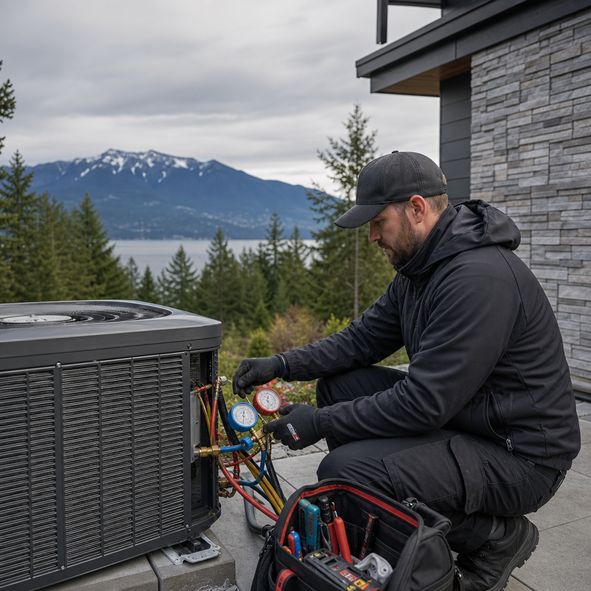
When a BCRC Red Seal Master Technician arrives at your North Vancouver property for a scheduled heat pump maintenance visit, they execute a systematic, multi-point inspection protocol that covers every critical subsystem of your heat pump. This is not a cursory visual check — it is a full mechanical, electrical, and refrigerant-cycle assessment designed to identify degradation before it becomes failure.
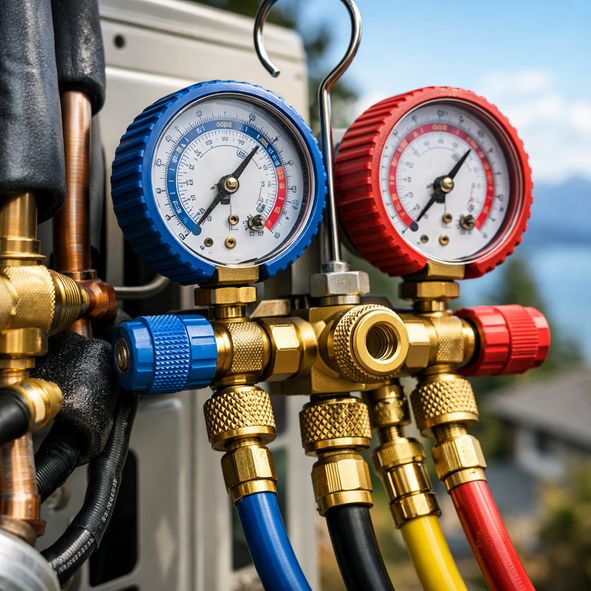
- Refrigerant Circuit Verification: Using calibrated manifold gauges, the technician measures suction and discharge pressures against manufacturer specifications at the actual outdoor ambient temperature, calculating real-time superheat and subcooling values to verify refrigerant charge accuracy. Even a 10 percent undercharge can reduce system COP by 20 percent or more.
- Coil Cleaning — Indoor and Outdoor: Both the evaporator coil (indoor) and condenser coil (outdoor) are cleaned using appropriate commercial coil cleaners and low-pressure rinsing. In North Vancouver, this step alone can restore 10 to 20 percent of lost efficiency in systems that have not been serviced for 12 months.
- Electrical System Inspection: All capacitors are tested under load using a true-RMS capacitance meter. Contactor contacts are inspected for pitting and burning. All terminal connections are torqued to specification and treated with anti-oxidant compound where required by the coastal environment.
- Blower Motor and Fan Blade Assessment: Indoor blower wheel and outdoor fan blade are inspected for balance, debris accumulation, and bearing wear. An out-of-balance fan blade creates vibration that accelerates bearing failure and transmits noise through the structure.
- Condensate System Flush and Treatment: Indoor drain pans and drain lines are flushed and treated with an EPA-registered biocide tablet to prevent algae and biofilm accumulation — a particularly important step in North Vancouver’s humid climate.
- Defrost Control Verification: Defrost board function is tested to confirm that the outdoor unit initiates and terminates defrost cycles correctly. A malfunctioning defrost control is one of the most common causes of winter heat pump failure in the Greater Vancouver region.
- Thermostat and Controls Calibration: Smart thermostat setpoints, scheduling, and emergency heat lockout temperatures are reviewed and calibrated against the homeowner’s comfort preferences and BC Hydro time-of-use rate schedules where applicable.
- Air Filter Inspection and Replacement: Filter condition is assessed and replacement recommendations made. In households with pets or high indoor air quality concerns, BCRC technicians can advise on upgrading to MERV-13 rated filtration compatible with the system’s airflow specifications.
Efficiency, Lifespan, and Cost: The Complete Heat Pump System Comparison
| System Type | Efficiency Rating | Expected Lifespan | Primary Fuel | Estimated Annual Operating Cost (North Vancouver) | BC CleanBC Rebate Eligibility |
|---|---|---|---|---|---|
| Standard Central Air Conditioner + Gas Furnace | AFUE 80–96% (heat) / SEER 13–16 (cool) | 15–20 years (furnace); 12–15 years (AC) | Natural Gas + Electricity | $1,800–$2,800 | Partial — furnace upgrade only |
| Electric Resistance Baseboard / Forced Air | COP 1.0 (100% efficient) | 20–30 years (simple) | Electricity | $2,400–$3,600 | Not eligible — upgrade incentive only |
| Standard Single-Stage Air-Source Heat Pump | HSPF 8–10 / SEER 14–18 | 12–16 years | Electricity | $1,000–$1,600 | Yes — up to $3,000 CleanBC rebate |
| Cold-Climate Inverter Heat Pump (e.g., Lennox, Mitsubishi, Bosch) | HSPF2 9–12 / COP up to 3.5+ at 0°C | 15–20 years with proper maintenance | Electricity | $700–$1,200 | Yes — up to $6,000+ CleanBC + BC Hydro combined |
| Ductless Mini-Split Multi-Zone Heat Pump | SEER 20–30 / HSPF2 10–13 | 15–20 years | Electricity | $600–$1,100 | Yes — per-zone rebates available |
| Geothermal / Ground-Source Heat Pump | COP 3.5–5.0 | 20–25 years (unit); 50+ years (ground loop) | Electricity | $500–$900 | Yes — federal Canada Greener Homes + CleanBC |
North Vancouver Homeowner’s Complete Heat Pump Buying and Maintenance Guide
For North Vancouver homeowners navigating the heat pump landscape in 2024 and beyond, the financial and regulatory environment has never been more favourable. The BC CleanBC Better Homes program currently offers rebates of up to $3,000 for qualifying air-source heat pump installations, with enhanced rebates of up to $6,000 available for cold-climate rated units (minimum HSPF2 of 9.5 or higher). BC Hydro’s Energy Saving Rebate program stacks on top of CleanBC incentives, offering additional rebates for qualifying equipment and professional installation by a registered contractor — which BCRC Heating and Cooling is fully certified and registered to perform. The federal Canada Greener Homes Grant program, while currently in transition, continues to offer interest-free financing through the Canada Greener Homes Loan for qualifying retrofits.
When selecting a heat pump for a North Vancouver property, homeowners should prioritize systems rated for cold-climate operation to a minimum of -25°C guaranteed heating capacity, even though North Vancouver rarely reaches such extremes. This rating is a proxy for compressor quality, refrigerant circuit design, and overall system robustness. For properties with existing ductwork in good condition, a ducted central heat pump paired with a smart zoning system is typically the most cost-effective total solution. For older homes, heritage properties, or additions without ductwork — common in North Vancouver’s diverse housing stock from Lynn Valley to Deep Cove — a ductless mini-split multi-zone system provides flexible, highly efficient comfort without the disruption and expense of ductwork installation.
Maintenance scheduling for North Vancouver’s coastal climate should follow a minimum annual professional service interval, with bi-annual service (spring and fall) strongly recommended for systems operating year-round as the primary heating and cooling source. Between professional visits, homeowners should check and clean or replace air filters monthly during peak operation seasons, keep the outdoor unit clear of debris and vegetation (minimum 24-inch clearance on all sides), and monitor for ice accumulation on the outdoor unit during cold snaps — brief frost is normal, but persistent ice that does not clear during defrost cycles indicates a system fault requiring professional attention. Homeowners with smart thermostats should review monthly energy reports to identify any sudden increases in runtime or consumption, which are early indicators of refrigerant loss, coil fouling, or compressor degradation.
Frequently Asked Questions: Heat Pump Maintenance in North Vancouver
How often should I schedule professional heat pump maintenance in North Vancouver?
For heat pump systems operating as the primary heating and cooling source in North Vancouver — which, given the mild climate, represents the majority of residential installations — BCRC recommends a minimum of one professional maintenance visit per year, ideally in the fall before the heating season begins. For systems that run year-round in both heating and cooling modes, bi-annual service (fall and spring) is strongly advisable. North Vancouver’s coastal humidity, salt air, and heavy rainfall create coil fouling and electrical oxidation at rates that exceed drier inland climates, making annual professional service not just best practice but a genuine reliability and warranty protection measure. Many heat pump manufacturers, including Lennox and Mitsubishi, explicitly require documented annual professional maintenance to maintain full warranty coverage — a requirement that BCRC’s maintenance visits satisfy with detailed service records provided to the homeowner.
What are the warning signs that my heat pump needs immediate service rather than waiting for scheduled maintenance?
Several indicators demand prompt professional attention rather than waiting for a scheduled visit. Unusual noises — grinding, squealing, rattling, or bubbling sounds from either the indoor or outdoor unit — indicate mechanical wear, refrigerant issues, or debris in the system. A sudden and unexplained increase in your monthly electricity bill without a corresponding change in usage patterns or weather is a classic early indicator of declining system efficiency, often caused by refrigerant undercharge, dirty coils, or a failing compressor. Ice accumulation on the outdoor unit that persists beyond normal defrost cycles (typically 15–45 minutes every 2–6 hours in cold weather) indicates a defrost control malfunction or refrigerant problem. If the system is blowing air that feels less warm or less cool than usual despite thermostat settings being unchanged, or if the auxiliary/emergency heat indicator on your thermostat is illuminated more frequently than in previous winters, schedule a service call without delay. In North Vancouver’s heating season, waiting weeks on a degraded system is not just uncomfortable — it accelerates component wear and risks a full system failure during the coldest weeks of the year.
Will a heat pump work efficiently during North Vancouver’s cold, wet winters?
Absolutely — and this is one of the most important facts for North Vancouver homeowners to understand. North Vancouver’s maritime climate, characterized by wet winters with temperatures typically ranging from -2°C to 8°C, is actually close to ideal for air-source heat pump operation. Heat pumps extract thermal energy from outdoor air, and there is meaningful heat energy available even at temperatures as low as -20°C (though efficiency does decline as temperatures drop). At North Vancouver’s typical winter temperatures, a modern cold-climate inverter heat pump will operate with a COP of 2.5 to 3.5, meaning it delivers 2.5 to 3.5 kilowatt-hours of heat for every kilowatt-hour of electricity consumed. This is dramatically more efficient than electric resistance heat (COP 1.0) and comparable in operating cost to natural gas heating in BC’s current energy pricing environment — with zero direct combustion emissions. Properly maintained heat pumps with clean coils, correctly charged refrigerant, and functioning defrost controls perform exceptionally well through North Vancouver winters. The key phrase is properly maintained — a neglected system with fouled coils and low refrigerant charge will struggle in cold weather, reinforcing the critical importance of annual professional maintenance.
What does a BCRC heat pump maintenance visit actually include, and what is the typical cost?
A comprehensive BCRC heat pump maintenance visit includes a full refrigerant pressure check and superheat/subcooling verification, indoor and outdoor coil cleaning, electrical system inspection with capacitor testing and terminal torquing, condensate drain flush and biocide treatment, blower motor and fan blade inspection, defrost control functional test, air filter inspection and replacement recommendation, thermostat calibration, and a complete written service report with photographs of any deficiencies noted. BCRC technicians are Red Seal certified, carry full TECA (Technical Standards and Safety Authority) certification for refrigerant handling, and are registered with BC Hydro and CleanBC as authorized contractors. Maintenance visit pricing is transparently quoted in advance, with no hidden diagnostic fees. For exact current pricing and to book your North Vancouver heat pump maintenance appointment, we encourage homeowners to contact BCRC directly at (604) 781-7272. Many homeowners find that the energy savings realized from a properly maintained system — often 10 to 25 percent reduction in annual operating costs — more than offset the cost of professional annual service within the first year alone.
The BCRC Commitment: Expert Heat Pump Maintenance North Vancouver Homeowners Can Trust
Your heat pump is not simply an appliance — it is the central nervous system of your home’s comfort, air quality, and energy efficiency. In North Vancouver’s unique coastal climate, where persistent humidity, salt air, and significant seasonal heating demand push heat pump systems harder than most Canadian climates, the difference between a neglected system and a professionally maintained one is measurable in thousands of dollars of energy savings, years of additional equipment lifespan, and the quiet confidence of knowing your home’s comfort will not fail you on the coldest, wettest January morning of the year. BCRC Heating and Cooling’s team of Red Seal Master Technicians brings that confidence to every maintenance visit — combining deep manufacturer-specific technical knowledge, locally calibrated maintenance protocols, and a genuine commitment to North Vancouver homeowner satisfaction that has made us one of the most trusted HVAC service providers across the North Shore. Whether you are scheduling your first professional maintenance visit, enrolling in an annual maintenance agreement, or exploring an upgrade to a new high-efficiency cold-climate heat pump system, BCRC is your certified local expert. For Red Seal certified, locally trusted heat pump installation in Vancouver and across the North Shore, call BCRC Heating and Cooling today at (604) 781-7272 — because your year-round comfort is too important to leave to chance.