


Furnace Maintenance Vancouver: Complete Guide
When Your Furnace Whispers, You Should Listen
There is a quiet, unsung miracle that unfolds every single morning across Greater Vancouver — the moment a cold, damp Pacific air mass pushes against your windows at 6 AM, and your home stays perfectly, effortlessly warm. No drama. No shivers. Just radiant, consistent comfort flowing through every room. That miracle has a name: a well-maintained, properly tuned, high-efficiency furnace. But like every precision machine, a furnace does not stay miraculous on its own. It speaks to you in subtle cues — a slightly longer ignition delay, a faint sulphur ghost in the ductwork, a utility bill that climbs a few dollars higher each month. The homeowners who listen to those whispers and act on them enjoy 20-year furnace lifespans, rock-bottom energy bills, and complete peace of mind. The ones who ignore them face emergency service calls, carbon monoxide scares, and premature replacements costing $5,000 to $12,000. This guide, written by BCRC Heating and Cooling’s Red Seal Master Technicians serving Greater Vancouver, gives you everything you need to be in the first group — not the second.
The Ancient Roots of Forced-Air Comfort: A History Worth Knowing
To truly appreciate your modern furnace, it helps to understand the extraordinary engineering lineage it descends from. The ancient Romans, those master builders of infrastructure, developed the hypocaust system as early as 100 BCE — a radiant underfloor heating method in which a wood or charcoal fire was lit in a basement furnace room, and the resulting hot gases were channelled through hollow spaces beneath tiled floors and inside hollow walls. Wealthy Roman villas and public bathhouses (thermae) across the empire, from Londinium (London) to Carthage, relied on this ingenious system for thermal comfort. The engineering principle — generating heat at a central point and distributing it throughout a structure — is philosophically identical to what your high-efficiency gas furnace does today.
Centuries later, in the Korean peninsula, the ondol system used stone channels beneath clay floors to distribute wood-fire heat with remarkable efficiency, a tradition that persists in modern Korean radiant floor heating. Medieval European great halls relied on massive central hearths, with the crude distribution mechanism being nothing more than convection and hope. It was not until the 17th and 18th centuries that European engineers began experimenting with closed stoves, flued fireplaces, and gravity warm-air furnaces — large wood or coal-burning iron boxes installed in basements with sheet-metal ducts rising through floor registers. The fundamental architecture of the North American forced-air heating system was taking shape.
Industrial Breakthroughs: From Coal Cellars to Gas-Fired Precision
The 19th century transformed domestic heating from a labour-intensive, dangerous, and inefficient ordeal into something approaching a managed system. The invention of cast-iron sectional boilers, combined with the proliferation of municipal coal gas networks in cities like London, New York, and Toronto, created the conditions for the first recognizable ancestors of the modern furnace. By the 1880s, gravity warm-air furnaces — massive octopus-like iron structures with large-diameter ducts — were standard in middle-class North American homes. They burned coal, required daily stoking, and produced enormous amounts of ash, soot, and the ever-present risk of carbon monoxide poisoning from cracked heat exchangers.
The true revolution came with electrification and automatic controls. The invention of the bimetallic thermostat by Warren Johnson in 1883 and its commercialization by Honeywell in the early 20th century meant that a furnace could, for the first time, regulate itself to a desired set-point temperature without human intervention. The shift from coal to natural gas after World War II was equally transformative. Natural gas burned cleaner, required no ash removal, and could be delivered automatically through a municipal pipeline. Combined with the development of the forced-air fan blower, the safety limit switch, and the standing pilot ignition system, the modern gas furnace by the 1960s was already recognizable as the core appliance found in millions of Canadian homes today. For Vancouver specifically, the expansion of the BC natural gas grid through the mid-20th century made gas furnaces the dominant heating technology across the Lower Mainland — a legacy that shapes every furnace maintenance call BCRC technicians make to this day.
The 20th-Century Standardization: AFUE Ratings and the Efficiency Era
By the 1970s, North American furnaces were reliable but notoriously wasteful. Standard furnaces of that era operated at Annual Fuel Utilization Efficiencies (AFUE) of just 55% to 65%, meaning that 35 to 45 cents of every dollar spent on natural gas was literally vented out of the flue as waste heat. The 1973 oil crisis and the subsequent natural gas price shocks galvanized governments and manufacturers to pursue efficiency gains with genuine urgency. The United States Department of Energy established the AFUE rating standard, Canada followed with its own efficiency regulations under the Energy Efficiency Act, and furnace manufacturers began the relentless engineering march toward higher efficiency that continues today.
The introduction of the induced-draft furnace in the 1980s, which used a powered exhaust blower to actively pull combustion gases through the heat exchanger, was a significant step. But the real quantum leap was the development of the condensing furnace — also called a high-efficiency or Category IV furnace — in the late 1980s and early 1990s. By adding a secondary heat exchanger that extracts latent heat from the water vapour in combustion gases (causing it to condense, hence the name), engineers pushed AFUE ratings past 90% and eventually to 98.5% on today’s best models. These furnaces vent through PVC plastic pipe rather than a traditional metal flue, a telltale sign of their efficiency. For Vancouver homeowners, whose heating seasons are milder than Calgary’s but whose gas bills still climb significantly from October through April, upgrading from a 70% AFUE furnace to a 96% AFUE model can reduce heating fuel costs by over 25% annually.
The Modern Era: Variable-Speed ECM Motors, Smart Diagnostics, and Wi-Fi Controls
The 21st-century furnace is a fundamentally different machine from its 20th-century predecessors, not just in combustion efficiency but in systems intelligence and airflow engineering. The introduction of the Electronically Commutated Motor (ECM) — a brushless DC variable-speed blower motor — was perhaps the single most transformative development in modern furnace technology. Unlike older single-speed PSC (Permanent Split Capacitor) motors that run at full power or not at all, an ECM motor continuously adjusts its speed to precisely match the heating load, the duct system’s static pressure, and the thermostat’s demand signal. The result is dramatically quieter operation, up to 75% less electrical energy consumed by the blower, superior air filtration performance because air moves through the filter at optimal velocity, and far more even temperature distribution throughout the home.
Paired with two-stage or modulating gas valves — which allow the burner to operate at a reduced firing rate (typically 40% to 65% of full capacity) during mild weather and only ramp up to full capacity during peak cold snaps — modern furnaces spend the vast majority of their operating hours in a low, steady, efficient burn cycle. This is not only more efficient but dramatically extends the lifespan of the heat exchanger, burner assembly, and inducer motor by reducing the mechanical and thermal stress of constant on-off cycling.
Smart Wi-Fi enabled thermostats from manufacturers like Ecobee, Nest, and Honeywell T-Series now communicate directly with furnace control boards, providing real-time diagnostics, fault code alerts sent directly to homeowners’ smartphones, and energy usage reporting. Some premium furnace models from Lennox, Carrier, and Trane feature onboard self-diagnostic systems that log error codes and performance data accessible to certified technicians through proprietary software — turning what was once a diagnostic guessing game into a precise, data-driven service call. At BCRC, our technicians are factory-trained on these systems, ensuring that your smart furnace receives smart service.
Vancouver’s Specific Climate Challenges: Why Local Expertise Matters
Greater Vancouver occupies a unique climatic niche that creates specific furnace maintenance challenges that technicians from other regions may not fully appreciate. The Lower Mainland’s temperate oceanic climate — characterized by prolonged periods of high humidity, heavy rainfall from October through April, mild but persistent cold, and occasional Arctic outflow events that can drop temperatures to -10°C or below — imposes distinct demands on residential heating systems.
High ambient humidity means that furnace air filters load with moisture-carrying particulates faster than in drier climates, reducing airflow and system efficiency more rapidly. It also means that the condensate drainage systems on high-efficiency furnaces — which can produce 2 to 4 litres of slightly acidic water per day during peak operation — require regular inspection to prevent blockages, overflow, and the resulting safety lockouts that leave Vancouver families without heat on the coldest nights of the year. The region’s older housing stock, much of it built in the post-war boom of the 1950s through 1970s with single-pane windows, minimal wall insulation, and undersized duct systems, presents additional challenges for modern high-efficiency furnaces that require properly sized duct systems to perform at their rated efficiency. Our technicians routinely perform static pressure testing and duct leakage assessments as part of comprehensive maintenance visits to ensure your system is actually delivering the efficiency printed on its EnerGuide label.
Arctic outflow events, while infrequent, are the moments that reveal deferred maintenance in the most uncomfortable and expensive ways. A furnace with a partially blocked heat exchanger, a weakening ignitor, or a failing inducer motor may limp through a mild Vancouver winter only to fail completely during a -8°C cold snap when demand for emergency HVAC service peaks and wait times lengthen. Annual maintenance, ideally performed in September or early October before the heating season begins, is the single most effective insurance policy against exactly this scenario.
What a Professional BCRC Furnace Maintenance Visit Actually Includes
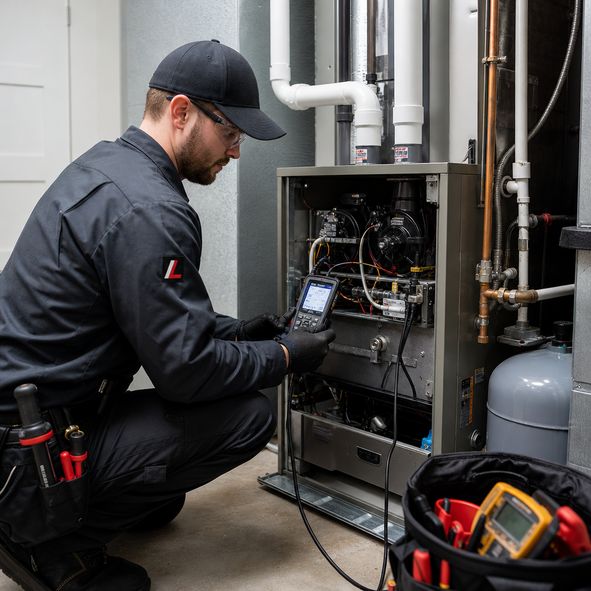
There is a significant difference between a cursory inspection and the comprehensive, Red Seal standard maintenance that BCRC technicians perform on every visit. Understanding what genuine professional maintenance entails helps homeowners evaluate service quality and avoid cut-rate providers who perform a visual check and call it a tune-up. A complete BCRC furnace maintenance service includes the following technical procedures:
- Heat Exchanger Inspection: Using a combustion analyzer, mirror probe, and in some cases a flexible borescope camera, we inspect all heat exchanger cells and the secondary heat exchanger (on condensing furnaces) for cracks, pinholes, corrosion, or carbon tracking. A cracked heat exchanger is not a minor issue — it is a potential carbon monoxide pathway directly into your living space and requires immediate furnace shutdown and replacement of the affected component.
- Combustion Analysis: We use a calibrated flue gas analyzer to measure CO (carbon monoxide), CO2, O2, and stack temperature in the flue gases, allowing us to calculate actual combustion efficiency and identify incomplete combustion conditions before they become safety hazards. This is a step that separates true professionals from technicians armed only with a screwdriver and a flashlight.
- Ignition System Service: The hot surface ignitor (HSI) — a silicon carbide or silicon nitride element that glows to 1,100°C to light the burner — is inspected for cracks, carbon deposits, and resistance readings (measured in ohms) that indicate approaching end-of-life. Proactive replacement of a weakening ignitor during a maintenance visit costs a fraction of an emergency no-heat call.
- Gas Valve and Manifold Pressure Verification: Using a calibrated manometer, we verify that the gas valve is delivering the correct manifold pressure (typically 3.5 inches water column for natural gas) at both the low-fire and high-fire stages. Incorrect manifold pressure results in improper combustion, elevated CO production, and accelerated heat exchanger wear.
- Inducer Motor and Blower Assembly Inspection: Both motors are inspected for bearing wear, noise signatures indicative of impending failure, and proper amperage draw (measured with a clamp meter). Blower wheels are cleaned of accumulated dust and debris, which can reduce airflow by 15% to 30% and force the system into high-limit lockout.
- Condensate System Service (High-Efficiency Furnaces): The condensate drain line, trap, and neutralizer (where present) are flushed, cleared of biological growth, and tested for proper drainage. The condensate sensor and safety switch are verified to function correctly.
- Control Board and Safety Device Testing: All safety controls — high-limit switch, pressure switches, flame sensor, rollout switches — are tested to verify proper operation. The flame sensor is cleaned of oxide buildup that causes nuisance lockouts and no-heat calls.
- Filter Replacement and Airflow Assessment: The air filter is replaced (we recommend keeping a supply of manufacturer-specified filters on hand), and return air static pressure is measured to identify potential duct restriction issues.
- Thermostat Calibration and Controls Verification: We verify thermostat calibration, check heat anticipator settings (on older mercury thermostats), and test the full heating cycle from call-for-heat through ignition, burner operation, blower activation, and shutdown.
Deep-Dive Comparison: Furnace Types for Greater Vancouver Homes
| Category | Standard Efficiency Gas (80% AFUE) | High-Efficiency Gas Condensing (96%+ AFUE) | Electric Furnace | Dual-Fuel Hybrid (Gas Furnace + Heat Pump) |
|---|---|---|---|---|
| Efficiency Rating | 78–82% AFUE | 95–98.5% AFUE | 100% AFUE (resistance heating) | Up to 300%+ COP in mild weather via heat pump |
| Typical Lifespan | 15–20 years | 18–25 years (with annual maintenance) | 20–30 years | 15–20 years (gas component); 15–20 years (heat pump) |
| Fuel Source | Natural Gas | Natural Gas | BC Hydro Electricity | Natural Gas + BC Hydro Electricity |
| Venting Type | Type B metal flue, chimney or B-vent | PVC Schedule 40 direct vent (no chimney required) | No combustion venting required | PVC direct vent (gas) + refrigerant lines (heat pump) |
| Installation Cost (Vancouver) | $3,200 – $5,000 | $4,500 – $8,500 | $1,800 – $3,500 | $8,000 – $15,000 (complete system) |
| Annual Operating Cost (avg. Vancouver home) | $1,400 – $1,900/yr | $900 – $1,300/yr | $1,800 – $2,800/yr (at BC Hydro Step 2 rates) | $600 – $1,100/yr (optimized switching) |
| CleanBC / BC Hydro Rebates Available | None (below minimum efficiency threshold) | Up to $1,000 (CleanBC Better Homes) | None | Up to $6,000+ (heat pump component via CleanBC) |
| Carbon Monoxide Risk | Moderate (requires annual CO testing) | Low (sealed combustion, PVC vent) | None | Low (sealed combustion gas component) |
| Best Suited For | Budget-conscious replacement; homes without chimney upgrades | Most Vancouver homeowners seeking best value and efficiency | Homes without gas service; all-electric CleanBC pathway | Homeowners wanting maximum efficiency and lowest operating cost |
Greater Vancouver Homeowner Buying and Maintenance Guide
CleanBC Better Homes Rebates: Don’t Leave Money on the Table
British Columbia’s CleanBC Better Homes program, administered in partnership with BC Hydro, FortisBC, and the Province of BC, offers meaningful financial incentives for homeowners who upgrade to high-efficiency heating equipment. For high-efficiency gas furnaces (96% AFUE and above), rebates of up to $1,000 are available through FortisBC’s Energy Efficiency Rebate Program. For homeowners making the switch to a dual-fuel hybrid system or a cold-climate heat pump, provincial rebates through CleanBC can reach $6,000 to $9,000, dramatically reducing the payback period on premium equipment. BCRC’s team handles all rebate paperwork and submission as part of our installation service — ensuring you receive every dollar of incentive you are entitled to without the administrative burden.
Coastal Climate Durability Considerations
Vancouver’s high-humidity coastal environment accelerates certain failure modes that are less common in drier inland climates. Secondary heat exchanger corrosion on condensing furnaces, condensate trap biological fouling, and outdoor unit corrosion on heat pump components all progress faster in the marine air environment of the Lower Mainland. When selecting a furnace for a Vancouver home, we recommend specifying units with stainless steel secondary heat exchangers (found on premium Lennox, Carrier Infinity, and Trane XV-series units) rather than aluminum, as stainless steel provides significantly superior resistance to the acidic condensate that forms during high-efficiency operation. Coastal corrosion protection packages for outdoor heat pump components are similarly important in neighbourhoods close to the water, such as White Rock, Tsawwassen, West Vancouver, and areas of Richmond.
Annual Maintenance Timing and DIY Between-Visit Tasks
The optimal window for professional furnace maintenance in Greater Vancouver is late August through October — after the cooling season has concluded and before the heating season begins in earnest. This timing ensures your furnace is fully commissioned and ready before the first cold snap, allows any parts that require ordering to arrive before they are urgently needed, and positions you ahead of the seasonal service rush that makes scheduling difficult in November and December. Between professional visits, homeowners can maintain optimal system performance by: checking and replacing the air filter every 1 to 3 months depending on filter type and household conditions (homes with pets and multiple occupants need more frequent changes); keeping supply and return air registers open and unobstructed by furniture; verifying that the condensate drain line is draining freely; and testing carbon monoxide detectors monthly. CO detectors should be installed on every level of the home and replaced every 5 to 7 years regardless of whether they appear to be functioning.
Frequently Asked Questions: Vancouver Furnace Maintenance
How often should I have my furnace professionally maintained in Vancouver?
Industry standard and manufacturer warranty requirements for most residential gas furnaces specify a minimum of one professional maintenance visit per year. For Vancouver specifically, we recommend this annual visit occur in September or October. Homes with high occupancy, pets, or allergy sufferers may benefit from a mid-season filter check and system inspection in January or February. Commercial properties and multi-family buildings with continuous-duty heating systems typically require bi-annual maintenance under BC Safety Authority regulations. It is important to note that many furnace manufacturers explicitly state in their warranty documentation that failure to perform annual professional maintenance voids the warranty — meaning that skipping your annual tune-up can expose you to full replacement costs on a furnace that is still within its warranty period.
What are the warning signs that my Vancouver furnace needs immediate professional attention?
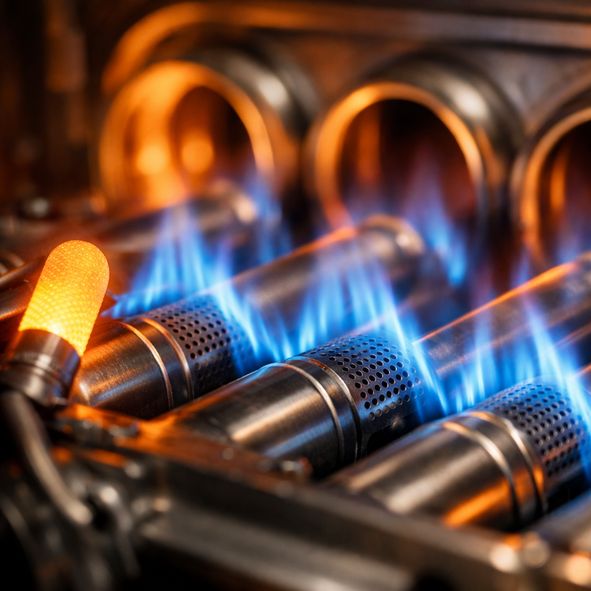
Several symptoms indicate that a furnace should be inspected by a Red Seal technician without delay. Yellow or orange burner flames (instead of crisp blue) indicate incomplete combustion and potential CO production. A persistent sulphur or metallic smell from the vents suggests combustion byproducts are entering the airstream — a heat exchanger crack must be ruled out immediately. Frequent cycling (the furnace turning on and off in short intervals) points to an overheating condition caused by restricted airflow or a failing limit switch. Unusual noises — banging at startup (delayed ignition), scraping or grinding (blower wheel contact), or high-pitched squealing (bearing failure) — all indicate mechanical issues requiring diagnosis. Any carbon monoxide detector alarm in the home should be treated as an emergency: evacuate all occupants, leave the door open, and call both BC Gas Emergency (1-800-663-9911) and your HVAC service provider from outside the building.
What is a heat exchanger, and why is a cracked one so dangerous?
The heat exchanger is the most critical safety component in any gas furnace. It is a series of steel or stainless steel cells that separate the combustion process (burning gas and its byproducts, including carbon monoxide) from the circulated air that flows through your ductwork and into your living spaces. Under normal operation, combustion gases flow inside the heat exchanger cells, heat is transferred through the steel walls to the air flowing over the outside of the cells, and the combustion gases exit safely through the flue vent. When a heat exchanger develops a crack — caused by metal fatigue from thousands of thermal expansion and contraction cycles, by overheating from restricted airflow, or by corrosion — combustion gases including carbon monoxide can be drawn through the crack and directly into the air supply. CO is colourless, odourless, and lethal at concentrations above 400 parts per million with extended exposure. A furnace with a confirmed cracked heat exchanger must be shut down immediately and either the heat exchanger replaced or the furnace decommissioned. This is not a repair that should be deferred or debated — it is a life-safety matter.
Are there BC government rebates available for furnace maintenance or replacement in 2024–2025?
Direct rebates for routine furnace maintenance are not available through BC government programs, as these programs are structured around equipment upgrades rather than service. However, significant rebates are available for qualifying equipment replacements and upgrades. FortisBC’s Home Efficiency Rebate program currently offers up to $1,000 for replacement of a furnace with an ENERGY STAR certified high-efficiency model (96% AFUE or higher). The CleanBC Better Homes program offers rebates of $3,000 to $9,000 for homeowners replacing gas heating systems with cold-climate heat pumps, and an additional $500 to $1,000 for smart thermostats and ancillary upgrades. The Canada Greener Homes Grant (where still active in BC) has provided up to $5,600 in federal funding for qualifying retrofits including heat pump installations. BCRC’s team stays current on all available provincial and federal programs and will assess your eligibility during any installation consultation at no charge. Rebate programs are updated annually, and availability can change — we recommend contacting us for the most current information applicable to your specific situation and postal code.
The BCRC Commitment: Red Seal Standards, Local Knowledge, Total Peace of Mind
Your furnace is not simply an appliance — it is the thermal foundation of your family’s comfort, safety, and health through every Vancouver winter. It deserves the attention of technicians who hold it to the same standard of care that a Red Seal certification demands: technically rigorous, safety-first, and grounded in a genuine understanding of the specific climate, housing stock, and energy landscape of Greater Vancouver. At BCRC Heating and Cooling, every maintenance visit, every installation, and every emergency service call is performed by certified professionals who live and work in the same communities they serve — from Langley and Surrey to North Vancouver, Burnaby, Coquitlam, Richmond, and the City of Vancouver itself. We carry full insurance, maintain active BC Safety Authority recognition, and back all of our work with written warranty coverage. Whether you need a comprehensive annual tune-up, an urgent no-heat diagnostic, or expert guidance on upgrading your aging system to a high-efficiency condensing furnace or dual-fuel hybrid setup, our team is ready. For trusted, Red Seal certified furnace repair in Vancouver and across the entire Lower Mainland, contact the local experts at BCRC Heating and Cooling today at (604) 781-7272 — because a warm, safe home is not a luxury, it is what you deserve.