



Fix Dry Winter Air: Humidifiers vs Whole-Home Systems
Why Is Winter Air So Dry in Vancouver and the Lower Mainland?
Quick Answer: Despite Vancouver’s coastal reputation for dampness, forced-air heating systems dramatically reduce indoor relative humidity (RH) during cold snaps, dropping RH below 25%—well under the recommended 35–50% range. Dry indoor air causes static shocks, cracked wood flooring, respiratory irritation, and elevated viral transmission risk.
The Lower Mainland’s heating season runs roughly October through April, and while outdoor air carries coastal moisture, your furnace or heat pump system heats that air rapidly—shrinking its relative humidity as temperature rises. A damp 5°C day outdoors can translate to bone-dry 18% RH indoors once that air is heated to 21°C. The physics are unforgiving. As a field technician operating across Burnaby, Richmond, Coquitlam, Surrey, and Vancouver, I see the same pattern every winter: homeowners attributing dry skin, nosebleeds, and persistent static electricity to everything except their HVAC system’s humidity management—or lack thereof.
What Are the Real Health and Structural Consequences of Low Indoor Humidity?
Quick Answer: Sustained indoor RH below 30% causes cracked hardwood floors, warped cabinetry, aggravated asthma and eczema, increased airborne viral particle survival, and accelerated wear on rubber seals inside your HVAC equipment—all measurable, preventable, and addressable with the right humidification strategy.
From a building science standpoint, wood materials equilibrate to ambient moisture levels. In a Lower Mainland home with engineered hardwood or solid wood flooring, sustained low humidity causes tangible contraction gaps between boards. Structurally, door frames and window casings can warp enough to compromise sealing, increasing heat loss and drafts. More critically, mucous membranes dry out, reducing your body’s first-line defence against airborne pathogens. ASHRAE Standard 62.1 targets 30–60% RH for occupied spaces—your home should be no different.
Portable Humidifiers vs. Whole-Home Systems: Which Actually Works?
Quick Answer: Portable humidifiers treat one room at a time and require daily maintenance. Whole-home systems integrate directly with your furnace or air handler, automatically maintaining target RH across all zones simultaneously—with no daily refilling, no mould risk from stagnant water tanks, and minimal maintenance requirements.
Portable Humidifiers: Honest Technical Assessment
Portable units—whether ultrasonic, evaporative, or warm-mist—output between 1 and 9 gallons of moisture per day. Ultrasonic models are energy-efficient but disperse white mineral dust from hard water, coating surfaces and degrading indoor air quality. Evaporative models use a wicking filter that, if not cleaned every 48–72 hours, becomes a mould and bacteria colony. Warm-mist units present a burn hazard in homes with children or pets.
For a standard Lower Mainland home of 1,800–2,500 sq ft with open-concept living, a single portable unit cannot maintain consistent RH throughout. You would need three to five units running simultaneously—each demanding daily water refills, weekly cleaning, and filter replacements. The cumulative maintenance burden is substantial, and RH stratification between rooms remains a persistent problem.
Whole-Home Bypass Humidifiers
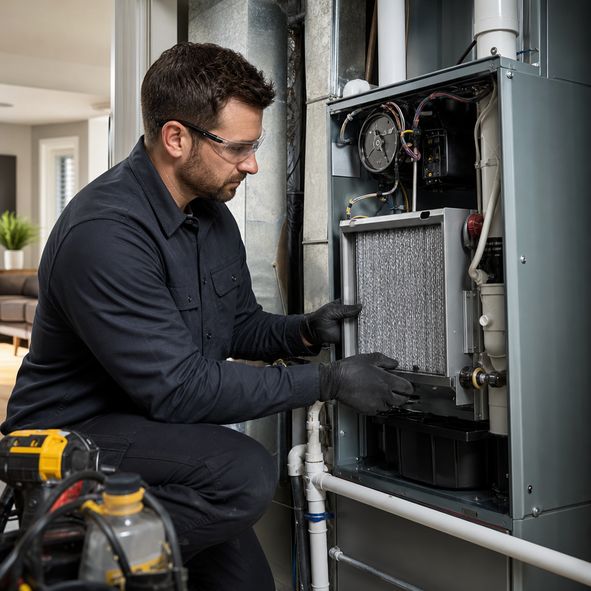
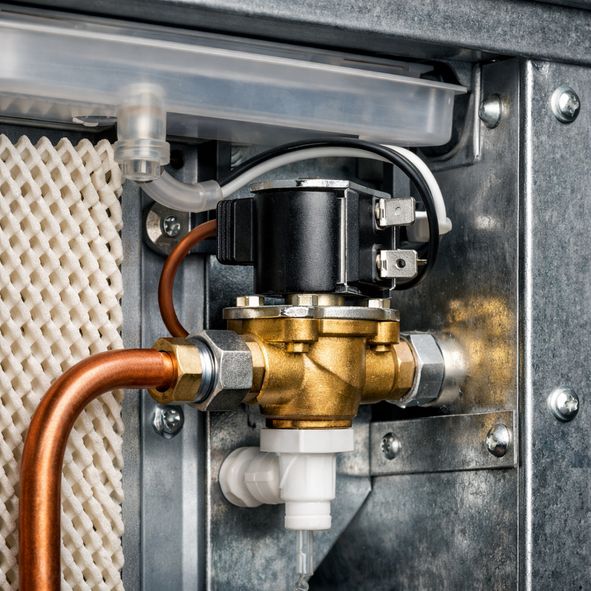
A bypass humidifier mounts directly on the supply or return plenum of your existing forced-air system. Warm air from the furnace passes through a water-saturated evaporator pad (also called a water panel), picks up moisture, and distributes it through your existing ductwork. A 24V solenoid valve, controlled by a humidistat, opens automatically when the furnace fires and RH falls below your set point.
Bypass models from manufacturers like Aprilaire (models 500, 600) and GeneralAire are sized by gallons-per-day (GPD) output. For a well-insulated 2,000 sq ft Lower Mainland home, a unit rated at 12–17 GPD is typically adequate. Sizing requires factoring in ceiling height, construction tightness (ACH50 from a blower door test), and your furnace’s airflow capacity in CFM. A technician performing a proper Manual J-equivalent humidity load calculation accounts for all infiltration points.
Whole-Home Flow-Through (Drum-less) Humidifiers
Flow-through humidifiers continuously drain a small amount of water to prevent mineral buildup, eliminating the stagnant water and mould risk entirely. They are ideally suited to the Lower Mainland’s moderately hard municipal water supply. Annual maintenance involves replacing the water panel—a 15-minute task during your seasonal tune-up.
Steam Humidifiers: Maximum Precision and Output
For larger homes exceeding 3,500 sq ft, heritage properties with high ceiling volumes, or homeowners requiring precise RH control (e.g., those with musical instruments, wine collections, or medical equipment), electrode steam humidifiers like the Aprilaire 800 or Nortec HumiSteam deliver up to 34.6 GPD with RH accuracy of ±3%. Steam units operate independently of furnace run cycles, meaning they humidify even when only your heat pump or fan is running—critical for variable-speed modulating systems that run at lower capacity for longer durations.
| Feature | Portable Humidifier | Bypass Whole-Home | Flow-Through Whole-Home | Steam Whole-Home |
|---|---|---|---|---|
| Coverage Area | Single room | Whole home | Whole home | Whole home (large) |
| Daily Maintenance | High (daily refill, cleaning) | Low (annual panel swap) | Very Low (annual panel swap) | Very Low (annual electrode check) |
| Mould/Bacteria Risk | High (stagnant reservoir) | Low | Very Low (continuous drain) | Negligible (boiled steam) |
| RH Consistency | Poor (room-by-room) | Good | Good | Excellent (±3%) |
| Integration with HVAC | None | Full (furnace-dependent) | Full (furnace-dependent) | Full (independent operation) |
| Mineral Dust Output | High (ultrasonic) | None | None | None |
| Technical Safety BC Compliance | N/A | Required for gas line tap | Required for gas line tap | Required (electrical + plumbing) |
| Best Suited For | Renters, temporary fix | Homes up to 3,000 sq ft | Homes up to 3,000 sq ft | Homes over 3,000 sq ft |
How Is a Whole-Home Humidifier Properly Sized and Installed?
Quick Answer: Proper sizing uses a humidity load calculation based on home square footage, ceiling height, construction tightness (ACH), and local design conditions. In the Lower Mainland, ASHRAE design conditions at -8°C outdoor dry-bulb guide the calculation. Installation requires Technical Safety BC permits when tapping into gas or electrical systems.
Installation of a bypass or flow-through humidifier involves cutting into the supply and return plenums, running a dedicated saddle-valve water line (typically 1/4-inch copper to the nearest cold supply), routing a drain line to the nearest floor drain, and wiring the humidistat to the furnace control board’s HUM terminal. On modern two-stage or variable-speed furnaces—common in Burnaby and Richmond new builds—the humidistat must be configured to activate only during heating calls to prevent over-humidification during low-stage operation.
Steam humidifiers require a dedicated 120V or 240V electrical circuit and must meet BC Electrical Code requirements. All work touching your gas appliance or electrical panel requires a licensed Gas Fitter or Electrician operating under Technical Safety BC jurisdiction. BCRC Heating and Cooling technicians carry all required BC certifications and pull permits on every installation—protecting your warranty and your home insurance coverage.
What Humidity Level Should You Target in a Lower Mainland Home?
Quick Answer: Target 35–45% RH indoors during winter. Below 30%, health and structural risks escalate. Above 50% during cold snaps, condensation forms on windows and within wall cavities—a serious mould risk in the Lower Mainland’s mild but persistently damp climate. A programmable humidistat adjusts set points automatically based on outdoor temperature.
Modern whole-home humidistats like the Aprilaire 62 or Honeywell HumidiPRO use outdoor temperature sensing to automatically reduce indoor RH set points as outdoor temperatures drop—preventing window condensation and interstitial moisture in wall assemblies. This outdoor temperature reset is non-negotiable in Lower Mainland homes with aluminum-framed windows or older vapor barriers.
Frequently Asked Questions
Can I install a whole-home humidifier on a heat pump system?
Yes, but only a steam humidifier operates reliably with a heat pump as the primary heating source. Bypass and flow-through models require the furnace blower to run and the heat exchanger to be active to evaporate water from the panel. In a heat pump-dominant system—increasingly common across Surrey and Coquitlam with BC’s electrification push—a steam unit operates independently of the air handler run cycle, maintaining target RH regardless of heating source.
My new variable-speed furnace runs almost continuously at low speed. Will that affect humidifier performance?
This is one of the most common installation oversights we see in the field. Variable-speed modulating furnaces running at 30–40% capacity move lower air volumes at reduced temperatures across the evaporator pad—significantly reducing a bypass humidifier’s effective GPD output. The solution is either upsizing to a higher-capacity bypass model, switching to a flow-through design with a larger water panel, or installing a steam humidifier. A technician must verify CFM at the plenum and derate the humidifier’s rated GPD accordingly.
How often does a whole-home humidifier need servicing?
Bypass and flow-through models require annual water panel replacement—typically performed during your fall furnace tune-up. In the Lower Mainland, municipal water hardness averages 50–80 mg/L (moderately soft), which means mineral scaling on panels is slower than in interior BC communities. Steam humidifier electrodes should be inspected annually and replaced every two to three seasons depending on water quality and runtime hours. The solenoid valve and drain line should be inspected for sediment blockage at every service visit.
Is there a risk of mould from adding humidity to my home?
Only if the system is oversized, improperly controlled, or installed without outdoor temperature reset capability. A correctly sized and commissioned whole-home humidifier, set to 35–45% RH with outdoor temperature compensation active, will not cause window condensation or wall cavity moisture issues in a properly air-sealed Lower Mainland home. The far greater mould risk comes from portable humidifiers with stagnant water reservoirs running unattended—or from doing nothing and allowing occupants to over-humidify with multiple portable units without any RH monitoring.
Take Control of Your Indoor Air Quality This Winter
Dry winter air is not a minor inconvenience—it is a measurable threat to your health, your home’s structural integrity, and the longevity of your HVAC equipment. For Lower Mainland homeowners in Vancouver, Burnaby, Richmond, Coquitlam, and Surrey, a properly sized and installed whole-home humidification system is the single most impactful indoor air quality upgrade you can make this heating season. Portable units are a temporary workaround, not a solution.
The BCRC Heating and Cooling field team performs complete on-site humidity load assessments, reviews your existing furnace or heat pump configuration, and recommends the correctly sized humidification system for your specific home—installed to Technical Safety BC standards with full permits and documentation. Do not let another dry winter season damage your floors, your sinuses, or your family’s comfort.
Call BCRC Heating and Cooling today at (604) 781-7272 to schedule your on-site technical inspection and humidification assessment. Serving Vancouver, Burnaby, Richmond, Coquitlam, Surrey, and the entire Lower Mainland.