


Fall HVAC Maintenance Checklist: Metro Vancouver
Why Fall HVAC Maintenance Is Critical for Metro Vancouver Homeowners
Every year, as Metro Vancouver’s coastal humidity shifts into its signature damp, grey autumn, heating systems that sat idle all summer face their most demanding test. A thorough fall HVAC maintenance checklist is not optional for Lower Mainland homeowners — it is the single most impactful action you can take to ensure reliable comfort, peak energy performance, and Technical Safety BC compliance before the cold snaps arrive. Whether your home relies on a gas furnace, a heat pump, or a dual-fuel hybrid system, the pre-season inspection window between September and mid-November is your last practical opportunity to identify faults before peak heating demand locks up service schedules.
What Does a Professional Fall HVAC Inspection Actually Cover?
Quick Answer: A certified fall HVAC inspection covers combustion analysis, heat exchanger integrity, refrigerant charge verification, airflow diagnostics, electrical safety checks, thermostat calibration, and a full filter and duct assessment — all benchmarked against Technical Safety BC standards and manufacturer warranty requirements.
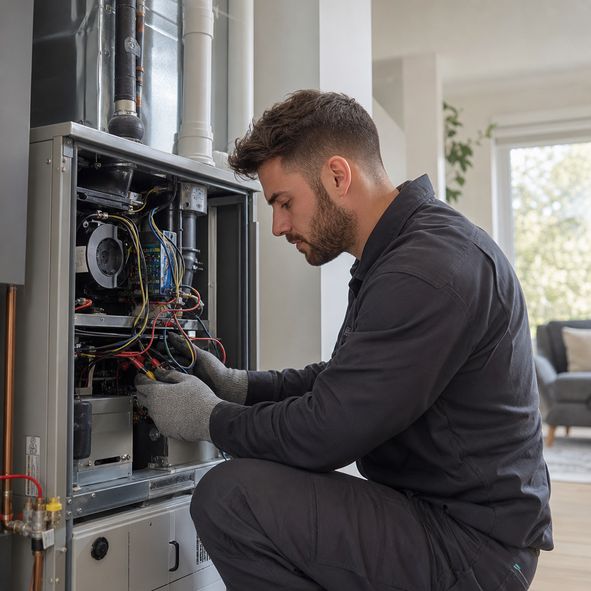
Many homeowners underestimate the scope of a genuine pre-season inspection versus a basic filter swap. A Red Seal HVAC technician approaching your system in the fall will methodically work through the following layers of technical assessment:
- Heat Exchanger Integrity: Cracked heat exchangers are the leading cause of carbon monoxide intrusion in Metro Vancouver homes. A technician uses combustion gas analyzers and differential pressure testing to confirm that flue gases remain entirely separated from your conditioned airspace — a non-negotiable Technical Safety BC requirement.
- Combustion Analysis: For gas furnaces, achieving optimal CO₂-to-O₂ ratios ensures complete combustion, maximizing your AFUE (Annual Fuel Utilization Efficiency) rating. A furnace rated at 96% AFUE performing at 88% due to poor combustion tuning is a preventable efficiency loss.
- Refrigerant Charge and Coil Condition (Heat Pumps): Air-source heat pumps operating in BC’s coastal climate must maintain precise refrigerant charge levels. Even a minor undercharge degrades HSPF2 (Heating Seasonal Performance Factor) ratings and forces the system into auxiliary resistance heat earlier than engineered thresholds — dramatically reducing efficiency during cold snaps.
- Electrical Component Testing: Capacitors, contactors, inducer motor windings, and control board diagnostics are checked under load. A failed start capacitor discovered in October during an inspection costs far less in disruption than a no-heat call in January.
- Airflow and Static Pressure Measurement: Using a digital manometer, technicians verify that external static pressure falls within the manufacturer’s specified range. Excessive static pressure from undersized ductwork or clogged coils forces variable-speed ECM blower motors to overwork, shortening motor lifespan.
Furnace Efficiency Ratings: What Metro Vancouver Homeowners Must Understand Before Winter
Quick Answer: In Metro Vancouver’s mild but persistently damp climate, a modulating gas furnace rated at 96%+ AFUE with a variable-speed ECM blower delivers the most consistent comfort and indoor humidity control. Single-stage furnaces cycle aggressively and are poorly matched to BC’s shoulder-season temperature patterns.
When your technician evaluates your existing furnace or recommends a replacement during a fall inspection, the conversation will centre around three performance tiers:
| System Type | AFUE Range | Stage Control | Best Application | Lower Mainland Humidity Control | Warranty Complexity |
|---|---|---|---|---|---|
| Single-Stage Gas Furnace | 80–92% | On/Off only | Small, well-insulated homes | Poor — wide temp swings | Standard; less maintenance-sensitive |
| Two-Stage Gas Furnace | 92–96% | Low/High fire | Mid-size Lower Mainland homes | Moderate — reduced cycling | Requires annual professional service |
| Modulating/Variable Gas Furnace | 96–98.5% | 40–100% modulation | Larger homes, open floor plans | Excellent — near-continuous low-fire | Mandatory annual inspection for full warranty |
| Air-Source Heat Pump (HSPF2) | HSPF2 8.5–13+ | Variable inverter compressor | Mild coastal BC climates | Excellent with ERV integration | Semi-annual service; refrigerant certification required |
| Dual-Fuel Hybrid System | Combined peak efficiency | Automatic switchover | Homes with existing gas infrastructure | Excellent — best of both systems | Most complex; requires certified dual-fuel technician |
Heat Pump Fall Checklist: Unique Demands of BC’s Coastal Climate
Quick Answer: Fall heat pump maintenance in Metro Vancouver must address defrost cycle calibration, outdoor coil cleaning for coastal particulate buildup, refrigerant system leak detection, and HSPF2 verification — because BC’s damp cold is significantly harder on heat pump performance than dry continental cold at the same temperature.
Metro Vancouver’s coastal air carries salt aerosols, elevated particulate matter, and persistent moisture that accelerate outdoor coil fouling far faster than inland climates. During your fall heat pump inspection, a certified technician will:
- Inspect and professionally flush the outdoor coil with approved coil cleaner to restore full heat exchange surface area — a fouled coil can reduce heating capacity by up to 20%.
- Verify defrost board calibration. Incorrectly timed defrost cycles in BC’s above-freezing-but-damp temperature range (the 2°C to 7°C band that dominates Vancouver winters) are a primary cause of unnecessary auxiliary heat activation and compressor stress.
- Check refrigerant line insulation integrity. Exposed suction lines in BC’s wet conditions deteriorate rapidly, causing condensation losses that compromise system HSPF2 performance.
- Test auxiliary heat lockout settings. Properly configured dual-stage systems should engage resistance backup only below the engineered balance point — typically around -5°C to -8°C for modern cold-climate inverter units certified for BC conditions.
Indoor Air Quality: The Fall Maintenance Step Most Vancouver Homeowners Overlook
Quick Answer: Fall is the optimal time to upgrade filtration, inspect HRV/ERV systems, clean return air plenums, and test carbon monoxide detectors — because Metro Vancouver’s wet season dramatically increases mold spore counts and indoor air stagnation from closed-window living conditions.
As homes seal up for winter across Burnaby, Richmond, Coquitlam, Surrey, and the broader Lower Mainland, indoor air quality deteriorates rapidly without proactive intervention. Your fall HVAC maintenance checklist must include:
- Filter Upgrade Assessment: Evaluate whether your current filter MERV rating is appropriate for your blower motor’s static pressure tolerance. Jumping from MERV 8 to MERV 13 on a system not engineered for higher resistance can reduce airflow, cause coil freezing on heat pumps, and void equipment warranties.
- HRV/ERV Servicing: Heat Recovery Ventilators are essential in Metro Vancouver’s tight modern homes. Fall service includes core cleaning, defrost sensor testing, and airflow balancing to ensure the unit meets ASHRAE 62.2 ventilation standards without over-pressurizing or depressurizing the building envelope.
- Carbon Monoxide Detector Testing and Placement Verification: Technical Safety BC mandates CO detectors on every level of a home with fuel-burning appliances. Fall is the time to test battery backup, verify placement height, and replace units older than seven years.
- Duct Leakage Assessment: In Metro Vancouver’s variable pressure climate, duct leakage to unconditioned crawlspaces draws in cold, damp air and mold spores directly into your breathing air. A duct blaster test or infrared scan identifies leakage points requiring sealing before winter.
Thermostat and Controls: Fall Calibration for BC’s Variable Weather Patterns
Quick Answer: Fall thermostat calibration for Metro Vancouver homes should include setback schedule optimization for BC’s shoulder-season temperature swings, heat pump auxiliary lockout verification, and smart thermostat geofencing configuration — ensuring the system responds intelligently to the unpredictable coastal autumn weather.
Modern communicating thermostats paired with modulating furnaces or inverter heat pumps offer granular control that generic scheduling cannot achieve. During fall commissioning, your BCRC technician will verify that balance point settings, emergency heat lockouts, and humidity control parameters align with your specific equipment’s engineering specifications and your home’s Manual J load calculation profile.
Frequently Asked Questions: Fall HVAC Maintenance in Metro Vancouver
How often should a gas furnace be professionally serviced in BC?
Gas furnaces in Metro Vancouver should receive a certified professional inspection and tune-up every year, without exception. Most manufacturer warranties — particularly on modulating two-stage and variable-speed systems — explicitly require documented annual professional service to remain valid. Technical Safety BC regulations also require that all gas appliance work be performed by a licensed Gas Fitter. Attempting to self-service a gas furnace beyond basic filter replacement voids warranty coverage and creates significant safety liability.
Can I run my heat pump through a Metro Vancouver winter without a fall inspection?
Technically yes — but it is inadvisable and potentially costly in reliability terms. BC’s coastal winter places unique stress on heat pump refrigerant circuits, defrost systems, and outdoor coil surfaces. An uninspected unit entering winter with a marginal refrigerant charge, a fouled coil, or a miscalibrated defrost board will operate inefficiently, engage auxiliary heat excessively, and risk compressor damage during extended cold snaps — the exact conditions that most stress the system.
What is a Manual J load calculation and do I need one for my Vancouver home?
A Manual J load calculation is the ACCA-standard engineering method for determining the precise heating and cooling capacity — measured in BTUs per hour — that your specific home requires based on floor area, insulation values, window types, orientation, infiltration rates, and local climate data. Every Metro Vancouver home that is replacing or upgrading HVAC equipment should have a Manual J performed. Oversized systems short-cycle aggressively, fail to dehumidify properly in BC’s damp conditions, and wear out faster. Undersized systems run continuously and cannot maintain comfort during cold snaps.
What are the signs my furnace heat exchanger may be cracked and dangerous?
Warning signs of a cracked heat exchanger include: a CO detector alarm or elevated CO readings, visible soot or rust streaks around the furnace cabinet exterior, a strange smell when the furnace first fires, occupants experiencing headaches or nausea that resolve when leaving the home, or the furnace burner flame visibly flickering when the blower motor activates. Any of these signs require an immediate shutdown of the furnace and an emergency call to a licensed Gas Fitter. Do not attempt to operate a furnace with a suspected cracked heat exchanger under any circumstances.
Book Your Fall HVAC Inspection with BCRC Heating and Cooling
Metro Vancouver’s coastal climate does not forgive deferred maintenance. As a homeowner in Vancouver, Burnaby, Richmond, Coquitlam, Surrey, or anywhere across the Lower Mainland, your heating system’s reliability this winter depends entirely on the quality of preparation you invest in this fall. At BCRC Heating and Cooling, our Red Seal certified HVAC technicians perform comprehensive, technically rigorous pre-season inspections covering combustion safety, refrigerant system integrity, airflow diagnostics, IAQ assessment, and full Technical Safety BC compliance verification — on every make and model of residential heating equipment.
Do not wait for the first cold snap to discover a problem that should have been caught in October. Call BCRC Heating and Cooling today at (604) 781-7272 to schedule your on-site fall HVAC inspection and technical assessment. Our team serves the entire Lower Mainland and is ready to ensure your home enters winter with a heating system performing at its engineered peak — safely, reliably, and efficiently.