



Extended Warranties & Maintenance Plans: Worth It?
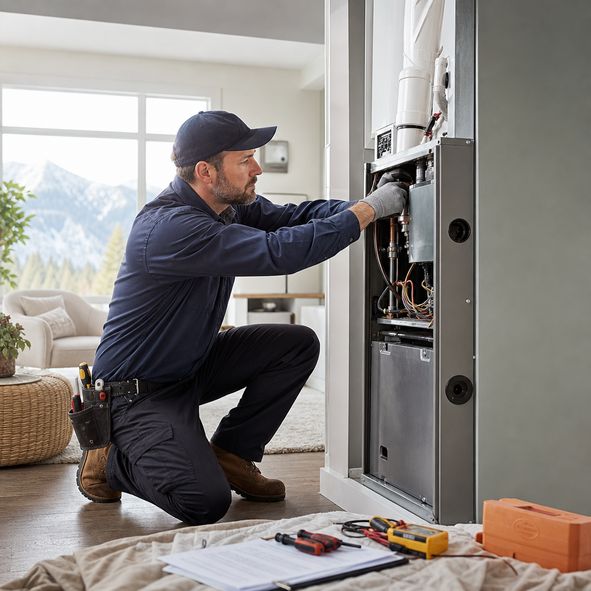
Are Extended Warranties and Maintenance Plans Worth It for Your HVAC System?
When investing in a new furnace, heat pump, or air conditioning system for your Lower Mainland home, the question of extended warranties and maintenance plans comes up almost immediately. For Vancouver-area homeowners dealing with coastal humidity, damp cold snaps, and year-round system demands, the answer is rarely straightforward — and the stakes are high. This guide breaks down exactly what these programs cover, what they miss, and how to make a technically sound decision for your specific equipment and climate.
What Is the Difference Between a Manufacturer Warranty and an Extended Warranty?
Direct Answer: A manufacturer warranty covers factory defects for a fixed term — typically five to ten years on parts. An extended warranty or service contract adds coverage beyond that window, often including labour, diagnostic fees, and refrigerant handling — protections the standard warranty never includes.
Most major HVAC manufacturers — Lennox, Carrier, Daikin, Mitsubishi, Trane — offer tiered warranty structures. A standard registered limited warranty usually covers the heat exchanger (on furnaces) for up to 20 years and functional parts for five years. However, this coverage applies strictly to manufacturing defects, not wear-and-tear, refrigerant leaks caused by vibration fatigue, or labour costs to diagnose and replace covered components.
Extended warranties — sometimes called extended service agreements or protection plans — bridge that gap. When evaluating one, a Red Seal technician will examine: whether labour and refrigerant are included, whether the plan is transferable to a new owner, and critically, whether the warranty requires proof of annual professional maintenance to remain valid. In BC, many manufacturers explicitly state that failure to maintain the unit with a qualified Gas Fitter or Refrigeration Mechanic can void coverage entirely.
How Does Lower Mainland Climate Affect HVAC Warranty Considerations?
Direct Answer: Vancouver’s coastal humidity, mild but damp winters, and increasingly hot summers accelerate corrosion on heat exchangers, coil fins, and electrical contacts. This climate-specific wear pattern makes warranty and maintenance coverage more valuable here than in drier inland regions.
The Lower Mainland sits in a temperate maritime zone — winters rarely drop below -10°C, but persistent moisture and salt-laden air from the Pacific create conditions that degrade HVAC components faster than the national average. Evaporator coils on ducted heat pumps and central air conditioners are particularly vulnerable to microbial buildup and fin corrosion. Furnace heat exchangers in poorly ventilated crawlspace installations — common across Burnaby, Richmond, and Coquitlam — face elevated condensation stress.
For variable-speed modulating systems (inverter-driven heat pumps with HSPF2 ratings above 9.5, or two-stage furnaces with AFUE ratings of 96%+), the control board, inverter module, and communicating thermostat integration add layers of electronic complexity. These components are significantly more expensive to replace than those in single-stage systems — making extended coverage on high-efficiency equipment proportionally more valuable.
What Should a Quality HVAC Maintenance Plan Actually Include?
Direct Answer: A technically rigorous maintenance plan should include combustion analysis, heat exchanger inspection, refrigerant charge verification (superheat/subcooling), electrical connection torquing, and filter system service — not just a visual walkthrough and filter swap.
Here is what a Red Seal-certified technician should perform during a comprehensive annual or bi-annual maintenance visit in the Lower Mainland:
- Combustion Analysis: Measuring CO, CO₂, and flue gas temperature on gas furnaces and boilers to confirm safe operation within Technical Safety BC standards.
- Heat Exchanger Inspection: Visual and pressure-differential testing to identify micro-cracks that allow combustion gases to enter living spaces — a critical safety requirement under BC Fire Code.
- Refrigerant Circuit Diagnostics: Verifying superheat and subcooling values on heat pumps and AC systems to identify low charge or metering device issues before compressor damage occurs.
- Electrical Safety Check: Torquing all terminal connections, testing capacitor microfarad ratings, and measuring blower motor amperage draw against nameplate specifications.
- Manual J Load Verification: On newly installed systems, confirming the installed BTU capacity aligns with the original load calculation — oversized or undersized systems cycle abnormally, reducing efficiency and lifespan.
- Airflow and Static Pressure Testing: Measuring external static pressure against the system’s design specifications to identify duct restrictions, dirty coils, or mismatched blower performance.
- SEER2/HSPF2 Performance Benchmarking: Logging operational data to confirm the system is achieving its rated efficiency metrics under real-world conditions.
Comparison: Manufacturer Warranty vs. Extended Warranty vs. Maintenance Plan
| Feature | Standard Manufacturer Warranty | Extended Warranty / Service Agreement | Annual Maintenance Plan |
|---|---|---|---|
| Parts Coverage | Yes (defects only) | Yes (defects + select failures) | No (service only) |
| Labour Coverage | No | Yes (typically included) | Included in visit scope |
| Refrigerant Coverage | No | Often included | Diagnostic included; recharge extra |
| Combustion Safety Check | No | No | Yes — mandatory for gas systems |
| Technical Safety BC Compliance | No active support | No active support | Yes — certified technician required |
| Keeps Manufacturer Warranty Valid | N/A | Requires maintenance proof | Yes — provides required documentation |
| Covers Variable-Speed Electronics | Partial (factory defect) | Yes (broader failure coverage) | Diagnostic and preventive care |
| Transferable to New Owner | Sometimes | Often yes — adds resale value | Plan typically non-transferable |
| Ideal For | New installations, first 5 years | High-efficiency, complex systems | All systems, all ages |
When Is an Extended Warranty Particularly Justified?
Direct Answer: Extended warranties deliver the most technical and financial protection on variable-speed inverter heat pumps, two-stage furnaces with communicating controls, and ducted mini-split systems — equipment where a single control board or inverter module failure represents a significant repair event.
Single-stage systems with simpler control architectures — a basic PSC blower motor, a single-stage gas valve, a non-communicating thermostat — carry lower component replacement complexity. The calculus changes significantly with modulating equipment. A variable-capacity heat pump rated at SEER2 20+ or HSPF2 10+ relies on an inverter-driven compressor, communicating controls, and sophisticated defrost logic that must function precisely in Vancouver’s cool, humid winters. These components, while highly reliable when properly maintained, carry higher individual replacement complexity than their single-stage counterparts.
Similarly, 96%+ AFUE two-stage condensing furnaces use induced draft motors, secondary heat exchangers, pressure switches, and modulating gas valves — each representing a potential failure point that a solid extended service agreement can address without an emergency service call.
Frequently Asked Questions
Does skipping annual maintenance actually void my HVAC warranty in BC?
Yes — most manufacturers require documented proof of annual professional maintenance performed by a qualified technician to honour warranty claims on major components. In BC, this means a Gas Fitter (B-ticket or A-ticket) for gas appliances, or a Refrigeration Mechanic for heat pumps and AC systems. Gaps in service records give manufacturers legitimate grounds to deny claims, particularly on heat exchangers and compressors.
Are maintenance plans from HVAC dealers more reliable than third-party extended warranties?
Generally, yes. Dealer-based maintenance plans are fulfilled by the same certified technicians who installed your system and understand its specific configuration, duct layout, and load calculation data. Third-party extended warranty companies may use subcontracted labour with less familiarity with your system’s SEER2/HSPF2 performance benchmarks and Technical Safety BC compliance requirements.
How often should a heat pump be professionally serviced in the Lower Mainland?
Bi-annual service — once in spring before cooling season and once in fall before heating season — is the Red Seal standard recommendation for ducted heat pumps operating in the Lower Mainland. The coastal humidity and year-round operation cycle mean coil fouling, refrigerant charge drift, and electrical connection degradation occur faster than in drier climates. Annual minimum service is non-negotiable for warranty compliance.
What is the biggest technical risk of running an HVAC system without a maintenance plan?
The highest-risk failure mode is an undetected heat exchanger crack on a gas furnace, which allows combustion byproducts — including carbon monoxide — to enter the living space. This is a Technical Safety BC reportable hazard. A secondary high-risk scenario is low refrigerant charge on a heat pump running into compressor overload — a failure that escalates from a minor refrigerant top-up into a full compressor replacement if left undetected through one full heating season.
Making the Right Decision for Your Lower Mainland Home
Extended warranties and maintenance plans are not upsells — when properly structured and fulfilled by Red Seal certified technicians, they are engineered reliability tools that protect complex, efficiency-rated HVAC investments operating under the specific demands of Vancouver’s coastal climate. The technical evidence is clear: systems on documented maintenance schedules consistently achieve longer operational lifespans, sustain their SEER2 and HSPF2 rated performance deeper into their service life, and produce zero lapses in Technical Safety BC compliance documentation. For every homeowner in Burnaby, Richmond, Surrey, Coquitlam, or the broader Lower Mainland running a modern variable-speed or two-stage system, a comprehensive maintenance plan paired with an extended service agreement is not optional — it is the technically responsible standard. For reliable, Red Seal certified furnace installation in Vancouver and expert HVAC maintenance plan guidance across the Lower Mainland, contact the local professionals at BCRC Heating and Cooling directly at (604) 781-7272.