


Expert Boiler Services in Burnaby | BCRC
The Quiet Powerhouse Beneath Your Burnaby Home
On a damp November morning in Burnaby, when the temperature drops and the Pacific mist rolls in off Burrard Inlet, there is one appliance working silently and relentlessly to keep your home genuinely comfortable — your boiler. Unlike forced-air furnaces that blast dry, recirculated air through ducts, a properly serviced hydronic boiler delivers radiant heat that warms walls, floors, and bodies with a deep, even consistency that forced-air systems simply cannot replicate. It is, in every sense, a quiet miracle of thermodynamic engineering. Yet like all mechanical marvels, a boiler demands expert attention to perform at its peak — and that is precisely where BCRC Heating and Cooling steps in as Burnaby’s most trusted hydronic heating specialists.
Ancient Roots: The Engineering Legacy Behind Modern Boilers
To truly appreciate the sophisticated hydronic systems heating Burnaby homes today, it helps to understand the remarkable 2,000-year engineering journey that produced them. The Romans, with characteristic ingenuity, pioneered the first large-scale radiant heating system known as the hypocaust — an underfloor network of hollow columns and wall channels through which heated air from wood-fired furnaces would circulate, warming the floors of bathhouses, villas, and public buildings across the empire. The fundamental principle — using a heat-transfer medium to distribute thermal energy through a structure — remains the philosophical ancestor of every modern boiler system.
By the medieval period, rudimentary steam systems were being explored in European foundries and workshops, primarily for industrial processes. It was the Industrial Revolution of the 18th and 19th centuries, however, that transformed heat distribution from an architectural luxury into a scalable, residential engineering discipline. Cast-iron sectional boilers began appearing in factories and grand public buildings, establishing the template for the central heating systems that would eventually find their way into North American homes throughout the early 20th century.
Industrial Breakthroughs: From the Geyser to the Modern Gas Boiler
The critical leap from industrial steam apparatus to practical residential heating came through a series of bold inventions. In 1868, London-based painter and inventor Benjamin Waddy Maughan created the first instantaneous domestic water heater, which he called the Geyser — a gas-fired device that heated water on demand without the need for a storage vessel. While Maughan’s invention was rudimentary and lacked the safety controls we take for granted today, it established the foundational concept of gas combustion as a viable residential heat source.
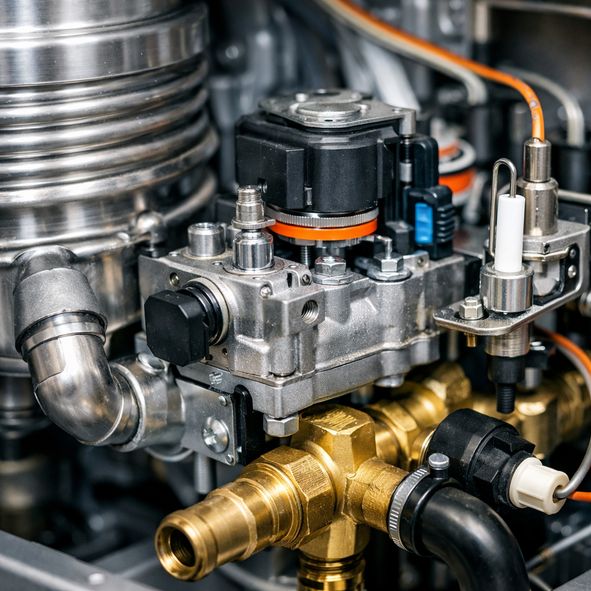
Norwegian-American engineer Edwin Ruud took the next transformative step in 1889, patenting the first automatic, storage-based water heater in Pittsburgh. Ruud’s design incorporated a thermostatically controlled gas burner, a flue for combustion gases, and an insulated storage tank — a configuration that formed the template for gas-fired boilers and water heaters for the next century. His work demonstrated that controlled combustion could be made safe, automated, and reliable enough for everyday homeowners. By the early 1900s, hydronic boiler systems based on these principles were being installed in upscale North American residences, delivering steam and hot water heat through cast-iron radiators that many Burnaby heritage homes still feature today.
20th-Century Standardization and the Rise of Residential Hydronic Systems
The post-World War II housing boom transformed boiler technology from a premium luxury into a residential standard across Canada. As Burnaby grew rapidly through the 1950s and 1960s — with the development of neighborhoods like Metrotown, Burnaby Heights, and Capitol Hill — hydronic heating systems became the dominant choice for multi-family apartment buildings, townhomes, and larger single-family residences. Cast-iron boilers gave way to steel heat exchangers; atmospheric burners were refined with draft-induction technology; and the introduction of copper finned-tube baseboard radiators made hydronic systems more compact and affordable to install.
The oil crises of the 1970s were the catalyst for the next major technological leap. With fuel costs spiking dramatically, the HVAC industry was forced to radically re-engineer combustion efficiency. The introduction of high-efficiency condensing boilers in the late 1970s and early 1980s represented a quantum leap: by extracting latent heat from flue gases through a secondary heat exchanger and allowing those gases to condense before exhausting, condensing boilers achieved Annual Fuel Utilization Efficiency (AFUE) ratings above 90% — compared to the 60–70% typical of older atmospheric designs. BC Gas (now FortisBC) began incentivizing high-efficiency upgrades, setting the stage for the modern boiler landscape Burnaby homeowners navigate today.
The Modern Era: Modulating Condensing Technology and Smart Wi-Fi Diagnostics
Today’s premium residential boilers — brands like Navien, Viessmann, Bosch, and IBC Technologies — bear little resemblance to the cast-iron behemoths of previous generations. Modern condensing combi-boilers are wall-mounted, stainless-steel masterpieces capable of AFUE ratings of 95–98.5%. Their modulating burners continuously vary heat output from as low as 20% capacity to 100%, responding dynamically to actual heating demand rather than cycling on and off at full blast — a process called on/off cycling that wastes fuel and stresses components in older designs.
Smart controls and Wi-Fi-enabled thermostats like the Nest, Ecobee, and Honeywell T10 Pro now integrate seamlessly with modern boilers, allowing Burnaby homeowners to adjust heating schedules remotely, monitor system performance in real time, and receive diagnostic fault alerts before minor issues escalate into costly emergency repairs. Some advanced systems even incorporate outdoor reset controls — sensors that measure exterior temperature and automatically adjust boiler water supply temperature (the hydronic setpoint) to match heating demand with pinpoint precision, maximizing efficiency across Burnaby’s wide seasonal temperature range.
Heat Pump Water Heaters and Hydronic Heat Pumps: The Peak Efficiency Paradigm for BC Homeowners
The most exciting development in residential heating for Greater Vancouver homeowners is the rapid maturation of air-source heat pump technology applied to hydronic systems. Where a conventional gas boiler generates heat through combustion — an inherently less-than-100%-efficient process — a hydronic heat pump extracts ambient thermal energy from outdoor air and upgrades it to usable heating temperatures using a refrigerant cycle. Modern cold-climate heat pumps like the Mitsubishi Zuba-Central and Daikin Altherma operate effectively down to -25°C, making them viable in Burnaby’s temperate but occasionally frosty winters.
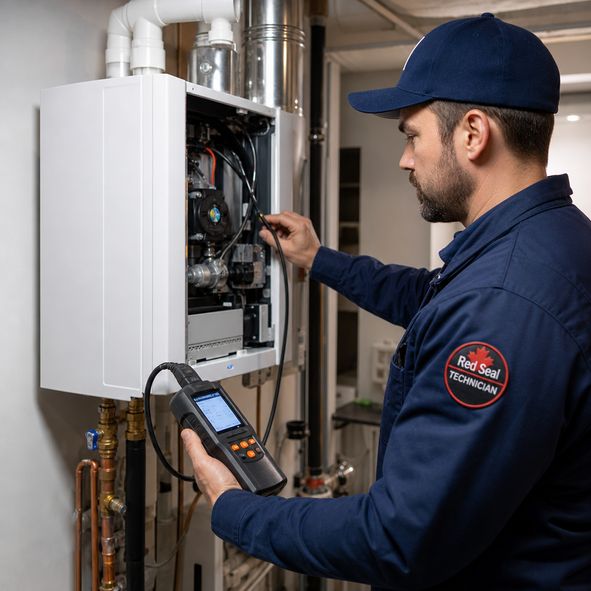
The efficiency advantage is staggering: while the best gas condensing boiler achieves roughly 98% combustion efficiency, a hydronic heat pump system delivers a Coefficient of Performance (COP) of 2.5 to 4.5 — meaning it delivers 2.5 to 4.5 units of heat energy for every unit of electrical energy consumed. Combined with BC Hydro’s relatively low electricity rates and CleanBC’s generous rebate programs (up to $6,000 for qualifying heat pump installations), the long-term economics increasingly favor the transition. BCRC’s Red Seal certified technicians are fully qualified to assess your existing hydronic distribution system and advise whether a heat pump retrofit or a high-efficiency condensing gas boiler is the optimal solution for your specific Burnaby home.
Boiler System Comparison: Choosing the Right Technology for Your Burnaby Home
| System Type | Efficiency Rating | Estimated Lifespan | Primary Fuel | Estimated Install Cost (CAD) | Best Application |
|---|---|---|---|---|---|
| Atmospheric Gas Boiler (Legacy) | 60–75% AFUE | 20–30 years | Natural Gas (FortisBC) | $3,500–$5,500 | Replacement in older Burnaby homes with existing cast-iron radiators |
| High-Efficiency Condensing Gas Boiler | 90–98.5% AFUE | 15–25 years | Natural Gas (FortisBC) | $5,000–$9,000 | Primary heating in well-insulated Burnaby single-family and multi-family |
| Condensing Combi-Boiler (Heat + DHW) | 95–98% AFUE | 15–20 years | Natural Gas (FortisBC) | $6,000–$10,500 | Space-limited Burnaby condos and townhomes needing combined heating and hot water |
| Electric Boiler | 99–100% (site efficiency) | 20–25 years | BC Hydro Electricity | $3,000–$6,500 | Homes without gas service; lower carbon footprint with BC’s hydroelectric grid |
| Hydronic Air-Source Heat Pump | COP 2.5–4.5 (250–450%) | 15–20 years | BC Hydro Electricity | $12,000–$22,000 | High-performance, low-emission heating for energy-conscious Burnaby homeowners; CleanBC rebate eligible |
Burnaby Homeowner Boiler Buying and Maintenance Guide
Coastal Climate Durability Considerations
Burnaby’s coastal climate — characterized by high humidity, mild but damp winters, and occasional freeze-thaw cycles — creates specific durability challenges for hydronic systems. Corrosion inhibitors are critically important in Burnaby’s soft, slightly acidic municipal water supply; without proper inhibitor concentration in the hydronic loop, aluminum heat exchangers in modern condensing boilers can experience accelerated pitting corrosion. BCRC technicians test and treat hydronic loop water chemistry at every annual maintenance visit. Additionally, stainless-steel condensate neutralizers are mandatory for condensing boilers discharging acidic condensate (pH 3.5–4.5) into Burnaby’s municipal drain system — an installation detail that less thorough contractors sometimes overlook.
Annual Maintenance Checklist: What BCRC Inspects at Every Service Call
- Combustion analysis (CO, CO2, O2 flue gas readings) to verify burner efficiency and safety
- Heat exchanger inspection for cracks, fouling, and corrosion
- Flue venting inspection for blockages, condensate drainage, and proper termination clearances per BC Fuel Gas Regulation
- Circulator pump operation, bearing condition, and impeller inspection
- Expansion tank pre-charge pressure verification (critical for system pressure stability)
- Pressure relief valve (PRV) test and inspection — a life-safety component
- Thermostat and zone valve calibration and operation test
- Hydronic loop water chemistry analysis and inhibitor top-up
- Condensate neutralizer media inspection and replacement if required
- Controls, ignition system, and safety lockout sequence verification
Frequently Asked Questions: Boiler Services in Burnaby
How often should my boiler be serviced in Burnaby?
Industry best practice and most boiler manufacturer warranty requirements specify annual professional maintenance for residential boilers. In Burnaby’s climate, the optimal service window is early autumn — September or October — before peak heating season demand. Annual servicing ensures combustion efficiency is maximized, safety devices are functioning correctly, and minor issues (such as a failing circulator pump bearing or a clogged condensate trap) are caught before they cause a mid-winter breakdown. Homeowners with combination boilers supplying both space heating and domestic hot water should consider semi-annual inspections given the year-round operational demands on the system.
What are the warning signs that my Burnaby boiler needs immediate repair?
Several symptoms warrant an immediate call to BCRC rather than a wait-and-see approach. Yellow or orange burner flames (instead of crisp blue) indicate incomplete combustion and potential carbon monoxide production — a serious life-safety emergency requiring immediate shutdown. Persistent pressure loss (system pressure dropping below 10 PSI repeatedly) suggests an active leak in the hydronic loop or a failed expansion tank. Kettling sounds — a rumbling or banging noise during operation — indicate limescale buildup on the heat exchanger, severely reducing efficiency and risking heat exchanger damage. Boiler lockout error codes on the display panel, water pooling around the unit, and zones that fail to heat despite the boiler firing are all indicators requiring professional diagnosis without delay.
Is it worth repairing my old boiler, or should I replace it entirely?
HVAC professionals use the ‘Rule of 5000’ as a practical decision-making framework: multiply the boiler’s age (in years) by the estimated repair cost. If the resulting figure exceeds $5,000, replacement is typically the more economically sound decision. Beyond the arithmetic, consider that an atmospheric boiler operating at 65% AFUE will cost roughly 35% more in annual gas bills than a modern 97% AFUE condensing unit on an equivalent heating load. With FortisBC gas prices in BC, that efficiency gap often represents $400–$900 per year in savings for a typical Burnaby single-family home — meaning a new high-efficiency boiler frequently pays for itself through energy savings and rebates within 5–8 years, before accounting for the elimination of ongoing repair costs on aging equipment.
Can BCRC help me access CleanBC rebates for a new boiler installation in Burnaby?
Absolutely — and this is one of the most valuable services BCRC provides beyond the technical installation work itself. Navigating BC’s layered rebate ecosystem (CleanBC Better Homes, FortisBC HER+, and occasionally federal Canada Greener Homes Grant credits) requires careful documentation, pre-approval applications, and equipment specification verification. Our team will confirm that the proposed equipment meets all program eligibility criteria before the job is quoted, prepare all required pre- and post-installation documentation, and submit rebate applications on your behalf where the program allows. Many Burnaby homeowners are surprised to discover they qualify for $1,500 to $3,000 in combined rebates on a qualifying high-efficiency condensing boiler replacement, substantially reducing net out-of-pocket installation costs.
Burnaby’s Boiler Experts: Why BCRC Heating and Cooling Is the Right Choice
BCRC Heating and Cooling has built its reputation across Greater Vancouver on a foundation of technical excellence, transparent pricing, and genuine accountability to every homeowner we serve. Our Red Seal certified gas fitters and hydronic technicians bring deep hands-on expertise with every major boiler brand — from Navien and Viessmann to IBC, Bosch, Weil-McLain, and Slant/Fin — ensuring your system is diagnosed and serviced to manufacturer specifications, not just patched to get through the season. We hold all required BC Safety Authority Gas Contractor licenses and carry full WCB and liability coverage, so you are fully protected on every job. Whether you need an urgent same-day boiler repair in Burnaby, a meticulously planned high-efficiency boiler installation, or a comprehensive annual maintenance agreement that keeps your hydronic system running flawlessly year after year, BCRC is ready to deliver. For trusted Red Seal certified boiler installation in Vancouver and throughout the Greater Vancouver region — including Burnaby, Coquitlam, New Westminster, North Vancouver, and Surrey — contact the hydronic heating specialists at BCRC Heating and Cooling today at (604) 781-7272. Your comfort, safety, and long-term peace of mind are always our highest priority.