



Boiler Service in White Rock | BCRC Heating
The Quiet Powerhouse Beneath Your White Rock Home
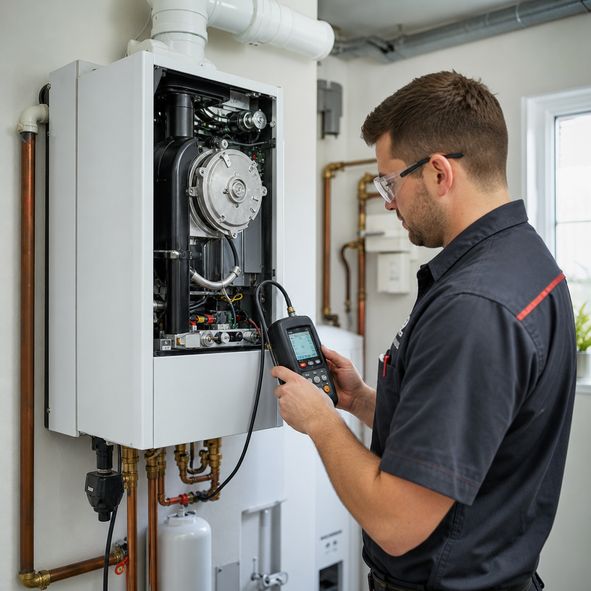
On a damp, grey morning along the White Rock waterfront, when the Pacific mist rolls in off Semiahmoo Bay and the temperature drops to that bone-chilling 3°C that Greater Vancouver winters are notorious for, there is one piece of mechanical engineering standing between your family and genuine discomfort — your boiler. Unlike a furnace that blasts dry, recycled air through ducts, a hydronic boiler system works with elegant, almost silent efficiency: it heats water, circulates it through a closed-loop network of radiant floors or baseboard radiators, and delivers a warmth that is remarkably even, deeply penetrating, and profoundly comfortable. It is, in every sense, the quiet powerhouse of a well-heated home. When that system falters — when a zone valve sticks, a circulator pump fails, or a heat exchanger develops a hairline crack — the consequences are immediate and uncomfortable. That is precisely why White Rock homeowners trust BCRC Heating and Cooling for comprehensive, technically rigorous boiler service in White Rock and across the entire South Surrey corridor.
Ancient Roots: How Humanity Learned to Heat From Below
The fundamental principle behind your modern hydronic boiler is not new. It is, in fact, ancient. Roman engineers of the first century BCE pioneered the hypocaust system — a sophisticated underfloor heating architecture in which a furnace called a praefurnium burned wood or charcoal, forcing hot gases and thermal radiation through hollow spaces beneath raised tile floors and through channels within stone walls. Roman bathhouses, villas, and military barracks across Britain, Gaul, and the Rhine frontier relied on this technology to survive northern European winters. The genius of the hypocaust was its radiant delivery model: heat was stored in thermal mass and released evenly, without drafts, without cold spots, without noise. Fast-forward nearly two thousand years, and the hydronic boiler systems we install in White Rock homes operate on a strikingly similar philosophical premise — heat a medium, distribute it through a structure, and allow it to radiate gently into living spaces. The Romans would recognize the logic immediately.
Beyond Rome, ancient Korean architecture produced the ondol system — stone-floored corridors heated by channelled flue gases — while Chinese kang heated sleeping platforms served a similar purpose. Across cultures and millennia, civilizations independently arrived at the same conclusion: radiant heat from below or within structural surfaces is the most comfortable, efficient form of space heating ever devised. That lineage flows directly into the high-efficiency condensing boilers BCRC technicians install and service in White Rock today.
Industrial Breakthroughs: From Open Flame to Pressurized Closed-Loop Systems
The transition from ancient radiant systems to recognizably modern boiler technology accelerated dramatically during the Industrial Revolution. By the mid-18th century, steam boilers were driving pumps, looms, and locomotives — but residential heating applications lagged behind due to legitimate safety concerns about pressurized steam in domestic settings. The pivotal breakthrough came through a gradual shift from high-pressure steam to low-pressure hot water systems. British and American engineers in the late 1800s began designing hot water gravity circulation systems, where a central cast-iron boiler heated water that rose naturally through convection into radiators throughout a building, then cooled and returned to the boiler. These systems were safer, quieter, and more controllable than steam.
The invention of the circulator pump in the early 20th century transformed hydronic heating from a gravity-dependent curiosity into a precisely controllable comfort system. Suddenly, engineers could design multi-zone systems, force hot water through radiant floor tubing, and modulate heat delivery with unprecedented accuracy. Concurrently, the development of cast iron sectional boilers — assembled on-site from individual sections — allowed heating systems to be tailored to buildings of any size. These are the direct ancestors of the wall-hung condensing boilers and floor-standing cast-iron units that BCRC Red Seal technicians service daily across White Rock and the broader Fraser Valley.
The 20th Century: Standardization, Gas Conversion, and Safety Codes
The 20th century brought two transformative forces to residential boiler technology: the widespread availability of natural gas as a fuel source, and the development of robust safety and efficiency standards. Prior to natural gas infrastructure expansion in the 1940s and 1950s, most residential boilers burned coal or fuel oil — systems that required manual stoking, produced significant ash and particulate matter, and demanded constant attention. The conversion to automatically ignited natural gas burners fundamentally changed the user experience: boilers became set-and-forget appliances, thermostatically controlled and largely self-managing.
Regulatory bodies in Canada and the United States — including what would evolve into the Technical Safety BC framework governing installations here in White Rock — began codifying minimum efficiency standards, mandatory safety controls, and certification requirements for technicians. The emergence of the Atmospheric Flue Gas Boiler as the dominant residential technology through the 1960s, 70s, and 80s established the template that most older White Rock homes still use today: a naturally aspirated gas burner, a cast-iron or steel heat exchanger, and a flue pipe venting combustion gases through a masonry chimney. These systems were reliable and long-lived, but their annual fuel utilization efficiencies (AFUE) rarely exceeded 65–70%, meaning roughly a third of every dollar spent on natural gas was vented unused into the atmosphere.
The Modern Era: Condensing Boilers, Modulating Burners, and Smart Diagnostics
The modern high-efficiency condensing boiler represents one of the most significant engineering leaps in residential heating history. By designing a secondary heat exchanger that extracts latent heat from flue gases — cooling those gases below their dew point so that water vapour condenses and releases additional thermal energy — manufacturers achieved AFUE ratings of 90% to 98%. For a White Rock homeowner spending $2,400 per year on natural gas heat, upgrading from a 70% AFUE atmospheric boiler to a 96% AFUE condensing unit can translate to annual savings of $600 or more, with a payback period of four to seven years depending on the system and rebate eligibility.
Modern condensing boilers are also modulating — their burners can fire at anywhere from 10% to 100% of rated capacity, matching heat output precisely to actual demand rather than cycling on and off at full blast. This modulation reduces thermal stress on components, extends equipment lifespan, and dramatically improves comfort by eliminating the temperature swings associated with on/off cycling. Brands like Navien, Viessmann, Bosch, and IBC — all of which BCRC Heating and Cooling works with extensively — offer wall-hung condensing boilers with onboard Wi-Fi modules, allowing homeowners and technicians to monitor flue temperatures, return water temperatures, error codes, and runtime statistics through smartphone applications. This data transforms proactive maintenance from guesswork into precision: our technicians can identify a developing heat exchanger inefficiency or a marginal igniter before it becomes a midnight emergency call.
Heat Pump Integration: The Peak Efficiency Paradigm for BC Hydronic Systems
White Rock homeowners operating existing hydronic heating systems now have access to a genuinely transformative technology: the Air-to-Water Heat Pump, sometimes called a hydronic heat pump. Rather than generating heat through combustion, these systems extract thermal energy from outdoor air — even at temperatures as low as -15°C — and transfer it into the hydronic loop at efficiencies expressed as a Coefficient of Performance (COP) of 2.5 to 4.5. This means for every 1 kWh of electricity consumed, the system delivers 2.5 to 4.5 kWh of thermal energy into your home. When powered by BC Hydro’s hydroelectric grid — one of the cleanest electricity sources in the world — an air-to-water heat pump system produces a fraction of the greenhouse gas emissions of even the most efficient natural gas boiler.
The CleanBC Better Homes program and BC Hydro’s rebate structure currently offer substantial financial incentives for qualifying heat pump installations, reducing the capital cost barrier significantly. For White Rock homeowners with radiant floor systems already in place — which operate ideally at lower water temperatures of 35–45°C, perfectly matched to heat pump output ranges — the transition to a heat pump boiler hybrid or full replacement can be economically and environmentally compelling. BCRC Heating and Cooling technicians are fully certified to design, size, and commission these integrated systems, navigating the rebate application process on your behalf.
Boiler System Comparison: Choosing the Right Technology for Your White Rock Home
| System Type | AFUE / COP Rating | Typical Lifespan | Fuel Source | Estimated Annual Operating Cost | Best Application |
|---|---|---|---|---|---|
| Atmospheric Natural Gas Boiler | 60–70% AFUE | 20–30 years | Natural Gas | $2,200–$2,800 | Older homes with existing cast-iron radiators |
| High-Efficiency Condensing Gas Boiler | 90–98% AFUE | 15–20 years | Natural Gas | $1,400–$1,900 | New installations, boiler replacements, radiant floor systems |
| Electric Boiler | 99% AFUE (resistance) | 20–25 years | Electricity | $2,800–$4,200 | Cabins, secondary suites, areas without gas service |
| Oil-Fired Boiler | 82–87% AFUE | 20–25 years | Heating Oil | $3,000–$4,500 | Rural properties without gas service |
| Air-to-Water Heat Pump Boiler | COP 2.5–4.5 | 15–20 years | Electricity (BC Hydro) | $900–$1,500 | Low-temperature radiant floor systems, eco-conscious upgrades |
White Rock Homeowner Guide: Boiler Buying, Maintenance, and BC Incentives
Sizing Your Boiler Correctly
One of the most consequential — and most frequently botched — aspects of a boiler installation is proper heat load calculation. Oversized boilers short-cycle chronically, never reaching steady-state efficiency and subjecting heat exchangers to accelerated thermal fatigue. Undersized units run continuously on the coldest days, failing to maintain setpoint temperatures. BCRC technicians perform rigorous Manual J equivalent heat load calculations for every new installation, accounting for White Rock’s specific climate data (Design Temperature: -7°C), your home’s insulation values, window area, air infiltration rates, and domestic hot water demand. This precision sizing is the foundation of a system that will perform reliably for its entire design life.
The White Rock Coastal Climate Factor
White Rock’s proximity to the ocean introduces specific durability considerations that inland installations do not face. The marine air environment — particularly in neighbourhoods close to the beachfront along Marine Drive — carries elevated chloride concentrations that can accelerate corrosion on external flue components, PVC condensate piping terminations, and outdoor heat pump units. BCRC technicians specify stainless steel or AL29-4C alloy flue systems for all condensing boiler installations in coastal zones, and apply UV-resistant protective coatings to outdoor electrical connections during annual maintenance visits. These measures are not standard practice across the industry — they reflect the site-specific expertise that comes from years of servicing systems specifically in this microclimate.
Annual Maintenance: What BCRC’s Comprehensive Boiler Service Includes
A properly executed annual boiler service visit from BCRC covers far more than a visual inspection and a filter change. Our Red Seal certified technicians perform a methodical, documented inspection protocol that includes:
- Combustion Analysis: Using calibrated flue gas analysers, we measure CO, CO₂, O₂, and flue temperature to verify that the burner is operating at optimal air-to-fuel ratio, confirming complete combustion and maximum thermal efficiency.
- Heat Exchanger Integrity Check: Visual and pressure-differential testing to identify any cracks, pitting, or corrosion in primary and secondary heat exchangers — the most critical safety component in any gas-fired appliance.
- Circulator Pump Assessment: Checking for seal leaks, bearing noise, and adequate flow rate through each zone, verifying that the glycol concentration in closed-loop systems is within specification for freeze protection.
- Expansion Tank Pre-charge Verification: Measuring and adjusting the air pre-charge pressure in the diaphragm expansion tank to match system static pressure — a frequently neglected task that, when ignored, leads to waterlogged tanks and chronic pressure fluctuations.
- Safety Control Testing: Functional testing of the high-limit aquastat, pressure relief valve, low-water cutoff (where applicable), and gas valve safety interlock to confirm all protective devices will operate as designed during a fault condition.
- Condensate System Inspection: Flushing the condensate neutralizer, verifying drain line flow, and testing the condensate pump (where installed) to prevent acidic condensate from backing up into the heat exchanger.
- System Water Quality Check: Testing pH and inhibitor concentration of system water. Improper pH (target range 7.5–8.5) accelerates internal corrosion of aluminum heat exchangers — a leading cause of premature boiler failure in systems not properly commissioned.
CleanBC and BC Hydro Rebates: Maximizing Your Investment
British Columbia’s CleanBC Better Homes Energy Savings Program offers rebates of up to $6,000 or more for qualifying heat pump installations, with additional top-up incentives available through BC Hydro for eligible customers. For natural gas boiler replacements with high-efficiency condensing units, FortisBC’s Energy Efficiency Rebate program currently provides rebates that can offset a meaningful portion of equipment costs. BCRC Heating and Cooling maintains current certification with all major rebate programs operating in the White Rock and South Surrey service area, and our team handles the rebate documentation and submission process as part of every qualifying installation — ensuring you capture every dollar of incentive available without the administrative burden falling on you.
Frequently Asked Questions: Boiler Service in White Rock
How do I know if my White Rock boiler needs repair or full replacement?
The decision between repair and replacement hinges on three variables: the age of the unit, the nature of the fault, and the cost-benefit analysis. As a general technical guideline, if your boiler is under 10 years old and the repair cost is less than 30% of replacement cost, repair is almost always the right economic decision. If the unit is over 15–18 years old and you are facing a heat exchanger failure, a failed gas valve, or a cracked section in a cast-iron unit, replacement with a modern high-efficiency condensing boiler will typically deliver a better long-term outcome — both financially and in terms of reliability. BCRC technicians provide honest, transparent assessments with no pressure toward unnecessary replacement; we will show you the numbers and let you make an informed decision.
What is the ideal system water pressure for a residential hydronic boiler?
For a typical two-storey residential hydronic heating system, cold-fill static pressure should be set between 12 and 15 PSI, rising to no more than 20–22 PSI when the system reaches operating temperature (typically 70–82°C for a standard high-temperature system, or 35–50°C for a low-temperature radiant floor system). Pressures consistently exceeding 25 PSI indicate either an oversized expansion tank, a waterlogged expansion tank, or a failed pressure reducing valve (PRV). Pressures dropping below 10 PSI suggest a system leak or a faulty auto-fill valve. Both conditions require prompt diagnosis — chronic over-pressure will eventually lift the pressure relief valve and discharge system water, while chronic under-pressure can allow air entrainment that causes noise, corrosion, and circulator pump cavitation.
How often should boiler system water be flushed and inhibitor refreshed?
In a properly sealed and pressurized closed-loop hydronic system, the system water itself does not need annual replacement. However, the corrosion inhibitor package — typically a blend of molybdate, nitrite, or azole-based compounds depending on the metals present in the system — degrades over time and should be tested annually and refreshed every two to three years. For systems with aluminum heat exchangers (common in modern condensing boilers from brands like Navien and Bosch), maintaining proper inhibitor concentration and pH is especially critical, as aluminum is highly susceptible to both acidic and caustic corrosion. A complete system flush and refill with fresh inhibited water is recommended any time significant components are replaced, when system water appears visually discoloured or turbid, or when pH testing reveals values outside the 7.5–8.5 target range.
Are there specific permits required for boiler installation in White Rock, BC?
Yes — and this is a point that homeowners hiring unlicensed contractors frequently overlook at significant legal and insurance risk. In British Columbia, all gas appliance installations — including residential boilers — require a BC Gas Permit pulled by a licensed gas contractor, and all work must be inspected and approved by Technical Safety BC (TSBC). Additionally, White Rock and Surrey municipal building departments may require a mechanical permit for new boiler installations involving significant piping modifications. BCRC Heating and Cooling holds all required contractor licences and handles permit applications as a standard part of every installation. Work performed without proper permits voids equipment warranties, invalidates homeowner insurance in the event of a fire or carbon monoxide incident, and creates significant complications at the time of property sale. Never allow any contractor to suggest that permits are optional or unnecessary for boiler work in BC.
BCRC Heating and Cooling: White Rock’s Boiler Service Authority
From the sun-drenched bluffs above the White Rock Pier to the quiet residential streets of Grandview Heights and Morgan Crossing, BCRC Heating and Cooling has built its reputation one technically excellent boiler service call at a time. Our Red Seal Master Technicians bring factory-level diagnostic precision, genuine transparency, and a deep commitment to your family’s comfort and safety to every installation, repair, maintenance visit, and emergency call we answer across White Rock, South Surrey, and the Greater Vancouver region. We do not cut corners, we do not recommend unnecessary work, and we do not leave a job until the system is performing correctly and you understand exactly what was done and why. Whether you need an emergency boiler repair on the coldest night of the year, a carefully planned high-efficiency condensing boiler replacement, or the peace of mind that comes from a comprehensive annual maintenance agreement, BCRC is the team White Rock homeowners call first. For certified, Red Seal quality boiler installation in Vancouver and all surrounding communities including White Rock, contact BCRC Heating and Cooling today at (604) 781-7272 — because your family’s warmth is not something you should ever have to compromise on.