


Air Conditioner Maintenance Vancouver Guide
Vancouver’s Hidden Summer Threat: What Happens When Your AC Stops Performing
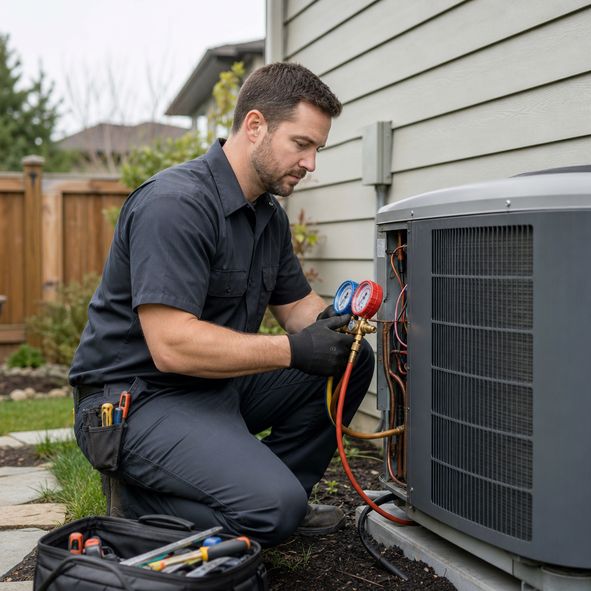
Picture this: it’s the peak of a rare Vancouver heat dome — the kind that sent temperatures soaring past 40°C in the summer of 2021 — and your air conditioner starts struggling. The airflow weakens, the thermostat can’t keep up, and what should be a cool refuge becomes an uncomfortable, stifling interior. The difference between a system that powers through the season and one that fails at the worst possible moment isn’t luck. It’s maintenance. Regular, professional, technically thorough air conditioner maintenance is the quiet guardian standing between your family and the full force of a Pacific Northwest summer. At BCRC Heating and Cooling, our Red Seal certified technicians have seen firsthand how a single annual tune-up can extend a system’s life by years, slash energy bills by double-digit percentages, and prevent the kind of emergency breakdowns that always seem to happen on the hottest Friday afternoon of the year.
Why Vancouver’s Climate Demands a Different AC Maintenance Approach
Greater Vancouver’s climate is deceptively complex. While the region enjoys mild, temperate winters, summers have grown measurably hotter and more intense over the past decade, driven by shifting Pacific weather patterns and urban heat island effects across Metro Vancouver, Burnaby, Surrey, and Coquitlam. The Lower Mainland’s proximity to the ocean also introduces elevated humidity and salt-laden coastal air — particularly in areas like Richmond, Tsawwassen, and West Vancouver — which accelerates corrosion on outdoor condenser coils, electrical terminals, and refrigerant line connections.
Unlike desert climates where air conditioners run continuously for months, Vancouver systems often sit dormant through the mild shoulder seasons, only to be called upon suddenly during intense summer heat events. This start-stop operating cycle creates its own set of maintenance challenges: capacitors that have weakened during inactivity, refrigerant lines that may have developed micro-leaks, and evaporator coils that have accumulated an entire season’s worth of biological growth. Understanding these Vancouver-specific stressors is the foundation of truly effective AC maintenance — and it’s exactly the knowledge base that BCRC technicians bring to every service call.
The Science of AC System Degradation: What’s Actually Happening Inside Your Unit
To appreciate why maintenance matters, it helps to understand what physically degrades inside your air conditioning system over time. Modern central air conditioners and ductless mini-splits are precision refrigeration machines operating on the vapour-compression cycle. Every component in that cycle is subject to wear, contamination, and efficiency loss.
Condenser Coil Fouling
The outdoor condenser unit is your system’s heat rejection engine. Its aluminium fins and copper coils must transfer heat from the refrigerant to the outside air with maximum efficiency. In Greater Vancouver, cottonwood seed fluff in late spring, airborne dust, pollen, and coastal particulate matter steadily choke these fins, creating an insulating blanket that forces the compressor to work harder, draws more electricity, and generates excess heat that shortens compressor life. A professionally cleaned condenser coil can restore system efficiency by 15 to 20 percent in a single service visit.
Evaporator Coil Biological Growth
The indoor evaporator coil operates in a perpetually cold, damp environment — the ideal breeding ground for mould, mildew, and biofilm. As this biological layer builds on the coil surface, it restricts airflow, reduces heat absorption efficiency, and critically, releases mould spores and volatile organic compounds directly into your home’s circulated air. For families with allergies, asthma, or respiratory sensitivities, a fouled evaporator coil is not just an efficiency problem — it’s a genuine indoor air quality health concern.
Refrigerant Charge Degradation
Modern systems use R-410A or the newer R-32 and R-454B refrigerants. These systems are designed to operate as sealed loops with no refrigerant consumption — but micro-leaks at Schrader valves, flare fittings, and brazed joints are common in systems older than five years. Even a 10 percent undercharge dramatically reduces cooling capacity and efficiency while forcing the compressor to operate under thermal stress. Only a licensed refrigeration mechanic with the appropriate EPA/TECA certification can legally handle, recover, and recharge refrigerants — another critical reason professional maintenance is essential rather than optional.
Electrical System Fatigue
Starting capacitors, contactor relay points, control boards, and wiring terminals all degrade through thermal cycling. A starting capacitor operating at 80 percent of its rated microfarad value may still start the compressor on a mild day but fail catastrophically when ambient temperatures spike and the system must work at peak load. Identifying these weakened components before they fail is one of the highest-value services a skilled technician provides.
BCRC’s Comprehensive Air Conditioner Maintenance Protocol
When BCRC performs an air conditioner maintenance visit, it is a systematic, technically rigorous process — not a simple filter change and a visual glance. Here is exactly what our Red Seal certified technicians execute on every maintenance call:
Step 1: Pre-Service System Performance Baseline
Before touching anything, we record the system’s current operating parameters: supply and return air temperatures (measuring actual Delta-T across the coil), static pressure readings, compressor amp draw, and outdoor unit fan current. This baseline tells us immediately how far the system has drifted from its factory design specifications.
Step 2: Outdoor Condenser Service
- Shut down and lock out power at the disconnect
- Remove condenser panels and inspect the cabinet interior for pest intrusion, water damage, and wiring deterioration
- Flush condenser coils from inside-out with low-pressure coil cleaner to remove embedded debris without bending delicate aluminium fins
- Straighten bent fins using a professional fin comb to restore full airflow cross-section
- Inspect and test the dual-run capacitor with a calibrated capacitance meter — replace if within 10 percent of rated tolerance
- Inspect contactor relay contact points for pitting and burning — replace if contact gap or surface condition is compromised
- Check all electrical connections for corrosion, looseness, and proper torque
- Lubricate condenser fan motor bearings if applicable (sealed motors are inspected for bearing noise under load)
- Measure compressor amp draw against nameplate RLA (Rated Load Amps) to assess compressor health
Step 3: Refrigerant System Assessment
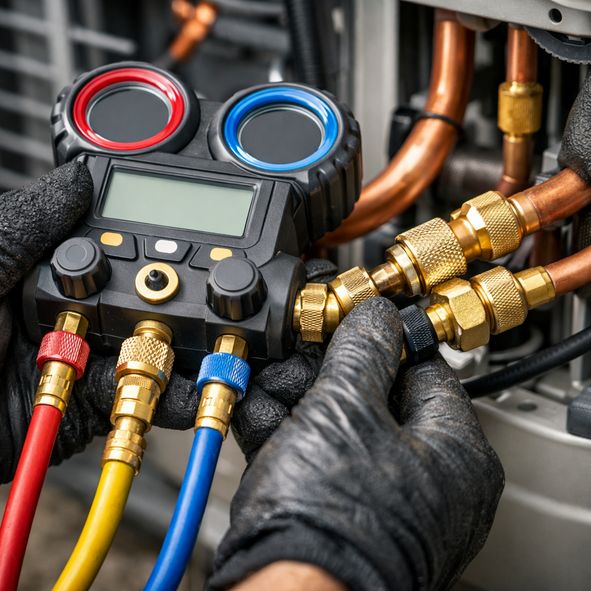
- Measure suction and discharge pressures using calibrated digital manifold gauges
- Calculate superheat and subcooling values and compare against manufacturer specifications for the installed refrigerant type
- Use an electronic leak detector to scan all accessible line connections, service valves, and coil joints
- Document refrigerant charge status and advise homeowner of any deficiencies found
Step 4: Indoor Air Handler / Evaporator Service
- Inspect and replace or clean the air filter — including assessment of filter MERV rating suitability for the system’s static pressure tolerance
- Inspect evaporator coil for biological growth, ice formation evidence, and physical damage
- Clean evaporator coil with no-rinse enzymatic coil cleaner where fouling is detected
- Flush and treat the condensate drain pan with biocide tablets to prevent algae blockage — a leading cause of water damage in Vancouver homes
- Inspect blower wheel for dust accumulation (a dirty blower can reduce airflow by 30 to 40 percent)
- Measure blower motor amp draw and check capacitor if applicable
- Inspect all accessible ductwork connections at the air handler for air leaks
Step 5: Controls and Thermostat Verification
- Test thermostat calibration and verify proper staging operation for multi-stage and variable-speed systems
- Test defrost cycle operation on heat pump equipped systems
- Verify all safety controls: high-pressure cutout, low-pressure cutout, freeze protection thermostat
- Test emergency heat operation on heat pump systems
Step 6: Post-Service Performance Verification
After all service tasks are complete, we re-measure the same parameters captured in Step 1 and document the improvement. We provide every BCRC customer with a written service report showing before and after measurements — concrete, transparent proof of the value delivered by every maintenance visit.
The Financial Case for Annual AC Maintenance in Greater Vancouver
Homeowners sometimes view air conditioner maintenance as an optional expense. The technical and financial data tell a very different story. Consider these well-documented performance impacts:
- Dirty condenser coils increase energy consumption by 10 to 30 percent — adding meaningless cost to every BC Hydro billing cycle all summer long
- Low refrigerant charge reduces system capacity by up to 25 percent while increasing compressor wear exponentially
- Failed capacitors cause hard-start compressor stress that shortens compressor lifespan from a potential 15 to 20 years down to 8 to 10 years
- Blocked condensate drains cause water overflow events that can damage ceilings, walls, and flooring — repair bills that dwarf the cost of a maintenance visit many times over
- Unmaintained systems void manufacturer warranties — leaving homeowners fully exposed on expensive component failures
By contrast, a professional BCRC maintenance visit is an investment that typically returns three to five times its cost in energy savings, avoided repairs, and preserved equipment life within the first year alone.
CleanBC and BC Hydro Incentives: Maximizing Value for Vancouver Homeowners
British Columbia’s CleanBC program and BC Hydro’s rebate initiatives have made upgrading to high-efficiency cooling systems more financially accessible than ever before. Homeowners considering replacing aging, inefficient air conditioners or upgrading to heat pump systems — which provide both efficient cooling and ultra-efficient heating — may qualify for substantial rebates that significantly reduce upfront investment costs.
BCRC’s team stays current with all active provincial and utility incentive programs. When we perform a maintenance visit and identify a system approaching end-of-life, we provide our customers with a complete, honest assessment of their replacement options alongside a full accounting of available rebates, helping them make informed decisions with complete financial clarity. We handle the paperwork and documentation required for rebate applications as a standard part of our installation service.
Ductless Mini-Split Maintenance: Vancouver’s Growing Cooling Solution
Ductless mini-split systems have become enormously popular across Greater Vancouver over the past decade, particularly in the region’s large inventory of older homes, condominiums, and heritage properties where installing central ducted systems is impractical or cost-prohibitive. These systems have specific maintenance requirements that differ meaningfully from traditional central air conditioners.
Mini-split indoor heads feature washable filter panels that require cleaning every four to six weeks during active use — a task homeowners can perform themselves. However, beyond filter cleaning, mini-split systems require professional attention for: deep cleaning of the indoor blower wheel (which accumulates a thick, greasy biofilm invisible to casual inspection), cleaning of the heat exchanger, inspection and testing of the expansion valve, verification of refrigerant charge at the outdoor unit, and inspection of the condensate drainage system. BCRC technicians are factory-trained on all major mini-split brands including Mitsubishi Electric, Daikin, Fujitsu, LG, and Samsung — brands that dominate the Greater Vancouver market.
Frequently Asked Questions: Air Conditioner Maintenance in Vancouver
How often should I have my air conditioner professionally serviced in Greater Vancouver?
For central air conditioning systems and heat pump systems used for cooling, we recommend professional maintenance once per year, ideally performed in early spring — April through May — before the summer cooling season begins. This timing ensures your system is at peak performance precisely when you need it most, and allows adequate time to source any parts that may be required. For ductless mini-split systems in year-round operation (both cooling and heating), a twice-annual service cadence — spring and fall — is the optimal protocol. Commercial systems and systems operating in high-demand environments may require quarterly service intervals.
What are the warning signs that my AC system needs immediate professional attention rather than waiting for a scheduled maintenance visit?
Several symptoms warrant an urgent service call rather than waiting: ice formation on the refrigerant lines or outdoor unit (indicates low refrigerant charge or severely restricted airflow — operating a system in this condition risks catastrophic compressor failure); unusual grinding, clanking, or high-pitched squealing sounds from either the indoor or outdoor unit (mechanical bearing failure in progress); water leaking from the indoor air handler (blocked condensate drain — can cause significant water damage quickly); a burning smell from supply registers (electrical fault — shut the system down immediately and call for service); and a system that runs continuously without reaching the thermostat setpoint on a day that is not excessively hot (significant loss of cooling capacity indicating refrigerant loss or major component degradation).
Can I perform any air conditioner maintenance tasks myself, and what should I leave strictly to professionals?
There is a meaningful distinction between homeowner-appropriate tasks and work that legally and technically requires a qualified refrigeration mechanic. Homeowners can safely and productively: replace or clean air filters on the recommended schedule (typically every 1 to 3 months depending on filter type and household conditions); keep the outdoor condenser unit clear of vegetation, debris, and obstructions by maintaining a 60-centimetre clearance on all sides; keep the area around indoor air handlers and mini-split heads clean; and ensure condensate drain lines remain clear by periodically flushing with a diluted bleach solution. Everything else — refrigerant handling, electrical component testing and replacement, coil chemical cleaning, and any internal system work — must be performed by a licensed technician. In British Columbia, handling refrigerants without proper TICO certification is illegal and carries significant penalties.
How does Vancouver’s coastal air quality specifically affect air conditioner longevity compared to inland locations?
This is an excellent and often-overlooked question. Greater Vancouver’s proximity to the ocean means outdoor air contains elevated concentrations of salt aerosols and moisture — particularly in coastal communities like West Vancouver, White Rock, and areas of Richmond adjacent to the Fraser River estuary. This coastal air environment dramatically accelerates the electrochemical corrosion of the aluminium fins and copper tubing in outdoor condenser coils. In severe cases, we see formicary corrosion — a specific type of copper tubing pitting caused by the interaction of formic acid (from certain decomposing organic materials common in our region), moisture, and oxygen — that can perforate refrigerant tubing within five to seven years on inadequately maintained systems. Annual professional coil cleaning, combined with the application of a corrosion-inhibiting coil coating, can extend condenser coil life significantly in these environments. BCRC technicians are specifically trained to identify early-stage corrosion during maintenance visits and apply protective treatments before damage becomes irreparable.
BCRC Heating and Cooling: Your Trusted Air Conditioner Maintenance Partner in Greater Vancouver
Your air conditioning system is one of the most significant mechanical investments in your home — and in Greater Vancouver’s increasingly warm summers, it is also one of the most important contributors to your family’s comfort, health, and safety. Protecting that investment requires more than a cursory annual check. It demands the kind of technically thorough, professionally documented, and genuinely expert maintenance service that only a Red Seal certified team with deep local knowledge can provide.
At BCRC Heating and Cooling, we bring factory-level technical knowledge, professional-grade diagnostic equipment, and an unwavering commitment to transparency to every maintenance visit across Metro Vancouver, Burnaby, Surrey, Coquitlam, North Vancouver, and the surrounding Lower Mainland. We do not cut corners, we do not upsell unnecessarily, and we do not leave until your system is performing at the standard it was engineered to achieve.
Do not wait for your system to fail during the next heat dome. For dependable, Red Seal certified AC installation in Vancouver and comprehensive air conditioner maintenance that protects your system season after season, contact the local experts at BCRC Heating and Cooling today at (604) 781-7272 and schedule your professional maintenance visit now.