



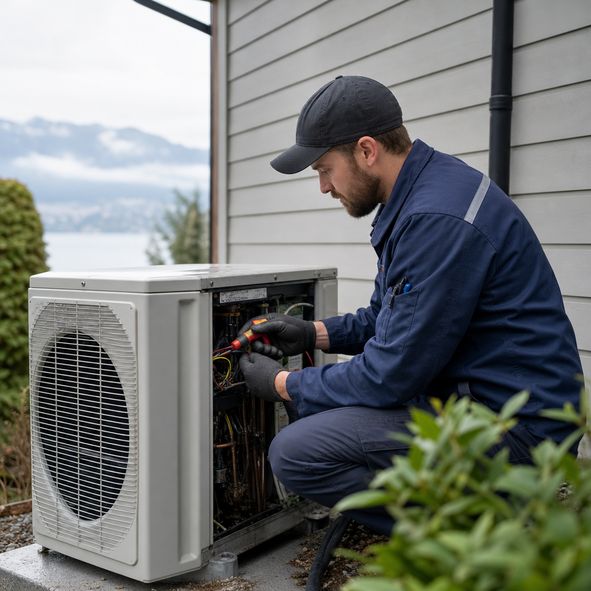
Vancouver’s Heat Pump in Crisis? Here’s What Every Homeowner Must Know
Picture this: it’s the middle of a damp Vancouver winter, temperatures hovering just above freezing, and your heat pump has gone silent. No warm air. No familiar hum. Just the creeping cold settling into your living room while you stare at a blinking thermostat. Or perhaps it’s the opposite scenario — a rare Lower Mainland heat dome has pushed temperatures past 35°C, and your system is struggling to keep up. Either way, a malfunctioning heat pump isn’t just an inconvenience in Greater Vancouver. It’s a genuine household emergency. Heat pumps are uniquely vulnerable in our coastal climate: the relentless moisture, the salt-laden air near Burrard Inlet, the rapid freeze-thaw cycles on the North Shore, and the dramatic seasonal swings all conspire to stress components that might last decades in drier, more stable climates. Understanding what goes wrong, why it goes wrong, and how a certified Red Seal technician diagnoses and resolves those failures is the difference between a quick, cost-effective repair and an expensive, mismanaged replacement. This comprehensive guide from BCRC Heating and Cooling — Greater Vancouver’s trusted HVAC specialists — covers everything you need to know about heat pump repair in Vancouver, BC.
How a Heat Pump Actually Works: A Technical Foundation
Before diagnosing problems, every Vancouver homeowner benefits from understanding the elegant thermodynamic cycle their heat pump executes thousands of times per year. Unlike a furnace, which generates heat by combustion, a heat pump moves heat — extracting latent thermal energy from outdoor air (even at temperatures as low as -25°C on modern cold-climate models) and transferring it indoors. In summer, the cycle reverses, expelling indoor heat outside to cool your home. This refrigeration cycle involves eight core components, and a failure in any single one cascades into system-wide performance loss:
- Evaporator Coil: Absorbs heat from the air passing over it by evaporating refrigerant at low pressure. Dirt accumulation here sharply reduces heat transfer efficiency.
- Refrigerant Circuit (Low-Pressure Side): Carries low-pressure, low-temperature refrigerant vapour from the evaporator toward the compressor. Leaks here cause pressure drop and inadequate heating or cooling.
- Compressor: The heart of the system. It pressurizes refrigerant vapour, dramatically raising its temperature. Compressor failure is the most costly heat pump repair and is often caused by neglected maintenance or refrigerant issues.
- Condenser Coil: Releases absorbed heat to the destination medium (indoor air or water). Outdoor coil icing is a classic Vancouver winter symptom requiring immediate attention.
- Expansion Valve (TXV or EEV): Precisely meters refrigerant flow, dropping pressure and temperature before the evaporator. Electronic expansion valves on modern inverter units require specialized diagnostic tools.
- Reversing Valve: The component that makes a heat pump unique — it switches refrigerant flow direction between heating and cooling modes. A stuck reversing valve is a common cause of a heat pump that heats in summer and cools in winter.
- Air Handler or Ductwork: Distributes conditioned air throughout your home. Leaky ductwork can account for up to 30% energy loss, masking as a heat pump performance problem.
- Thermostat and Control Board: The brain of the system. Modern communicating thermostats and PCB assemblies require fault-code reading with manufacturer-specific software for accurate diagnosis.
Vancouver’s Climate: Why Your Heat Pump Works Harder Than Most
Greater Vancouver’s climate sits in a unique and demanding HVAC zone. The Lower Mainland receives over 1,150 mm of precipitation annually — most of it falling as rain during the shoulder seasons when your heat pump is working hardest. This persistent moisture accelerates corrosion on outdoor coil fins, electrical connections, and cabinet steel. Coastal communities from Tsawwassen to Lions Bay face additional salt-air exposure that degrades aluminum coil fins and outdoor fan motor bearings. Meanwhile, North Vancouver and Coquitlam homeowners experience genuine overnight freezing during cold snaps, triggering extended defrost cycles that stress reversing valves and defrost control boards. The 2021 Heat Dome — which pushed Vancouver to a record 49.6°C in Lytton — demonstrated that many heat pump systems installed before 2018 were not engineered for such extreme cooling demand, pushing compressors and refrigerant circuits into overload. BCRC technicians across the region responded to hundreds of calls during that event alone. Understanding these local stressors is precisely why cookie-cutter HVAC advice from non-local sources fails Vancouver homeowners.
The 7 Most Common Heat Pump Problems in Vancouver and Their Root Causes
Through thousands of service calls across Metro Vancouver, BCRC’s Red Seal technicians have identified the fault patterns most prevalent in our specific climate. Here is a technically honest breakdown of what we find most often and what it means for your repair:
1. Refrigerant Leaks and Low Charge
Refrigerant is not consumed — it circulates in a sealed loop. If your system is low on refrigerant, it has a leak, full stop. Common leak points in Vancouver homes include Schrader valve cores corroded by moisture, micro-cracks in evaporator coil hairpin bends caused by vibration over years of operation, and flare fittings that were inadequately torqued during original installation. Symptoms include ice formation on the outdoor unit even in mild weather, warm air from indoor vents during heating mode, hissing or bubbling sounds, and steadily rising energy bills. Proper repair requires leak detection (electronic sniffer and UV dye), leak repair, nitrogen pressure testing, deep vacuum to 300 microns or better, and precise refrigerant charge by weight to manufacturer specification — not by pressure alone.
2. Frozen Outdoor Coil and Defrost Control Failures
Vancouver’s wet winters are the primary driver of this failure. When ambient temperatures drop below 7°C and humidity is high, frost naturally accumulates on the outdoor coil. Heat pumps manage this through timed or demand-initiated defrost cycles. When the defrost control board, outdoor temperature thermistor, or defrost thermostat fails, the unit cannot initiate defrost, and ice builds progressively until the outdoor fan blade contacts the coil or airflow is completely blocked. BCRC technicians diagnose this with live defrost cycle testing and thermistor resistance checks against manufacturer temperature-resistance charts.
3. Compressor Failures and Hard-Start Conditions
The compressor is the most expensive single component in any heat pump — often $800–$2,500 in parts alone. In Greater Vancouver, we see two primary compressor failure modes: hard-start failures caused by capacitor degradation (the capacitor provides the electrical boost needed to start the compressor motor) and liquid slugging failures caused by refrigerant migration into the compressor crankcase during cold off-cycles. Modern inverter-driven scroll compressors are more resilient but require inverter board diagnostics when they fail. A hard-start kit installation can extend compressor life by several years at a fraction of replacement cost.
4. Reversing Valve Sticking or Leaking
The reversing valve uses refrigerant pressure differentials to shift a slider mechanism that reverses refrigerant flow direction. In Vancouver’s high-humidity environment, internal corrosion of the valve body or solenoid coil failure causes this valve to stick in one position. The diagnostic tell-tale: a heat pump that provides cooling in winter and heating in summer, or one that runs but delivers only ambient-temperature air. Some stuck valves can be cleared by cycling the solenoid rapidly; others require valve replacement, which involves brazing and refrigerant recovery.
5. Capacitor and Contactor Degradation
Run capacitors maintain smooth operation of compressor and fan motors; start capacitors provide initial torque. Contactors are electromechanical switches that energize the compressor and outdoor fan. Both are consumable components with typical lifespans of 5–10 years under Vancouver conditions. A failing run capacitor causes the motor it supports to draw excessive amperage, run hot, and eventually burn out. BCRC technicians check capacitor microfarad values on every tune-up call — a $45 capacitor caught early prevents a $1,200 fan motor or $2,000 compressor replacement.
6. Blower Motor and Indoor Air Handler Problems
The indoor air handler’s blower motor moves conditioned air through your ductwork. In Vancouver homes with older duct systems, restricted airflow from dirty filters, collapsed flex duct, or closed registers causes the evaporator coil to freeze in cooling mode and significantly reduces heating output in winter mode. Variable-speed ECM blower motors on modern systems can be diagnosed for fault codes via the control board; older PSC motors require amperage testing and capacitor checks.
7. Control Board and Thermostat Communication Failures
Modern communicating heat pump systems (Mitsubishi, Daikin, Bosch, Carrier Infinity) use proprietary communication protocols between the indoor and outdoor units. A single corroded connector or failed communication board can present as almost any symptom — erratic operation, fault codes, failure to respond to thermostat commands. Accurate diagnosis requires manufacturer-specific service tools and training, which is why brand-certified technicians deliver faster, more accurate repairs on these systems.
Warning Signs Your Vancouver Heat Pump Needs Professional Attention Now
Not every heat pump problem announces itself dramatically. Some of the most damaging failure modes develop gradually, masked by a system that is still technically running but consuming far more energy than it should. Watch for these indicators and call BCRC promptly if you observe any of them:
- Reduced Heating or Cooling Output: If your home takes noticeably longer to reach set temperature, or the air from your vents feels lukewarm instead of warm, your heat pump is in distress.
- Unusual Noises: Grinding suggests bearing failure. Banging or clanking indicates loose or broken components (possibly inside the compressor). Squealing points to a failing fan motor bearing. Hissing or gurgling sounds from refrigerant lines indicate a leak or improper charge.
- Skyrocketing Energy Bills: A heat pump working harder to compensate for a performance deficit — whether from low refrigerant, dirty coils, or a failing compressor — will reflect immediately on your BC Hydro bill. A sudden 20–30% increase in your heating/cooling energy consumption warrants an immediate diagnostic call.
- Short Cycling: A system that starts, runs for 2–3 minutes, shuts off, and immediately restarts is short cycling. This indicates a refrigerant overcharge, airflow restriction, oversized system, or refrigerant leak — all of which cause accelerated compressor wear.
- Ice Formation on Outdoor Unit in Mild Weather: Light frost on the coil during cold weather is normal and managed by the defrost cycle. A solid block of ice on the outdoor unit in 5°C weather is a system emergency requiring immediate shutdown and professional assessment.
- Burning or Musty Odours: A burning smell from air vents suggests an overheating motor or electrical component. A musty smell indicates mould growth in the indoor air handler or ductwork — a health concern that must be addressed promptly.
- Auxiliary Heat Locking On Permanently: Most heat pumps have auxiliary electric resistance backup heat that activates during extreme cold or when the heat pump cannot keep up. If your auxiliary heat indicator is permanently lit even in mild weather, your heat pump’s primary refrigeration cycle has failed.
BCRC’s Diagnostic and Repair Process: What Happens When We Arrive
BCRC Heating and Cooling technicians follow a structured, evidence-based diagnostic protocol developed over years of service across Greater Vancouver. Here is exactly what that process looks like on your doorstep:
Step 1 — System History Review and Customer Interview
Before touching a tool, our technician reviews your system’s model, age, service history, and listens carefully to your description of symptoms. When did the problem start? Is it constant or intermittent? Does it correlate with outdoor temperature? These details often point directly to the root cause before the diagnostic even begins.
Step 2 — Full Visual and Electrical Inspection
We inspect the outdoor unit for physical damage, coil condition, refrigerant line insulation integrity, electrical disconnect condition, and evidence of water intrusion. Indoors, we check the air handler filter, coil condition, condensate drain, electrical connections, and control wiring. Loose electrical connections under Vancouver’s humidity conditions are a surprisingly common source of intermittent faults.
Step 3 — Operational Performance Testing
With the system running, we measure supply and return air temperatures, calculate delta-T (the temperature difference across the coil), measure static pressure across the air handler, check compressor and fan motor amperage draws against nameplate ratings, and read any fault codes stored in the control board memory.
Step 4 — Refrigerant Circuit Analysis
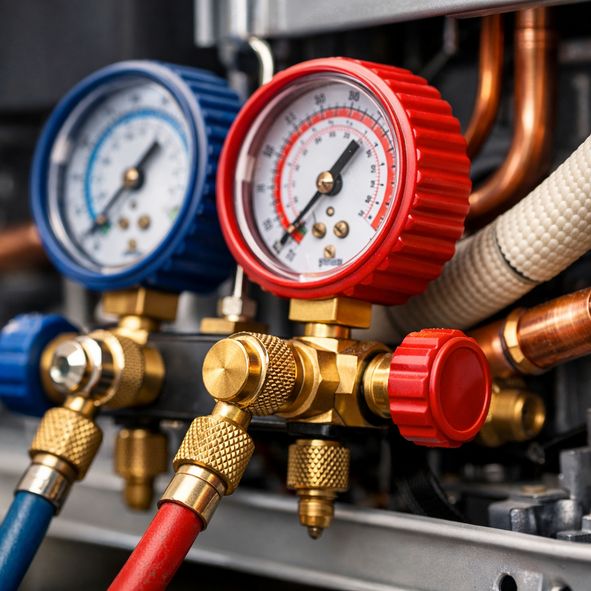
Using calibrated manifold gauges, we measure suction and discharge pressures, calculate superheat and subcooling values, and compare them against the manufacturer’s target parameters for current ambient conditions. This analysis definitively identifies refrigerant charge issues, compressor valve failures, and expansion device problems.
Step 5 — Transparent Diagnosis and Written Estimate
We explain our findings in plain language, provide a written estimate covering parts and labour, and present all repair options — including honest guidance on repair-versus-replace decisions for older systems. BCRC never performs work without your explicit written authorization.
Step 6 — Precision Repair and System Optimization
Repairs are performed using OEM-specified or equivalent-grade parts. After every repair, we re-run the full performance test to confirm the system is operating within specification — not just running. We verify proper defrost cycle operation, check thermostat calibration, and ensure all safety controls are functional before we consider the job complete.
Heat Pump Sizing Reference: Vancouver Homes
Proper heat pump sizing is fundamental to both installation quality and long-term repair frequency. An oversized unit short-cycles (causing compressor wear), while an undersized unit runs continuously and locks on auxiliary heat in winter. The following table provides a general sizing reference for Metro Vancouver’s climate zone. Always require a full Manual J load calculation from your HVAC contractor before purchase.
| Home Size (Square Feet) | Approximate Heat Pump Size (Tons) | Typical BTU/hr Capacity | Notes for Vancouver Climate |
|---|---|---|---|
| Under 1,000 sq ft | 1.0 – 1.5 tons | 12,000 – 18,000 BTU/hr | Well-insulated condos; consider cold-climate mini-split |
| 1,000 – 1,500 sq ft | 1.5 – 2.0 tons | 18,000 – 24,000 BTU/hr | Typical rancher or townhome; insulation level critical |
| 1,500 – 2,000 sq ft | 2.0 – 2.5 tons | 24,000 – 30,000 BTU/hr | Standard Vancouver two-storey; zoning recommended |
| 2,000 – 2,500 sq ft | 2.5 – 3.0 tons | 30,000 – 36,000 BTU/hr | Larger homes; multi-zone system often superior |
| 2,500 – 3,000 sq ft | 3.0 – 3.5 tons | 36,000 – 42,000 BTU/hr | Consider dual-zone or multi-head mini-split |
| Over 3,000 sq ft | 3.5+ tons | 42,000+ BTU/hr | Commercial-grade or multi-unit system; full load calc mandatory |
Preventive Maintenance: The Smartest Heat Pump Investment in Vancouver
The majority of emergency heat pump repairs BCRC responds to in Greater Vancouver are entirely preventable. A properly maintained heat pump in our climate should deliver 15–20 years of reliable service. Here is what a comprehensive annual tune-up from BCRC covers — and why each step matters specifically for Vancouver homes:
- Coil Cleaning (Outdoor and Indoor): Vancouver’s abundant cottonwood seeds, coastal salt particles, and construction dust clog coil fins rapidly. Even a 15% reduction in coil airflow can drop system efficiency by over 20%. We use coil-safe, pH-neutral cleaners and low-pressure rinsing to restore full heat transfer capacity.
- Refrigerant Pressure and Charge Verification: Annual pressure checks catch slow leaks before they cause compressor damage. Even a 10% refrigerant undercharge increases compressor discharge temperature significantly, accelerating wear on internal compressor components.
- Electrical Connection Torque Check: Vancouver’s humidity causes oxidation on terminals and screw connections. We use a torque driver to verify every electrical connection and apply anti-oxidant compound on aluminum wiring connections — a critical step often skipped by less thorough contractors.
- Capacitor Testing: We test run and start capacitors with a true-RMS capacitance meter. Capacitors degrade gradually; we replace any unit measuring below 90% of its rated microfarad value before it causes a motor failure.
- Defrost Cycle Testing: We manually initiate and observe a complete defrost cycle, confirming that the reversing valve shifts cleanly, the outdoor fan stops, and the system returns to heating mode properly — every single visit.
- Condensate Drain Cleaning: Clogged condensate drains in cooling mode cause water damage to air handlers and trigger overflow shutoff switches. A simple flush and algaecide tablet prevents this common summer service call.
- Filter Replacement and Airflow Measurement: We replace filters and measure system airflow with a digital anemometer, confirming that total airflow is within 10% of the design specification. Restricted airflow is the single most common root cause of heat pump inefficiency in residential applications.
BC Hydro Rebates and CleanBC Incentives for Heat Pump Repair and Upgrade
British Columbia’s aggressive electrification policy means significant financial incentives are available to Vancouver homeowners who repair, upgrade, or replace their heat pump systems. The CleanBC Better Homes program currently offers rebates of up to $6,000 for the installation of qualifying cold-climate heat pump systems. BC Hydro’s ENERGY STAR rebate program provides additional incentives for high-efficiency heat pumps meeting minimum HSPF2 ratings. When a repair assessment reveals that your existing heat pump is beyond economical repair — particularly systems over 15 years old with failed compressors — BCRC’s team will walk you through the full rebate landscape to ensure you capture every available incentive. We are CleanBC registered and can process rebate paperwork on your behalf, reducing the administrative burden considerably. For current rebate amounts and eligibility requirements, the BCRC team stays current with every program update — ask us at the time of your service call.
Repair vs. Replace: An Honest Framework for Vancouver Homeowners
One of the most valuable things an honest HVAC contractor does is help you make the repair-versus-replace decision with clarity and without bias. The industry standard guidance is the 50% rule: if the cost of a repair exceeds 50% of the installed cost of a comparable new system, replacement is the more economically rational choice — particularly when the existing unit is more than 10 years old. But in Vancouver’s context, two additional factors sharpen this calculation. First, older R-22 refrigerant systems (pre-2010) cannot be legally recharged in Canada and face parts obsolescence; any significant repair on these units should trigger a replacement conversation. Second, the efficiency gap between a 15-year-old system (HSPF 7.0–8.0) and a modern cold-climate inverter heat pump (HSPF2 10.0+) is so significant that the energy savings from a new system frequently cover the net cost (after rebates) within 4–6 years. BCRC technicians will always give you a straight answer on this question — we have no interest in selling you a repair that delays an inevitable replacement by only 18 months.
Frequently Asked Questions About Heat Pump Repair in Vancouver
Why is my heat pump blowing cold air in heating mode during a Vancouver winter?
This is one of the most alarming symptoms homeowners call us about, and it has several possible causes with very different repair implications. The most common cause is a stuck reversing valve — the solenoid or the valve slider mechanism has failed, leaving the system locked in cooling mode regardless of thermostat commands. A second common cause is a refrigerant leak severe enough that the system cannot achieve adequate discharge pressure to deliver warm air, even though the compressor is running. Third, a failed outdoor defrost thermostat or control board may have caused an ice blockage on the outdoor coil so severe that refrigerant flow has effectively stopped. Finally, on systems with auxiliary electric heat, a tripped auxiliary heat breaker can cause the heat pump to run its refrigeration cycle but deliver no supplemental warming — resulting in air that feels cold during very cold weather. Each of these requires a different repair approach, which is why accurate diagnosis before parts ordering is so important.
How much does heat pump repair typically cost in Vancouver, BC?
Heat pump repair costs in Greater Vancouver vary widely based on the nature of the fault. Minor repairs — capacitor replacement, thermostat recalibration, contactor swap, coil cleaning — typically range from $150 to $450 including labour and parts. Mid-range repairs such as refrigerant leak location and repair, refrigerant recharge, reversing valve replacement, or defrost control board replacement typically range from $450 to $1,200. Major repairs involving compressor replacement range from $1,500 to $3,500 depending on the compressor type (scroll, inverter-driven, or reciprocating) and system size. BCRC provides written estimates before all work and charges a flat diagnostic fee that is applied toward the repair cost if you proceed. We never provide estimates over the phone without a physical inspection — doing so is a disservice to homeowners and leads to inaccurate expectations.
How often should a heat pump be serviced in the Greater Vancouver area?
BCRC recommends annual professional maintenance for all residential heat pump systems in Greater Vancouver — ideally in the fall before heating season begins, or in the spring before the first cooling demand. Due to our coastal climate’s elevated corrosion risk and high annual runtime hours (heat pumps here run year-round, unlike furnace-only systems that rest in summer), annual service is not optional — it is the minimum. Homes near the ocean (West Vancouver, White Rock, Tsawwassen waterfront) or in heavily forested areas (North Vancouver, Maple Ridge, Pitt Meadows) may benefit from semi-annual coil inspections due to accelerated debris and salt loading. Between professional visits, homeowners should check and replace or clean air filters every 1–3 months and keep the outdoor unit clear of vegetation, leaves, and snow accumulation.
Can I add refrigerant to my heat pump myself to fix low charge issues?
No — and this is critically important. In Canada, handling refrigerants (including R-410A, R-32, and R-454B used in modern heat pumps) requires a valid refrigerant handling certificate under the federal Environmental Protection Act and provincial regulations. Unlicensed purchase or handling of refrigerants is illegal and subject to significant fines. Beyond the legal dimension, adding refrigerant to a system without first locating and repairing the leak is a temporary and harmful non-solution — the system will simply leak down again, potentially causing compressor damage in the interim. Accurate refrigerant charging requires calibrated gauges, temperature measurement of the refrigerant lines, and calculation of superheat or subcooling values based on the specific refrigerant type and system design. Overcharging a heat pump is as damaging as undercharging it. This work must be performed by a certified technician — always.
BCRC’s Service Coverage Across Greater Vancouver
BCRC Heating and Cooling provides professional heat pump repair services across the entire Metro Vancouver region, including Vancouver, Burnaby, Richmond, North Vancouver, West Vancouver, Coquitlam, Port Coquitlam, Port Moody, New Westminster, Surrey, Langley, Abbotsford, White Rock, Delta, Tsawwassen, Maple Ridge, Pitt Meadows, Lions Bay, Anmore, Belcarra, and Bowen Island. Our technicians are strategically positioned across the region to minimize response times, and our 24/7 emergency dispatch ensures that no Vancouver homeowner is left without heat or cooling when it matters most.
Conclusion: Don’t Let a Failing Heat Pump Compromise Your Vancouver Home’s Comfort
Your heat pump is the most hardworking mechanical system in your home — operating year-round through Vancouver’s challenging coastal climate, delivering efficient heating through wet winters and reliable cooling through increasingly intense summers. When it falters, the speed, accuracy, and quality of the repair work determines whether you enjoy another decade of efficient comfort or face a premature, expensive replacement. BCRC Heating and Cooling’s Red Seal certified technicians bring manufacturer-level diagnostic precision, transparent honest pricing, and genuine local climate expertise to every service call across Greater Vancouver. Whether you need a same-day emergency repair or a planned preventive tune-up, there is no substitute for working with a team that has serviced thousands of heat pump systems in this exact climate. For reliable, Red Seal certified heat pump installation in Vancouver and all of Greater Vancouver, call the local experts at BCRC Heating and Cooling today at (604) 781-7272 — your comfort is our commitment, every single day of the year.