



Home Office Heating & Cooling: Stay Comfortable
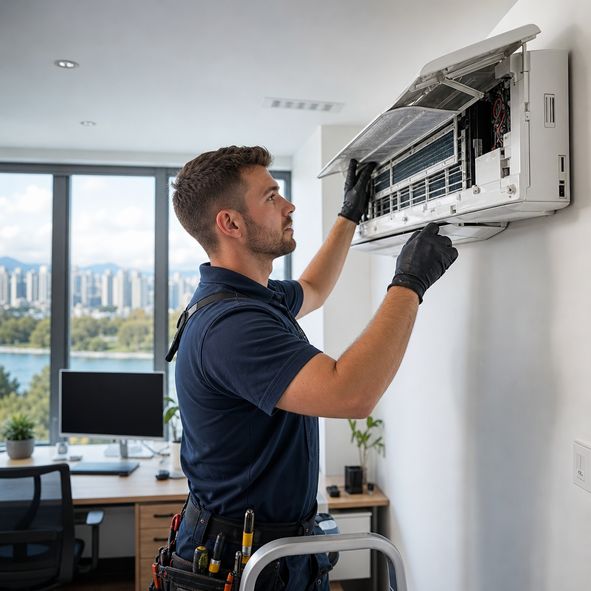
Why Is Heating and Cooling a Home Office Different From the Rest of Your Home?
Quick Answer: A home office is a dedicated, occupied zone with unique heat loads from electronics, occupancy patterns, and air quality demands. Standard whole-home HVAC often over- or under-conditions this space, creating discomfort and reducing productivity during long work sessions.
If you work from home in Vancouver, Burnaby, Richmond, or anywhere across the Lower Mainland, you already know the challenge: your living room might feel fine while your home office is either sweltering from monitor heat or freezing during one of the region’s damp, penetrating cold snaps. Heating and cooling a home office requires a targeted approach that accounts for micro-zone load, continuous occupancy, and BC’s coastal humidity profile — factors that generic HVAC sizing simply ignores.
Unlike bedrooms or living spaces, a home office runs equipment generating significant sensible heat — multiple monitors, desktop towers, printers, and LED lighting — often for eight to ten consecutive hours. These internal gains dramatically shift the Manual J load calculation. Add the Lower Mainland’s relative humidity averaging 70–80% in autumn and winter, and you have a conditioning challenge that demands precision engineering, not guesswork.
How Do You Properly Size an HVAC System for a Home Office?
Quick Answer: Proper sizing requires a room-level Manual J load calculation factoring square footage, ceiling height, insulation R-values, window orientation, internal heat gains from electronics, and local design temperatures — not a simple per-square-foot rule of thumb.
The classic rule-of-thumb — 20 BTU per square foot — collapses when applied to a south-facing home office in Surrey with a glass wall and three monitors running all day. A certified technician performing a Manual J load calculation will assess:
- Sensible heat from electronics: A typical dual-monitor workstation generates 300–500 BTU/hr continuously.
- Occupancy load: Each occupant adds approximately 250 BTU/hr sensible heat.
- Envelope performance: Wall insulation (R-13 to R-22 in Lower Mainland builds), window U-values, and air leakage rates.
- Latent load: Coastal humidity means your system must manage moisture removal, not just temperature.
- Vancouver design conditions: ASHRAE 99% heating design temperature for Vancouver is approximately 23°F (-5°C); cooling design is 79°F (26°C) dry bulb — relatively mild compared to Alberta, but humidity amplifies perceived discomfort significantly.
Oversizing is as damaging as undersizing. An oversized system short-cycles, fails to dehumidify properly, and creates temperature swings that are genuinely distracting during video calls. Undersizing means the system runs continuously without reaching setpoint during cold snaps. Neither outcome is acceptable for a productive work environment.
What Is the Best HVAC System Type for a Home Office in Vancouver?
Quick Answer: A variable-speed ductless mini-split heat pump is typically the best solution for a dedicated home office in the Lower Mainland — offering precise zone control, whisper-quiet operation, superior dehumidification, and year-round heating and cooling from a single system.
Let’s evaluate the primary system options available to Lower Mainland homeowners:
Ductless Mini-Split Heat Pumps (Variable-Speed/Inverter-Driven)
These systems are engineered for exactly this application. An inverter-driven compressor modulates capacity continuously — from as low as 20% to 100% — meaning the system holds your setpoint within ±0.5°F rather than cycling on and off. For a 150–300 sq ft home office, a 9,000–12,000 BTU/hr unit with an HSPF2 rating of 9.0 or higher and a SEER2 rating of 18 or higher provides outstanding year-round performance. Cold climate models rated to -22°F (-30°C) ambient heating operation are available, though Vancouver’s winters rarely challenge this limit. Indoor head unit sound levels as low as 19–26 dB(A) mean you will not hear the system during calls or recordings.
High-Efficiency Gas Furnaces with Zone Control
If your home already has ducted forced air, a two-stage or modulating furnace paired with a zone damper system can serve the home office as a dedicated zone. Look for AFUE ratings of 96% or higher and variable-speed ECM blower motors, which reduce airflow noise substantially. However, ducted systems deliver less precise humidity control and require balancing to prevent pressure imbalance across zones — a task requiring Technical Safety BC-compliant commissioning.
Single-Stage Systems: Why to Avoid Them for This Application
Single-stage equipment — whether a furnace, heat pump, or central air conditioner — operates at 100% capacity or zero. In a small home office, this produces temperature swings of 3–5°F, audible cycling noise, and poor dehumidification because the system does not run long enough per cycle to pull adequate moisture from the air. For Vancouver’s humid shoulder seasons (October–April), this is a meaningful comfort deficit.
System Comparison Table: Home Office HVAC Options
| System Type | Efficiency Metric | Noise Level | Humidity Control | Zone Precision | Best For |
|---|---|---|---|---|---|
| Variable-Speed Mini-Split Heat Pump | HSPF2 ≥9.0 / SEER2 ≥18 | 19–26 dB(A) | Excellent | Outstanding (±0.5°F) | Dedicated office, any size home |
| Modulating Gas Furnace + Zoning | AFUE ≥96% | Moderate (duct noise) | Good (add HRV) | Good (zone dampers) | Homes with existing ductwork |
| Two-Stage Central Heat Pump | HSPF2 7.5–8.5 / SEER2 15–17 | Moderate | Good | Moderate | Whole-home with partial zoning |
| Single-Stage Forced Air | AFUE 80% / SEER2 <14 | High (cycling) | Poor | Poor | Not recommended for offices |
| Electric Baseboard | COP 1.0 (100% efficient) | Silent | None | Per-room thermostats | Supplemental heat only |
What Indoor Air Quality Considerations Apply to a Home Office?
Quick Answer: Home offices accumulate VOCs from electronics, CO2 from continuous occupancy, and particulates from paper handling. In Vancouver’s humid coastal climate, mould-inhibiting ventilation through an HRV or ERV integrated with your HVAC system is strongly advisable for long-term respiratory health.
An often-overlooked dimension of home office comfort is air quality. Hours of continuous occupancy in a sealed room elevate CO2 levels, reducing cognitive performance measurably above 1,000 ppm. A Heat Recovery Ventilator (HRV) or Energy Recovery Ventilator (ERV) integrated with your HVAC system continuously exchanges stale indoor air for fresh outdoor air while recovering 70–80% of the thermal energy — maintaining comfortable temperatures without compromising ventilation.
Mini-split indoor units equipped with multi-stage filtration (including activated carbon and HEPA-grade filters) further reduce particulates and VOCs, addressing the specific environment of electronics-heavy workspaces. All ventilation and combustion appliance work in BC must comply with Technical Safety BC regulations and BC Building Code Section 9.32 — another reason to insist on licensed, Red Seal certified installation.
How Do You Optimize Thermostat Settings and Controls for a Home Office?
Quick Answer: Use a smart thermostat or the mini-split’s built-in scheduling to pre-condition your office 30 minutes before work begins, maintain 70–72°F (21–22°C) during working hours, and set back automatically after hours — maximizing comfort without conditioning an unoccupied space unnecessarily.
Modern mini-splits and smart thermostats support occupancy scheduling, geofencing, and remote access via smartphone. This means your home office reaches target temperature before you sit down, and reverts to setback mode the moment your workday ends. Wi-Fi enabled mini-split controllers integrate with home automation platforms, while communicating thermostat systems on ducted equipment provide real-time diagnostics and filter change reminders — reducing the risk of a mid-workday system failure.
Frequently Asked Questions: Home Office HVAC in the Lower Mainland
Q1: Can I just use a portable air conditioner or space heater for my home office?
Portable units are a last resort, not a solution. Portable ACs vent hot exhaust through a window kit, creating negative pressure that draws humid outdoor air into your space — the opposite of what a coastal BC home needs. Electric space heaters offer zero humidity control and consume substantial power. Neither option provides the dehumidification, air filtration, or precise temperature modulation a home office requires for sustained comfort and productivity.
Q2: How do I know if my existing HVAC system can handle adding a home office zone?
A licensed HVAC technician will perform a duct leakage test and static pressure measurement on your existing system. If your furnace or air handler is already operating near capacity, adding a zone without upgrading the equipment or installing a bypass damper will cause pressure imbalance, airflow noise, and premature equipment failure. Never assume spare capacity exists without measurement — assumptions are what lead to expensive callbacks.
Q3: What efficiency rating should I look for in a mini-split for year-round use in Vancouver?
For the Lower Mainland’s climate — mild cooling load, moderate heating load, high humidity — target an HSPF2 of 9.0 or above for heating efficiency and SEER2 of 18 or above for cooling. Ensure the unit is rated for low-ambient heating operation (at minimum to 5°F/-15°C) even though Vancouver rarely hits those temperatures. Cold-climate ratings provide a buffer of reliability during anomalous cold snaps like those experienced in December 2022.
Q4: Does a mini-split installation in a home office require permits in BC?
Yes. Any refrigerant system installation in British Columbia requires a licensed refrigeration mechanic (Refrigeration and Air Conditioning Mechanic — Red Seal or BC Trades Qualification) and must comply with Technical Safety BC regulations. Permits are required for electrical connections, and work must meet BC Electrical Code requirements. Unpermitted work voids manufacturer warranties, creates liability exposure, and may cause complications with home insurance. Always insist on fully licensed, permitted installation.
Conclusion: Work Smarter With the Right Home Office Climate System
Heating and cooling a home office in Vancouver’s Lower Mainland is a precision engineering challenge — one that rewards homeowners who invest in properly sized, efficiency-rated, variable-speed systems with years of quiet, stable, productive comfort. Whether you choose an inverter-driven ductless mini-split for dedicated zone control or a modulating furnace with smart zoning for a ducted home, the fundamentals remain constant: accurate Manual J sizing, Technical Safety BC-compliant installation, and equipment matched to our coastal climate’s unique humidity demands. Do not leave your workday comfort — or your equipment warranty — to chance. For reliable, Red Seal certified heat pump installation in Vancouver and throughout the Lower Mainland, contact the local experts at BCRC Heating and Cooling today at (604) 781-7272 and schedule your professional home office HVAC assessment.