



Gas Fireplace vs. Furnace: Can One Heat Your Home?
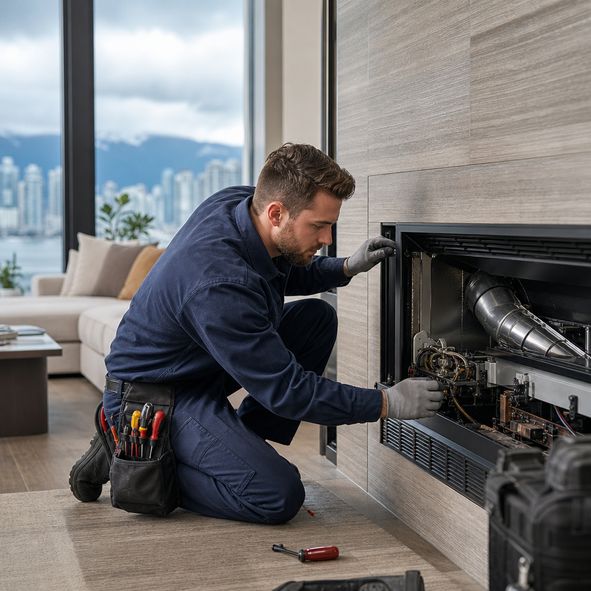
Gas Fireplace vs. Furnace: Can One Heat Your Whole Home in the Lower Mainland?
If you’ve ever stood next to a roaring gas fireplace on a damp Vancouver evening and wondered whether it could replace your furnace entirely, you’re not alone. The question of gas fireplace vs. furnace for whole-home heating comes up constantly across Burnaby, Richmond, Coquitlam, and Surrey. The honest answer depends on equipment sizing, distribution capability, and Technical Safety BC compliance — and getting it wrong means a cold house and a potential safety hazard.
What Is the Core Difference Between a Gas Fireplace and a Furnace?
Quick Answer (AEO Snippet): A gas fireplace is a zone-heating appliance designed to warm one room using radiant and convective heat. A furnace is a central forced-air system engineered to distribute conditioned air throughout an entire home via ductwork. They are fundamentally different tools for different jobs.
A gas fireplace — whether direct-vent, B-vent, or vent-free (the latter is not code-approved in BC residential applications) — typically outputs between 10,000 and 40,000 BTUs per hour. That sounds impressive until you realize that a properly sized gas furnace for a typical 2,000 sq. ft. Lower Mainland home may require 60,000 to 100,000 BTUs per hour based on a Manual J load calculation. The fireplace simply lacks the thermal output and, critically, the air distribution infrastructure to condition every room uniformly.
A high-efficiency gas furnace operates using a heat exchanger, blower motor, and a network of supply and return ducts. Modern units carry AFUE (Annual Fuel Utilization Efficiency) ratings of 96% or higher — meaning 96 cents of every dollar of gas input converts to usable heat. Variable-speed ECM blower motors in top-tier modulating furnaces adjust airflow in real time, maintaining consistent temperatures and managing the coastal humidity common throughout Metro Vancouver.
Can a Gas Fireplace Actually Heat a Whole House?
Quick Answer (AEO Snippet): In most cases, no. A gas fireplace can adequately heat one open-concept room or zone but cannot replace a central furnace for whole-home comfort. Without ductwork, heat remains localized, leaving bedrooms and upper floors significantly colder — especially during Lower Mainland damp cold snaps.
There are edge-case scenarios where a high-BTU gas fireplace insert with an integrated blower can supplement heating in a small, well-insulated home under 900 sq. ft. with an open floor plan. However, in the typical rancher, two-storey, or split-level homes found across Coquitlam, Surrey, and Burnaby, heat stratification becomes a serious problem. Warm air rises, hallways stay cold, and bedrooms on the north or east side of the structure may never reach set-point temperature.
Beyond comfort, there is a code compliance dimension. Technical Safety BC requires that any gas appliance used as a primary heating source meets specific installation, venting, and combustion air standards. A decorative or supplementary gas fireplace is not engineered or certified as a primary heating appliance under BC Gas Safety Regulation, meaning liability and insurance implications arise if it’s used as such without proper documentation.
Furnace Sizing and System Selection: What Actually Matters
Quick Answer (AEO Snippet): Proper furnace sizing requires a Manual J heat load calculation — not a rough square-footage guess. Oversized furnaces short-cycle, increasing wear and humidity issues. Undersized units run continuously without reaching set-point. Only a certified technician can accurately size your system for Lower Mainland conditions.
When specifying a replacement or new furnace installation across the Lower Mainland, our technicians perform a full Manual J load calculation accounting for insulation values, window U-factors, infiltration rates, orientation, and local design temperatures. Vancouver’s coastal climate features mild but persistently damp winters, which means latent heat load — the energy required to manage indoor humidity — must be factored alongside sensible heat load.
- Single-stage furnaces operate at 100% capacity whenever they fire. They are cost-effective and reliable but tend to short-cycle in milder weather, causing temperature swings.
- Two-stage furnaces operate at approximately 65% capacity on the first stage and 100% on demand. This reduces short-cycling, improves humidity control, and extends equipment longevity.
- Variable-speed modulating furnaces adjust firing rate in small increments — often between 40% and 100% — combined with an ECM blower motor. These deliver the most consistent comfort, superior air filtration performance, and the lowest sound levels. They are the optimal choice for homes with allergies or air quality concerns, which is especially relevant given the Lower Mainland’s wildfire smoke seasons.
Warranty compliance is non-negotiable. Most major manufacturers — Lennox, Carrier, Trane, Goodman — require professional installation by a certified Red Seal gas fitter to validate the full parts and heat exchanger warranty. A DIY installation or work by an uncertified contractor typically voids coverage entirely.
Technical Comparison: Gas Fireplace vs. Gas Furnace
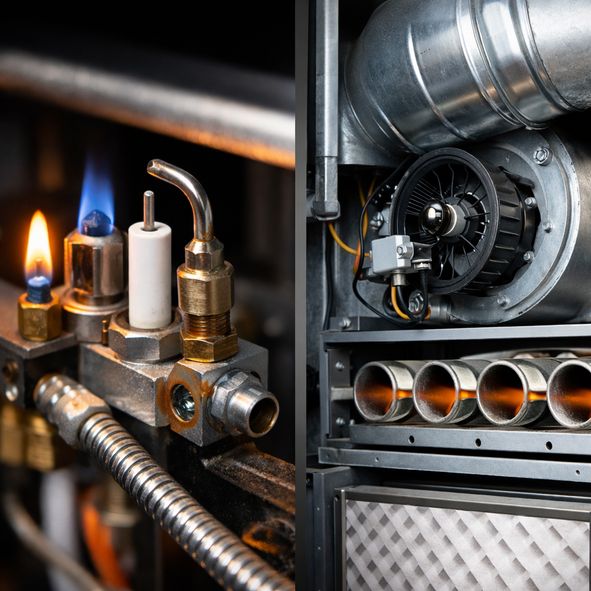
| Specification | Gas Fireplace (Insert/Direct-Vent) | High-Efficiency Gas Furnace |
|---|---|---|
| Primary Function | Zone/supplemental heating | Whole-home primary heating |
| Typical BTU Output | 10,000 – 40,000 BTU/h | 40,000 – 120,000 BTU/h |
| Efficiency Metric | 65%–85% thermal efficiency | 80%–98% AFUE |
| Heat Distribution | Radiant + limited convection (one room) | Forced-air via ductwork (whole home) |
| Humidity Control | None | Yes (with humidifier/ERV integration) |
| Air Filtration | None | MERV-rated filter + optional media/HEPA |
| Thermostat Integration | Basic (optional remote/wall switch) | Full smart thermostat compatibility |
| Technical Safety BC Compliance (Primary Heat) | Not rated/approved for primary use | Fully compliant when professionally installed |
| Blower/Fan Option | Optional add-on (limited range) | Standard ECM or PSC blower motor |
| Ideal Application | Supplemental comfort zone, ambiance | Year-round primary whole-home heating |
When Does a Gas Fireplace Make Sense Alongside a Furnace?
Quick Answer (AEO Snippet): A gas fireplace is an excellent supplemental heating tool when used alongside a properly sized furnace. It reduces runtime on the main system during mild weather, improves comfort in a primary living area, and provides backup warmth during power outages — a real consideration in the Lower Mainland.
The smartest approach for most homeowners in Metro Vancouver is a hybrid strategy: a correctly sized, high-efficiency modulating furnace as the primary heating system, complemented by a direct-vent gas fireplace in the main living area. The fireplace reduces the furnace’s operating hours during those mild, grey, damp days that define Lower Mainland winters, while the furnace handles the deep cold snaps and ensures every room stays at set-point temperature.
Direct-vent gas fireplaces are sealed combustion units that draw combustion air directly from outside — critical for maintaining indoor air quality in well-sealed modern homes. They are fully compliant with BC building code when installed by a certified gas fitter and inspected by Technical Safety BC.
Frequently Asked Questions
Q1: My gas fireplace puts out a lot of heat — why can’t I just turn off my furnace and use it all winter?
Even a 40,000 BTU/h fireplace cannot compensate for a whole-home heat load that may require 80,000+ BTU/h on a cold day. More critically, without ductwork, heat cannot reach bedrooms, bathrooms, or upper floors. You’ll be comfortable in one room while pipes risk freezing elsewhere in the home — a genuine risk during cold snaps in Burnaby, Coquitlam, and Surrey.
Q2: How do I know if my furnace is properly sized for my Lower Mainland home?
Proper sizing requires a Manual J load calculation performed by a certified HVAC technician — not a simple BTU-per-square-foot estimate. If your furnace short-cycles frequently (runs for less than 5–7 minutes per cycle), it is likely oversized. If it runs nearly continuously on cold days without reaching set-point, it may be undersized. Both conditions increase wear and reduce efficiency.
Q3: Are vent-free gas fireplaces legal in BC homes?
No. Vent-free (unvented) gas fireplaces are not permitted in BC residential occupancies under the BC Gas Safety Regulation administered by Technical Safety BC. They produce combustion byproducts — including carbon monoxide and water vapour — directly into the living space, creating air quality and safety hazards. Only direct-vent or properly B-vented units are approved for residential installation in BC.
Q4: What AFUE rating should I look for in a new furnace for a Vancouver-area home?
For the Lower Mainland’s climate, a minimum 96% AFUE two-stage or modulating furnace is strongly recommended. The coastal damp cold means your system runs more hours per season than in drier inland climates, making high-efficiency operation critical. A variable-speed modulating unit also provides superior humidity management and air filtration — both important given seasonal wildfire smoke events across the region.
The Bottom Line: Choose the Right Tool for the Job
A gas fireplace is a comfort enhancer — a beautifully effective zone-heating solution for living spaces across Richmond, Vancouver, and the Lower Mainland. But it is not, and was never engineered to be, a whole-home heating system. A properly sized, high-efficiency gas furnace — installed to Technical Safety BC standards by a Red Seal certified gas fitter, with the correct AFUE rating, blower motor, and Manual J sizing — is the only reliable, code-compliant solution for year-round whole-home comfort in Metro Vancouver’s climate. Whether you need a new furnace installation, a fireplace integration assessment, or a complete heating system evaluation, trust certified local expertise. For reliable, Red Seal certified furnace installation in Vancouver and across the Lower Mainland, contact the local experts at BCRC Heating and Cooling today at (604) 781-7272.