


Pet Owners’ HVAC Guide: Fur, Dander & Air Quality
Why Pet Ownership Puts Extra Demands on Your HVAC System
If you share your Vancouver or Burnaby home with cats, dogs, or other furry companions, your Pet Owners’ Guide to HVAC: Fur, Dander, and Air Quality starts with one hard truth: your heating and cooling system works significantly harder than it does in a pet-free household. Pet hair, dander, and the coastal humidity of the Lower Mainland combine to create filter-clogging, coil-fouling, and duct-contaminating conditions that degrade both equipment efficiency and indoor air quality faster than most homeowners realize.
In this technically rigorous guide, Red Seal certified technicians from BCRC Heating and Cooling break down exactly what happens inside your HVAC system when pets are part of the family — and what you can do to protect equipment performance, maintain healthy air, and extend system lifespan across Vancouver, Richmond, Coquitlam, Surrey, and the entire Lower Mainland.
How Does Pet Dander Affect HVAC Efficiency and Performance?
Quick Answer: Pet dander and fur act as insulating debris on evaporator coils, heat exchanger surfaces, and filter media. This forces your system to run longer cycles, reduces airflow by up to 15–25%, and can cause AFUE and SEER2 ratings to drop measurably within months without proper maintenance.
From a mechanical standpoint, pet dander particles range from 2.5 to 10 microns — small enough to bypass a standard MERV 4–6 filter and settle on the internal surfaces of your air handler, blower wheel, and evaporator coil. In Vancouver’s coastal climate, ambient relative humidity regularly sits between 70–85% in winter months, causing dander and fine hair to clump and adhere to these surfaces with surprising tenacity.
On a high-efficiency gas furnace rated at 96% AFUE, restricted airflow caused by bio-debris accumulation forces the heat exchanger to run hotter, triggering high-limit safeties, reducing modulation efficiency on variable-speed systems, and accelerating thermal fatigue on the heat exchanger itself — a Technical Safety BC compliance concern if cracks develop and combustion gases migrate into conditioned air.
For heat pump systems measured under HSPF2 and SEER2 standards, coil fouling caused by pet hair reduces heat transfer coefficient efficiency, meaning your system must run longer to meet thermostat demand. A variable-speed inverter-driven system handles this more gracefully than a single-stage unit, but no system is immune to the cumulative impact of pet-related particulate loading.
What MERV Rating Is Best for Pet Owners in the Lower Mainland?
Quick Answer: For pet owners in Vancouver and surrounding areas, MERV 11 to MERV 13 filters offer the best balance between dander and allergen capture and system airflow. MERV 16 and HEPA filters require professional verification that your air handler’s static pressure tolerance can support the added restriction.
Filter selection is one of the most consequential decisions a pet-owning homeowner makes. The chart below summarizes key filter specifications relevant to your situation:
| Filter Type | MERV Rating | Particle Size Captured | Pet Dander Capture Rate | Change Frequency (Pets) | Airflow Impact | Best For |
|---|---|---|---|---|---|---|
| Standard Fibreglass | MERV 1–4 | >10 microns | Very Low | Monthly | Minimal | Equipment protection only |
| Pleated Polyester | MERV 8–10 | 3–10 microns | Moderate | Every 30–45 days | Low–Moderate | Single-pet households |
| High-Efficiency Pleated | MERV 11–13 | 1–3 microns | High | Every 20–30 days | Moderate | Multi-pet households |
| HEPA / Near-HEPA | MERV 14–16 | 0.3–1 micron | Very High | Every 60–90 days | High — requires CFM verification | Allergy-sensitive households |
| Electronic Air Cleaner | MERV 15+ equivalent | Sub-micron | Excellent | Panel wash every 30 days | Low (when clean) | High-dander multi-pet homes |
Critical technical note: Installing a MERV 13+ filter on a system sized for MERV 8 media can increase external static pressure beyond the blower’s rated capacity, reducing airflow below the minimum CFM required for proper heat exchanger operation or refrigerant charge evaporation. Always have a Red Seal technician verify your air handler’s rated static pressure before upgrading filter media.
Single-Stage vs. Two-Stage vs. Variable-Speed: Which System Handles Pet Homes Best?
Quick Answer: Variable-speed modulating furnaces and inverter-driven heat pumps are the superior choice for pet owners. Their continuous low-speed operation circulates air through filtration media more frequently, dramatically reducing airborne dander and maintaining consistent humidity levels — critical in Vancouver’s damp climate.
Here is how each system type performs in a pet-heavy Lower Mainland household:
- Single-Stage Systems: Operate at 100% capacity or off. Short, infrequent cycles mean less air circulation through filters, allowing dander to accumulate and resettle on surfaces. Manual J load calculations must account for this cycling behavior in homes with high internal particulate loads.
- Two-Stage Systems: Run at approximately 65% capacity on first stage, providing longer, gentler cycles and improved air filtration time. A meaningful improvement over single-stage for pet households.
- Variable-Speed Modulating Systems: Can operate at as low as 30–40% capacity, running almost continuously at low output. This constant low-velocity airflow through MERV 11–13 media represents the gold standard for dander control. These systems also maintain tighter humidity control — a critical advantage in Burnaby, Richmond, and coastal Surrey microClimates where humidity swings are pronounced.
What Ventilation and IAQ Equipment Should Pet Owners Add?
Quick Answer: Heat Recovery Ventilators (HRVs) are essential in tight Lower Mainland homes with pets, introducing fresh outdoor air while recovering heat energy. Paired with UV-C germicidal lights and electronic air cleaners, they address dander, VOCs from pet bedding, and biological contaminants simultaneously.
Vancouver’s energy-efficient new construction creates tight building envelopes that trap pet odours, dander, and VOCs. An HRV installed and commissioned to BC Building Code specifications maintains balanced ventilation, flushes stale dander-laden air, and helps regulate the 35–50% relative humidity range ideal for both human comfort and HVAC equipment protection.
UV-C germicidal irradiation systems mounted in the air handler’s supply plenum neutralize airborne biological particles — including pet dander-bound bacteria and mould spores that thrive in the Lower Mainland’s coastal moisture environment. These are factory-integrated or field-installed additions compatible with most major residential air handlers and must be positioned per Technical Safety BC electrical installation requirements.
How Often Should Pet Owners Schedule HVAC Maintenance?
Quick Answer: Pet owners should schedule professional HVAC maintenance every six months rather than the standard annual interval. Semi-annual service allows technicians to inspect coil fouling, verify heat exchanger integrity, check refrigerant charge, and clean blower assemblies before bio-debris causes efficiency loss or safety hazards.
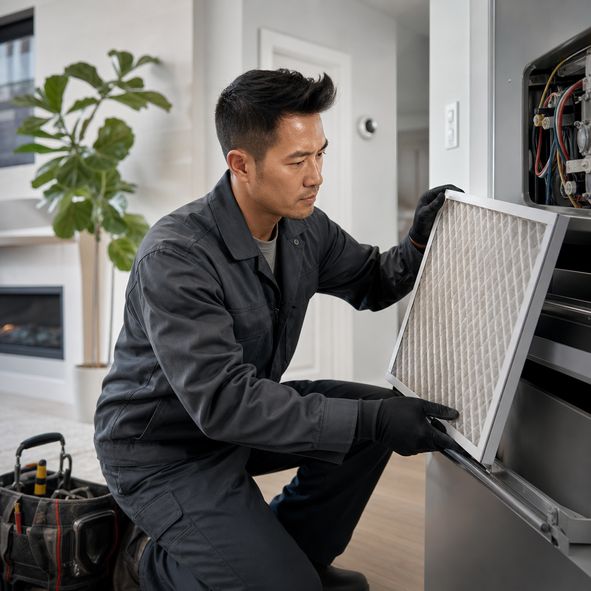
During a professional tune-up in a pet household, a Red Seal technician will: perform a combustion analysis on gas furnaces to confirm safe flue gas composition; measure supply and return static pressure to detect filter bypass or blower restriction; inspect the evaporator coil for hair and dander accumulation using a coil brush and approved non-acid coil cleaner; verify refrigerant subcooling and superheat values on heat pump systems; and confirm all warranty documentation requirements are met, as most manufacturers void warranties when maintenance intervals are not observed.
Frequently Asked Questions: HVAC and Pet Owners
Q1: Can pet hair actually damage my furnace or heat pump?
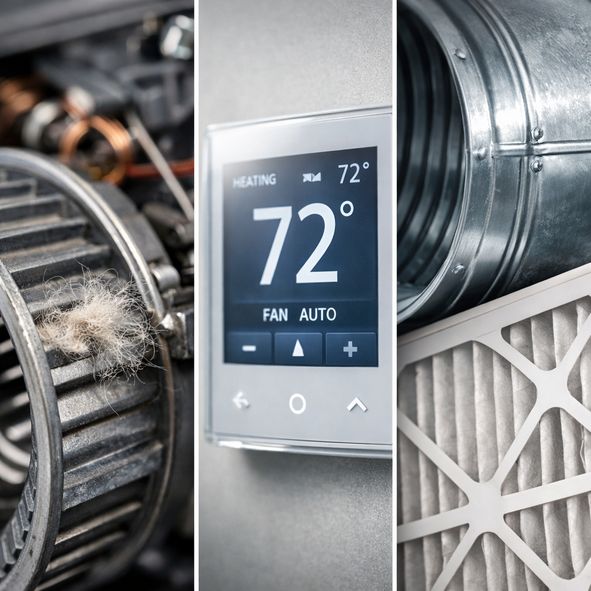
Yes. Pet hair entering the blower compartment wraps around motor bearings and capacitor leads, causing overheating and premature motor failure. Hair accumulation on the evaporator coil restricts refrigerant evaporation, potentially causing liquid slugging back to the compressor — one of the most expensive failure modes in a heat pump or air conditioner. Semi-annual coil cleaning by a certified technician is your primary defence.
Q2: My dog sheds heavily. How often should I truly change my furnace filter?
In a heavy-shedding single-dog household using a MERV 11 pleated filter, inspect your filter every two to three weeks and replace it when you observe more than 30% surface loading — typically every 20 to 30 days during peak shedding seasons. Waiting for the filter to appear fully grey causes airflow restriction that forces your furnace’s high-limit control to cycle on safety, stressing the heat exchanger and triggering service calls.
Q3: Will an air purifier replace the need for more frequent HVAC filter changes?
No. Standalone room air purifiers address localized dander in a single room but do nothing to protect your HVAC equipment’s internal components. The furnace filter’s primary job is equipment protection, not air quality alone. A whole-home electronic air cleaner integrated into your duct system provides both equipment protection and superior dander removal, but still requires monthly panel washing to maintain rated efficiency.
Q4: Does pet ownership affect the sizing of my HVAC system when I replace it?
Indirectly, yes. A proper Manual J load calculation accounts for internal heat gains, ventilation rates, and latent load — all of which are affected by occupancy patterns in multi-pet homes. HRV ventilation rates, additional internal moisture from animals, and the need for higher-static-pressure-compatible equipment to handle upgraded filter media are all variables a qualified technician must factor into equipment selection and duct system evaluation.
Protect Your Pets, Your Family, and Your HVAC Investment
Living with pets in Vancouver, Burnaby, Coquitlam, Surrey, or Richmond means your HVAC system faces year-round particulate challenges compounded by the Lower Mainland’s coastal humidity. The solution is not reactive — it is a proactive combination of correctly rated filtration, semi-annual professional maintenance, appropriate system selection, and integrated ventilation equipment. Variable-speed modulating systems, properly sized and commissioned to Technical Safety BC standards, deliver the continuous low-speed airflow that keeps dander in suspension and in contact with your filter media rather than settling on coils, ducts, and occupied living spaces. Every decision from filter MERV rating to HRV commissioning flow rate impacts both equipment warranty validity and the long-term respiratory health of your household — human and animal alike.
For expert HVAC assessments, coil cleaning, filter system upgrades, and furnace installation in Vancouver tailored specifically for pet-owning households, call the Red Seal certified team at BCRC Heating and Cooling directly at (604) 781-7272. We serve Vancouver, Burnaby, Richmond, Coquitlam, Surrey, and the entire Lower Mainland — and we understand exactly what your system needs to perform reliably in a home full of four-legged family members.