



SEER, AFUE & HSPF Ratings Explained for BC Homes
What Do SEER, AFUE, and HSPF Ratings Actually Mean for Lower Mainland Homeowners?
If you’ve ever shopped for a furnace, air conditioner, or heat pump and found yourself staring at a wall of numbers — SEER, AFUE, HSPF, SEER2, HSPF2 — you’re not alone. These efficiency ratings are the single most important technical benchmarks when selecting HVAC equipment for a Vancouver-area home, yet most homeowners never receive a clear explanation. This guide decodes every metric, connects them to real Lower Mainland climate conditions, and gives you the technical foundation to make a confident, informed decision.
What Is AFUE and Why Does It Matter in BC’s Damp Climate?
AFUE (Annual Fuel Utilization Efficiency) measures how efficiently a furnace or boiler converts fuel into usable heat over an entire heating season. A 96% AFUE furnace converts 96 cents of every dollar of natural gas into heat, wasting only 4 cents. In BC’s coastal climate with long, damp heating seasons, maximizing AFUE directly maximizes comfort and reliability.
AFUE is expressed as a percentage and is governed by standardized testing under ANSI/ASHRAE conditions. Here’s what the ranges mean in practical terms for Metro Vancouver and the Fraser Valley:
- 80% AFUE (Standard Efficiency): Single-stage, conventional heat exchanger. Vents through a metal flue. These units draw combustion air from inside the home, which matters in tightly sealed modern builds.
- 90–95% AFUE (Mid-High Efficiency): Two-stage burners and induced-draft motors. Significantly more stable indoor temperatures than single-stage units.
- 96–98.5% AFUE (Modulating Condensing): Variable-speed ECM blower motors, secondary stainless-steel condensing heat exchangers, and PVC exhaust venting. These are the top-tier units designed for BC’s lengthy but moderate heating seasons. Condensing furnaces extract latent heat from flue gases, dropping exhaust temperatures low enough that PVC pipe is used instead of steel flue — a critical safety and Technical Safety BC compliance point.
For homes in Burnaby, Coquitlam, and Richmond — where coastal humidity accelerates corrosion — a modulating condensing furnace with a stainless-steel or silicon-aluminum heat exchanger is the professional recommendation. Manual J load calculations are mandatory before specifying BTU output; oversizing a furnace causes short-cycling, excessive humidity swings, and premature heat exchanger fatigue.
What Is SEER2 and How Does It Apply to AC Systems in Vancouver?
SEER2 (Seasonal Energy Efficiency Ratio 2) measures an air conditioner’s cooling output divided by the electrical energy it consumes over a full cooling season, using updated M1 external static pressure testing conditions introduced in 2023. Higher SEER2 means more cooling delivered per unit of electricity consumed. BC’s moderate summers make mid-to-high SEER2 ratings a smart long-term performance choice.
The original SEER rating was replaced by SEER2 in January 2023 to better reflect real-world installed duct system resistance. A unit rated 16 SEER under the old standard is approximately equivalent to 15.2 SEER2 under the new protocol — so always compare within the same rating system when evaluating equipment. Key SEER2 benchmarks for Lower Mainland residential installations include:
- 13.4 SEER2: Current federal minimum for split-system central air conditioners in Canada’s northern climate zone.
- 16–18 SEER2: Two-stage or variable-speed compressor systems. Ideal for Surrey and Langley homes where summer cooling loads are moderate but humidity control is paramount.
- 20+ SEER2: Inverter-driven variable-speed compressors. Near-continuous low-capacity operation delivers superior humidity control, quieter operation, and longer equipment lifespan. Best suited for high-performance homes with well-sealed, properly sized ductwork verified by a Manual J and Manual D calculation.
Single-stage compressors blast at 100% capacity until the thermostat setpoint is reached, then shut off completely — this on/off cycling is the enemy of humidity management in Vancouver’s maritime climate. Variable-speed systems modulate between roughly 25–100% capacity, maintaining consistent supply air temperatures and dramatically improving indoor air quality and comfort.
What Is HSPF2 and Why Is It the Key Metric for Heat Pumps in BC?
HSPF2 (Heating Seasonal Performance Factor 2) measures a heat pump’s total heating output in BTUs divided by total electrical energy consumed in watt-hours over an entire heating season, under updated testing conditions. The higher the HSPF2, the more heat delivered per kilowatt-hour. BC’s mild winters make heat pumps with strong HSPF2 ratings an exceptionally efficient primary heating source.
Like SEER2, HSPF2 replaced the original HSPF standard in 2023. A unit originally rated 10 HSPF may carry an HSPF2 rating of approximately 7.5–8.2 depending on the testing protocol — these are not directly interchangeable numbers. For Lower Mainland homeowners evaluating ducted heat pumps or ductless mini-splits, here’s what HSPF2 tiers mean technically:
- 7.5–8.5 HSPF2: Entry-level cold-climate heat pumps. Adequate for mild coastal Vancouver and Richmond winters.
- 9.0–10.5 HSPF2: High-efficiency inverter systems. Variable-speed compressors maintain rated heating capacity down to -15°C ambient — critical for Coquitlam and Maple Ridge, where cold snaps occur.
- 10.5+ HSPF2: Premium cold-climate models maintaining 100% rated capacity at -25°C. These hyper-heating units are warranted for BC’s most demanding residential applications and pair ideally with a gas furnace backup in a dual-fuel configuration.
All heat pump installations in BC must comply with Technical Safety BC gas and electrical permit requirements, and equipment must meet BC Hydro’s performance specifications for grid compatibility. Only Red Seal certified gas fitters and licensed electricians should handle refrigerant lines, electrical connections, and commissioning.
Efficiency Ratings Comparison Table: Furnaces, AC Units & Heat Pumps
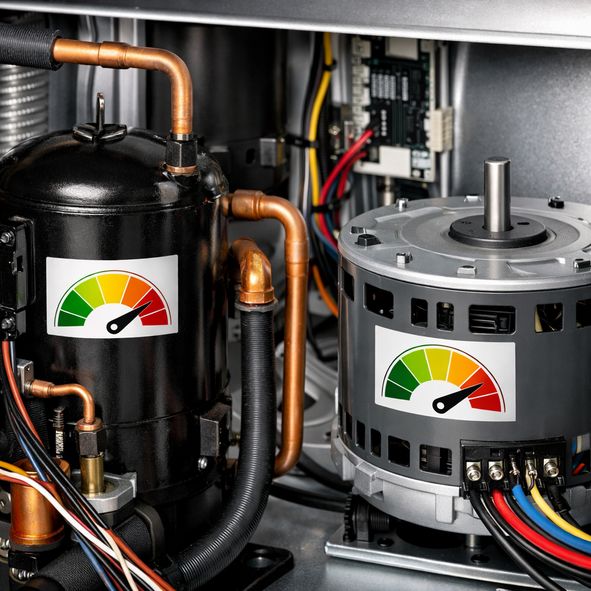
| Equipment Type | Efficiency Metric | Entry Level | High Efficiency | Premium / Variable-Speed | Best Application in Lower Mainland |
|---|---|---|---|---|---|
| Gas Furnace | AFUE % | 80% AFUE | 96% AFUE | 98%+ AFUE Modulating | Burnaby, Surrey, Fraser Valley long heating seasons |
| Central Air Conditioner | SEER2 | 13.4 SEER2 | 16–18 SEER2 | 20+ SEER2 Inverter | Surrey, Langley, Coquitlam summer humidity control |
| Heat Pump (Ducted) | HSPF2 / SEER2 | 7.5 HSPF2 | 9.0–10.5 HSPF2 | 10.5+ HSPF2 Cold Climate | Vancouver, Richmond, North Shore mild winters |
| Ductless Mini-Split | HSPF2 / SEER2 | 8.0 HSPF2 | 10.0 HSPF2 | 12+ HSPF2 Hyper Heat | Older homes without ductwork across the Lower Mainland |
Single-Stage vs. Two-Stage vs. Variable-Speed: Which Technology Matches BC’s Climate?
Efficiency ratings alone don’t tell the full story — the compressor and blower motor technology determines how that efficiency is actually delivered in the field. Single-stage systems operate at one fixed output level: fully on or fully off. They achieve their rated efficiency in lab conditions but rarely replicate it in real residential installations due to short-cycling. Two-stage systems run at approximately 65% capacity on mild days and 100% on peak demand days, dramatically reducing short-cycling and improving comfort. Variable-speed modulating systems adjust output in small increments from roughly 25% to 100%, maintaining near-constant airflow, superior humidity control, whisper-quiet operation, and the longest operational lifespan — all characteristics that align perfectly with Vancouver’s maritime climate profile.
Proper BTU sizing via a certified Manual J load calculation is non-negotiable. Oversizing any system — regardless of its AFUE, SEER2, or HSPF2 rating — produces short-cycling that destroys heat exchangers, compressors, and electrical components prematurely, and voids most manufacturer warranties. Undersizing causes continuous operation during peak demand, accelerating mechanical wear. Neither scenario delivers the efficiency the rating promises.
Frequently Asked Questions: HVAC Efficiency Ratings in the Lower Mainland
Q1: Is a higher AFUE furnace always the right choice for my Vancouver home?
Not automatically. A 96–98% AFUE modulating condensing furnace is the technically superior choice for most Metro Vancouver homes because BC’s heating season is long and mild — the modulating operation matches the load profile perfectly. However, the installation must include proper venting (PVC), adequate combustion air supply, and a correctly sized BTU output verified by Manual J. A high-AFUE furnace improperly sized or vented will underperform a correctly installed 80% unit — though we strongly recommend high-efficiency equipment for all new installations.
Q2: What’s the real-world difference between a 14 SEER2 and a 20 SEER2 air conditioner for a Burnaby home?
The 20 SEER2 unit is typically variable-speed, meaning it modulates compressor speed continuously rather than cycling on and off. In Burnaby’s humid summers, this translates to significantly better moisture removal from indoor air, quieter operation (often below 55 dB), more consistent supply air temperatures, and a longer compressor lifespan due to reduced mechanical stress. The efficiency gap only widens as the system ages — variable-speed compressors maintain closer to rated efficiency throughout their lifespan compared to single-stage units.
Q3: My heat pump struggles below 5°C in Coquitlam. Does HSPF2 rating explain why?
Yes, almost certainly. If your unit carries an HSPF2 below 8.5, it’s likely not a true cold-climate model and may be rated for heating capacity only down to -8°C ambient. Below that threshold, standard heat pumps experience significant capacity drop-off. Modern cold-climate units rated 10+ HSPF2 use enhanced vapour injection (EVI) compressor technology to maintain full rated heating capacity at -15°C to -25°C. If you’re in Coquitlam or the Tri-Cities area, cold-climate HSPF2 specification is essential, not optional.
Q4: Do SEER2 and HSPF2 ratings apply to the system as a whole, or just the outdoor unit?
Both ratings are system-level metrics — they apply to the matched combination of outdoor unit, indoor air handler or coil, and in the case of heat pumps, the refrigerant line set and expansion device. This is why mismatched components (e.g., pairing a high-efficiency outdoor unit with an older indoor coil) will never achieve the rated SEER2 or HSPF2. All components must be AHRI-matched and installed according to manufacturer specifications to validate both the efficiency rating and the full manufacturer warranty — a critical point that Technical Safety BC inspectors verify during system commissioning.
Conclusion: Matching the Right Efficiency Rating to Your Lower Mainland Home
Understanding SEER2, AFUE, and HSPF2 isn’t just academic — these numbers determine the comfort, reliability, and long-term performance of the equipment protecting your family through every damp Vancouver winter and humid Fraser Valley summer. The right rating tier, matched to a properly sized system installed by Red Seal certified technicians and commissioned to Technical Safety BC standards, is what separates genuinely high-performing HVAC equipment from a costly disappointment. Whether you’re replacing an aging furnace in Burnaby, upgrading to a variable-speed heat pump in Richmond, or installing a new central AC system in Surrey, the decision starts with an honest, professional load assessment — not a spec sheet. For Red Seal certified heat pump installation in Vancouver and throughout the Lower Mainland, trust the local technical experts at BCRC Heating and Cooling. Call us today at (604) 781-7272 to schedule your in-home assessment and equipment recommendation.