



How Windows Affect Your Heating & Cooling Bills
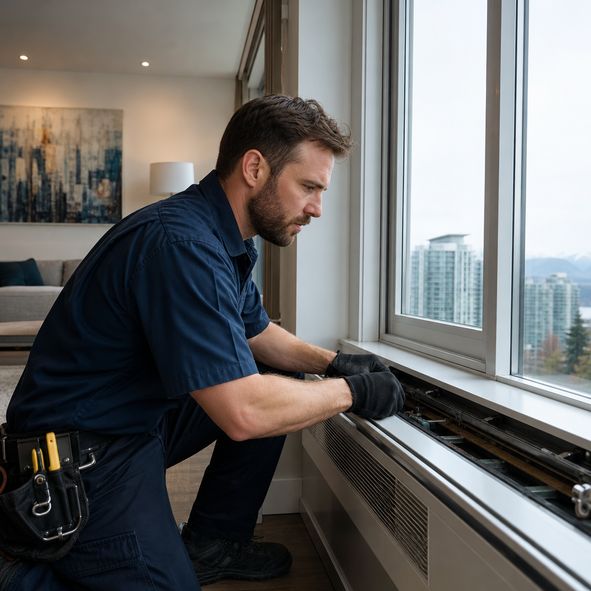
How Windows Affect Your Heating and Cooling Bills in the Lower Mainland
If you’ve ever noticed your furnace or heat pump running longer than expected during a damp Vancouver winter or a humid Burnaby summer, your windows may be the hidden culprit. How windows affect your heating and cooling bills is one of the most underestimated factors in HVAC system performance — and in the Lower Mainland’s coastal climate, the impact is amplified. Poor window performance forces your HVAC equipment to overwork, compromises indoor comfort, and can accelerate premature system failure. Understanding the relationship between your glazing and your mechanical systems is essential for every homeowner in Vancouver, Richmond, Surrey, Coquitlam, and beyond.
Why Do Windows Have Such a Large Impact on HVAC Load?
Direct Answer: Windows are responsible for up to 30% of a home’s total heating and cooling load. In the Lower Mainland’s damp, variable climate, poorly performing windows force HVAC systems to run longer cycles, increasing mechanical wear and dramatically reducing comfort and efficiency.
From a technical standpoint, every HVAC system is sized using a Manual J load calculation — the industry-standard method for determining the correct BTU capacity required to condition a space. This calculation accounts for window area, orientation, glazing type, U-factor, Solar Heat Gain Coefficient (SHGC), and air infiltration rates. When a home’s windows degrade or are replaced with units of different performance characteristics, the original Manual J assumptions become invalid. This means your furnace, heat pump, or air conditioner may now be undersized or oversized relative to the actual thermal load — both conditions cause serious operational problems.
In Vancouver and Burnaby, where coastal humidity regularly drives dew points higher than inland BC regions, window condensation and air sealing failures compound the issue further. Moisture infiltration around window frames doesn’t just affect comfort — it introduces latent heat load that forces variable-speed heat pumps and two-stage furnaces to modulate more aggressively, reducing their efficiency metrics (HSPF2 for heat pumps, AFUE for furnaces) in real-world operation versus rated conditions.
What Window Specifications Actually Matter for HVAC Performance?
Direct Answer: The U-factor, Solar Heat Gain Coefficient (SHGC), and air leakage rating are the three most critical window metrics affecting HVAC load. Lower U-factors reduce heat transfer; appropriate SHGC values balance solar gain with cooling demand; tight air leakage ratings minimize infiltration loads.
Here’s how each specification connects directly to your HVAC system’s workload:
- U-Factor: Measures the rate of non-solar heat transfer through the window assembly. For Lower Mainland climates (ASHRAE Climate Zone 5), a U-factor of 0.30 or lower is recommended. Every incremental improvement in U-factor directly reduces the heating BTU demand your furnace or heat pump must supply.
- Solar Heat Gain Coefficient (SHGC): Measures how much solar radiation passes through the glass. South-facing windows in Richmond or Surrey can be optimized with a moderate SHGC (0.35–0.45) to allow passive solar heating in winter while your heat pump’s SEER2-rated cooling mode handles summer. North-facing windows benefit from lower SHGC values.
- Air Leakage Rating: Expressed in cubic feet per minute per square foot (cfm/ft²), this metric directly contributes to infiltration load in your Manual J calculation. High-infiltration windows in older Coquitlam homes can add significant unaccounted latent and sensible load to your system.
- Frame Material Conductivity: Aluminum frames common in older Lower Mainland construction conduct heat aggressively. Fiberglass or thermally broken frames dramatically reduce edge-of-glass heat loss.
How Do Windows Affect Different HVAC System Types?
Direct Answer: Single-stage, two-stage, and variable-speed modulating systems respond differently to window-driven load variations. Variable-speed systems absorb load fluctuations most efficiently, but all systems suffer reduced lifespan and efficiency when window-related loads push them outside their design operating range.
Understanding how each system type responds to window performance is critical when evaluating upgrades:
- Single-Stage Furnaces (Fixed AFUE): Operate at 100% capacity or off. Poor windows create oversized load swings that cause short-cycling — a primary cause of heat exchanger cracking and premature blower motor failure. Technical Safety BC requires annual inspections on aging single-stage units for exactly this reason.
- Two-Stage Furnaces: Can operate at approximately 65% and 100% capacity. Better suited to moderate load variation caused by window performance changes, but still vulnerable to chronic oversizing if window degradation significantly increases the building envelope’s heat loss coefficient.
- Variable-Speed Modulating Heat Pumps (HSPF2-rated): These systems — particularly cold-climate ductless mini-splits and ducted inverter heat pumps — are the most resilient to window-driven load fluctuations. Variable-speed compressors modulate continuously between roughly 30% and 120% of nominal capacity, maintaining efficiency across a wide BTU range. However, even a high-HSPF2 heat pump operating in a thermally compromised building envelope will log more compressor hours, reducing overall system longevity.
- Central Air Conditioners (SEER2-rated): In Surrey and Richmond where summer cooling demand is rising, high-SHGC windows on west-facing exposures create afternoon peak loads that can exceed system capacity, causing the evaporator coil to operate below its dew point continuously — accelerating drain pan corrosion and biological growth.
Window Performance vs. HVAC System Type — Technical Comparison
| Window Type | U-Factor Range | SHGC Range | Impact on Furnace (AFUE) | Impact on Heat Pump (HSPF2) | Impact on AC (SEER2) | Recommended HVAC Pairing |
|---|---|---|---|---|---|---|
| Single-Pane Aluminum Frame | 0.80–1.10 | 0.70–0.86 | Severe real-world AFUE reduction; short-cycling risk | High compressor cycling; reduced HSPF2 field performance | Peak load overrun; coil freeze risk | Not compatible with modern variable-speed systems without envelope upgrade |
| Double-Pane Standard (older) | 0.40–0.60 | 0.40–0.60 | Moderate load; two-stage systems manage adequately | Moderate HSPF2 impact; acceptable for most Lower Mainland applications | Moderate cooling load; SEER2 near rated | Two-stage furnace or entry-level heat pump |
| Double-Pane Low-E (argon) | 0.25–0.35 | 0.25–0.40 | Minimal load; AFUE performance approaches rated value | HSPF2 field performance close to nameplate; reduced run hours | Reduced solar gain; SEER2 performance maintained | Variable-speed heat pump or high-AFUE modulating furnace |
| Triple-Pane Low-E (krypton) | 0.10–0.20 | 0.20–0.35 | Minimal heating load; furnace may be oversized at original sizing | Excellent; heat pump operates at minimum modulation — maximum HSPF2 | Lowest solar load; AC runtime minimized | Variable-speed inverter heat pump; re-evaluate Manual J sizing |
Diagnostic Signs Your Windows Are Stressing Your HVAC System
Direct Answer: Cold drafts near windows during Lower Mainland winters, excessive condensation on interior glazing, uneven room temperatures, and unusually long furnace or heat pump run cycles are all diagnostic indicators that window performance is adding abnormal load to your HVAC system.
As a certified HVAC technician conducting field diagnostics across Vancouver and the Lower Mainland, here are the red flags to look for:
- Thermal Imaging Anomalies: Infrared camera scans around window frames reveal cold bridging and air infiltration pathways invisible to the naked eye. These infiltration zones directly translate into unaccounted BTU losses in your system’s load.
- Short-Cycling Furnace or Heat Pump: If your system is turning on and off more than 3–4 times per hour in mild weather, window-driven load spikes may be causing the thermostat to rapidly satisfy and lose setpoint — a classic oversizing symptom triggered by envelope degradation.
- Elevated Indoor Relative Humidity in Winter: Lower Mainland damp cold snaps drive outdoor humidity above 85% frequently. If your windows are poorly sealed, latent infiltration load overwhelms your system’s dehumidification capacity, creating condensation and air quality issues that your HRV or ventilation system must compensate for.
- Uneven Temperature Distribution: Rooms with large single-pane or degraded double-pane windows create radiant cold asymmetry — where occupants feel cold even when air temperature is at setpoint. This triggers thermostat override behavior that increases system runtime artificially.
FAQ: Windows and HVAC Performance in the Lower Mainland
Q1: If I upgrade my windows, do I need to resize my HVAC system?
A: Potentially, yes. Significantly improving your window U-factor and air leakage rating reduces your home’s total BTU demand. If your furnace or heat pump was sized to the original Manual J load, it may now be oversized — causing short-cycling, humidity control issues, and accelerated mechanical wear. A certified technician should run a new Manual J after any major window upgrade to confirm system sizing remains appropriate. This is especially relevant in Coquitlam and Surrey where older homes with original aluminum windows are being retrofitted.
Q2: Can a high-efficiency heat pump compensate for poor windows in a Vancouver home?
A: A variable-speed cold-climate heat pump will perform better than a single-stage system in a thermally compromised envelope, but it cannot fully compensate for severe window heat loss. The system will log significantly more compressor hours, its real-world HSPF2 will fall well below its nameplate rating, and you’ll experience persistent comfort complaints near window surfaces regardless of air temperature setpoint.
Q3: What window specification should I request when discussing HVAC sizing with a technician?
A: Always provide or obtain the NFRC label data for your windows: U-factor, SHGC, and air leakage rating (cfm/ft²). Your HVAC contractor needs these values to run an accurate Manual J load calculation. For the Lower Mainland’s Climate Zone 5 classification, target U-factor ≤ 0.30, SHGC appropriate to window orientation, and air leakage ≤ 0.1 cfm/ft².
Q4: How does coastal humidity in Burnaby and Richmond affect the window-HVAC relationship differently than drier BC climates?
A: Coastal Lower Mainland humidity significantly increases the latent heat component of your total building load. Single-pane or poorly sealed windows allow humid outdoor air to infiltrate, adding latent BTU demand that sensible-only metrics like U-factor don’t fully capture. This is why Manual J calculations in coastal BC must use accurate moisture data, and why HVAC systems here often require enhanced dehumidification capacity compared to equivalent homes in the BC interior.
Trust a Red Seal Certified Team to Assess Your HVAC and Building Envelope Together
Windows and HVAC systems are not independent systems — they are thermally interdependent components of your home’s total building envelope. In Vancouver, Burnaby, Richmond, Surrey, and across the Lower Mainland, the coastal climate demands that both be evaluated together by a qualified professional. Whether you’re planning a window retrofit, sizing a new heating system, or diagnosing comfort complaints that your thermostat can’t explain, BCRC Heating and Cooling brings Red Seal certified expertise and rigorous Manual J methodology to every assessment. For reliable, Red Seal certified heat pump installation in Vancouver and comprehensive HVAC system sizing across the Lower Mainland, contact the local experts at BCRC Heating and Cooling today at (604) 781-7272.