


Burnaby Older Home HVAC Inspection Checklist
Why HVAC Inspection Is Non-Negotiable When Buying an Older Home in Burnaby
Buying an older home in Burnaby is an exciting opportunity — but hidden inside those charming walls could be an aging, undersized, or outright unsafe HVAC system ready to fail. Before you sign on the dotted line, a thorough HVAC inspection can reveal critical issues that affect your family’s comfort, indoor air quality, and long-term peace of mind across every season the Lower Mainland throws at you.
What Should I Look for in an HVAC System When Buying an Older Burnaby Home?
Quick Answer: Inspect the furnace age and AFUE rating, heat pump HSPF2 and SEER2 scores, ductwork condition, refrigerant type, carbon monoxide risks, and Technical Safety BC compliance. Any system older than 15–20 years deserves serious scrutiny and likely replacement planning.
Burnaby’s climate is deceptively demanding. The Lower Mainland’s coastal humidity creates persistent damp cold snaps that stress aging HVAC equipment far harder than dry inland climates. A system that limped through its last few winters may not survive another. Here’s exactly what a qualified technician evaluates on-site.
1. Furnace Age, AFUE Rating, and Combustion Integrity
The furnace is typically the most expensive and most critical component in an older Burnaby home. Start by locating the data plate and noting the manufacture date and model number. Any gas furnace over 20 years old operating at an Annual Fuel Utilization Efficiency (AFUE) below 80% is both inefficient and potentially hazardous.
- Low-efficiency furnaces (AFUE 56–70%): Often single-stage, non-condensing, with atmospheric burners — a combustion spillage risk in tightly sealed older homes.
- Mid-efficiency furnaces (AFUE 78–82%): Induced-draft, slightly better but still single-stage and increasingly obsolete.
- High-efficiency condensing furnaces (AFUE 95–98%): Two-stage or modulating variable-speed ECM blower motors — the current standard, dramatically reducing temperature swings and humidity spikes in coastal conditions.
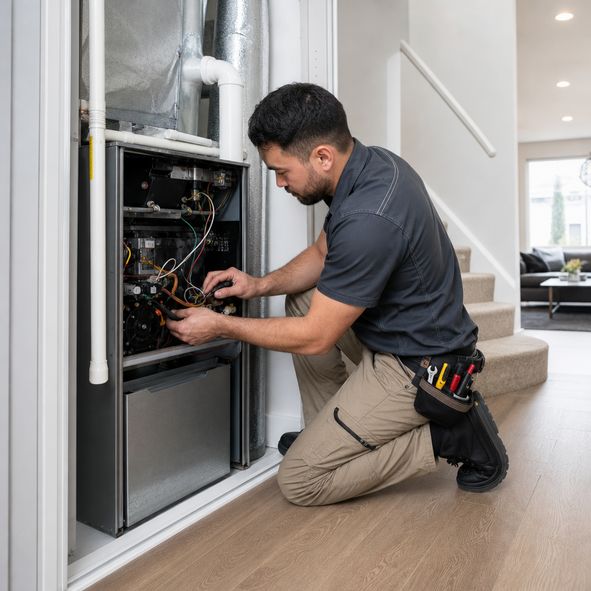
A technician will perform a combustion analysis, check the heat exchanger for cracks (a critical carbon monoxide risk), verify draft pressure, and inspect the flue venting for corrosion — all mandatory under Technical Safety BC gas regulations.
2. Heat Pump Assessment: HSPF2 and SEER2 Ratings
Many older Burnaby homes are now well-suited to air-source heat pumps, particularly cold-climate models rated for operation down to -25°C. If the home already has a heat pump, verify its HSPF2 (Heating Seasonal Performance Factor, the updated 2023 standard) and SEER2 ratings. Equipment with an HSPF2 below 7.5 or a SEER2 below 14.3 is essentially obsolete by modern performance benchmarks.
- Check the refrigerant type: R-22 (Freon) is now banned from production — any system still running R-22 means no legal top-ups are possible and replacement is the only path forward.
- Inspect the outdoor unit coil for corrosion, bent fins, and refrigerant line insulation integrity.
- Verify that a qualified technician installed the system under a Technical Safety BC permit — unpermitted installations are a serious liability when purchasing a home.
3. Ductwork: The Hidden Efficiency and Air Quality Killer
In homes built before the 1990s, ductwork is frequently undersized, poorly sealed, or constructed from materials no longer considered safe. Burnaby’s humidity accelerates mold growth inside deteriorating flex duct and around leaking supply boot connections.
- Request a duct leakage test — industry standard allows no more than 4–6% total leakage in a well-performing system.
- Inspect for asbestos-wrapped ductwork (common in pre-1980 construction) — this requires certified abatement, not just HVAC service.
- Check for improper duct sizing relative to the furnace or air handler capacity. Undersized ducts cause excessive static pressure, noisy operation, and premature blower motor failure.
4. Manual J Load Calculation: Was the System Ever Properly Sized?
One of the most overlooked issues in older homes is equipment that was never properly sized. Many older Burnaby installations were done with a rough square-footage guess rather than a formal Manual J load calculation — the ACCA-standard engineering method that accounts for insulation levels, window area, orientation, air infiltration, and occupancy.
An oversized furnace short-cycles, causing excessive humidity fluctuation and accelerated heat exchanger wear. An undersized system simply cannot maintain comfort during Lower Mainland cold snaps. A qualified technician will assess whether the existing equipment matches the actual thermal load of the home — especially relevant if the previous owner added an addition, upgraded windows, or added insulation since the system was installed.
5. Electrical Panel and System Compatibility
Heat pumps and variable-speed air handlers place unique demands on a home’s electrical panel. Older Burnaby homes with 60-amp or 100-amp service panels often cannot support a modern dual-fuel or full-electric HVAC system without an electrical upgrade. Have the panel inspected alongside the HVAC assessment to identify any compatibility constraints before finalizing your purchase decision.
HVAC System Comparison Table: What You Might Find in an Older Burnaby Home
| System Type | Typical Age Found | Key Efficiency Metric | Control Type | Key Risk Factors | Recommended Action |
|---|---|---|---|---|---|
| Atmospheric Gas Furnace | 25–40+ years | AFUE 56–70% | Single-stage | Cracked heat exchanger, CO risk, banned venting materials | Replace immediately |
| Mid-Efficiency Induced Draft Furnace | 15–25 years | AFUE 78–82% | Single-stage | Aging controls, single-speed blower, high static pressure | Assess condition; plan replacement |
| High-Efficiency Condensing Furnace | Under 15 years | AFUE 95–98% | Two-stage or modulating | Condensate drain blockage, secondary heat exchanger wear | Service and certify |
| R-22 Central Air Conditioner | 15–25+ years | SEER below 10 | Single-stage | Refrigerant unavailable, coil corrosion, compressor wear | Replace immediately |
| R-410A Heat Pump | 8–15 years | HSPF2 varies; SEER2 varies | Single or two-stage | Refrigerant phase-out transitioning to R-32/R-454B | Inspect thoroughly; assess ratings |
| Cold-Climate Variable-Speed Heat Pump | Under 8 years | HSPF2 9.5+; SEER2 17+ | Variable-speed inverter | Minimal if properly permitted and installed | Verify permit and service records |
Frequently Asked Questions: HVAC Inspection for Older Burnaby Homes
How old is too old for a furnace when buying a home in Burnaby?
Any gas furnace exceeding 20 years should be treated as end-of-life. Beyond the efficiency losses associated with low AFUE ratings, older heat exchangers are at significant risk of cracking — a condition that allows combustion gases, including carbon monoxide, to enter living spaces. A Technical Safety BC-licensed technician must perform a full combustion safety inspection before the system is used.
Can I keep the existing ductwork if I upgrade the furnace or heat pump?
Possibly, but it requires evaluation. Existing ductwork must be assessed for sizing compatibility with the new system’s airflow requirements, measured in CFM. Variable-speed and two-stage systems are more tolerant of minor duct deficiencies than single-stage units, but significant leakage, undersizing, or hazardous materials like asbestos wrapping will require remediation regardless of the new equipment selected.
What does Technical Safety BC compliance mean for HVAC systems in BC?
Technical Safety BC is the provincial authority that regulates the installation, alteration, and inspection of gas and HVAC equipment in British Columbia. All gas furnace installations, heat pump refrigerant work, and electrical connections must be performed by licensed contractors and covered by active permits. When purchasing a home, ask for all HVAC permit records — unpermitted work creates liability and insurance complications for the new owner.
Is a home inspection sufficient or do I need a separate HVAC inspection?
A general home inspector performs a visual, non-invasive review and is not equipped to conduct combustion analysis, refrigerant pressure testing, duct leakage measurements, or Manual J load calculations. For any older Burnaby home, a dedicated HVAC inspection by a Red Seal-certified or Technical Safety BC-licensed technician is strongly recommended as a separate, specialized assessment prior to closing.
Make a Confident, Informed Purchase Decision
An older home in Burnaby can be an outstanding investment — but only when you know exactly what HVAC infrastructure you’re inheriting. From heat exchanger integrity and refrigerant compliance to duct performance and proper load sizing, every element of the mechanical system deserves rigorous evaluation before you take possession. The Lower Mainland’s coastal climate demands reliable, properly specified heating and cooling equipment, and the consequences of neglecting a pre-purchase inspection can be significant in terms of comfort, safety, and system longevity.
Don’t leave your HVAC inspection to chance. The certified technicians at BCRC Heating and Cooling provide comprehensive on-site HVAC assessments for home buyers across Burnaby, Vancouver, Richmond, Coquitlam, Surrey, and the entire Lower Mainland. We evaluate every component — from combustion safety and refrigerant compliance to duct performance and system sizing — and deliver a clear, actionable technical report so you can negotiate and purchase with confidence.
Call BCRC Heating and Cooling today at (604) 781-7272 to schedule your pre-purchase HVAC inspection. Visit us at bcrcheating.com to learn more about our inspection services across the Lower Mainland.