


Is Duct Cleaning Worth It? What Improves Air
Is Duct Cleaning Worth It for Lower Mainland Homeowners?
Direct Answer: Duct cleaning is worth it in specific, documented scenarios — visible mould, pest infestation, post-renovation debris, or confirmed microbial growth. For most Vancouver-area homes, targeted system maintenance and filtration upgrades deliver measurably better air quality improvements than duct cleaning alone.
If you’ve been searching is duct cleaning worth it, you’re asking exactly the right question. The Lower Mainland’s coastal humidity, damp cold snaps, and dense urban particulate load create a unique indoor air environment. What genuinely cleans your air isn’t always what’s being sold to you. This field-tested guide cuts through the marketing noise with real HVAC engineering answers.
What Duct Cleaning Actually Does — And Doesn’t Do
Direct Answer: Professional duct cleaning removes accumulated dust, debris, and biological contaminants from supply and return air ducts. However, Health Canada and NADCA research consistently show it does not significantly improve air quality unless a specific contamination trigger — mould, pests, or heavy debris — is confirmed.
Duct cleaning performed by a certified technician involves negative-pressure vacuuming, agitation brushing, and sometimes antimicrobial treatment of the internal duct surfaces. Done properly with truck-mounted or high-efficiency portable equipment, it is a legitimate service. The problem is that many homeowners pay for duct cleaning when their actual air quality issue originates elsewhere — at the air handler, evaporator coil, or filtration stage.
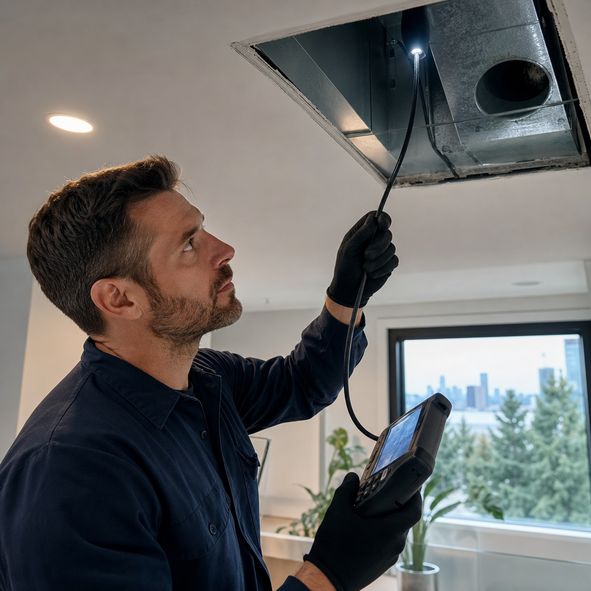
In older Burnaby and Coquitlam homes with flex ductwork or fiberglass-lined ducts, aggressive mechanical cleaning can actually dislodge liner material and introduce new particulates. A proper pre-inspection using a duct camera is non-negotiable before recommending the service.
What Actually Improves Indoor Air Quality in BC Homes
Direct Answer: The highest-impact air quality improvements come from upgrading your air filtration (MERV-13 or better), maintaining your furnace heat exchanger, cleaning evaporator coils, ensuring proper system airflow, and controlling moisture. These mechanical fixes address the root causes of poor air, not just symptoms.
1. High-Efficiency Air Filtration Upgrades
Standard 1-inch fiberglass filters (MERV 1–4) capture less than 20% of fine particulates. Upgrading to a MERV-13 rated media filter or a whole-home HEPA bypass filtration system captures particles down to 0.3 microns — including PM2.5, mould spores, and fine combustion particles common in Surrey and Richmond during wildfire smoke season. Always verify that your air handler’s static pressure tolerance supports the filter upgrade; a MERV-13 filter installed on an undersized blower motor will restrict airflow and reduce system efficiency.
2. Evaporator Coil and Heat Exchanger Maintenance
The evaporator coil operates in a humid, cool environment — a perfect incubator for mould and biofilm in Lower Mainland conditions. A dirty coil degrades heat transfer efficiency, spikes system runtime, and actively blows biological contaminants into conditioned air. Annual coil cleaning is not optional — it is a Technical Safety BC-aligned maintenance standard. Similarly, a cracked furnace heat exchanger can introduce combustion gases including carbon monoxide into supply air, making heat exchanger inspection a critical safety diagnostic at every tune-up.
3. Variable-Speed Blower Motors and Continuous Circulation
Variable-speed ECM (Electronically Commutated Motor) blower systems run at low speed continuously, cycling air through your filter 24/7 rather than only during heating or cooling calls. This dramatically increases filter contact time and removes airborne particulates more effectively than intermittent single-stage operation. If your system uses a standard PSC motor running at a fixed speed, your filter is only active roughly 30–40% of the time the system is running.
4. Humidity Control and Ventilation
Vancouver’s coastal climate means indoor relative humidity can spike above 60% — the threshold at which dust mite populations and mould colonies accelerate. A whole-home bypass or powered humidifier with an integrated humidistat, or a dedicated HRV (Heat Recovery Ventilator), addresses moisture at the source. HRVs are especially important in tight, modern construction where natural infiltration is minimal and stale, humid air accumulates.
When Duct Cleaning IS Genuinely Recommended
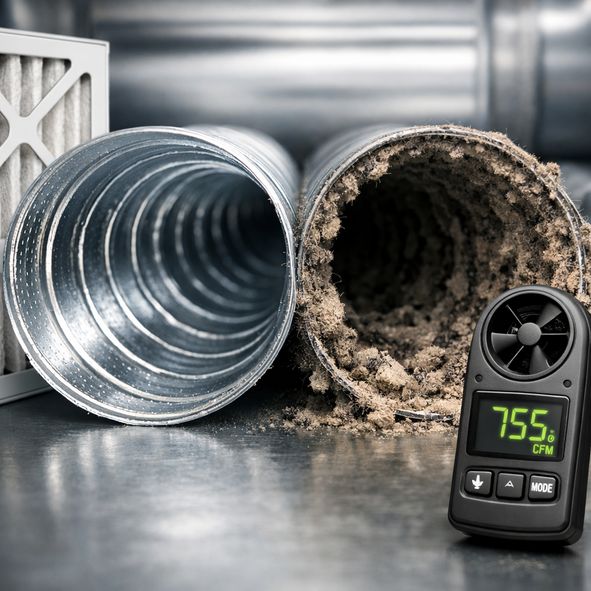
Direct Answer: Schedule professional duct cleaning after any home renovation generating drywall dust or insulation debris, confirmed rodent or pest activity inside ducts, visible mould growth on duct surfaces, or if the home has never had ducts cleaned after 10-plus years of occupancy with pets and no filtration upgrades.
- Post-renovation debris: Drywall compound, fibreglass insulation, and wood dust coat duct interiors and bypass filters during construction phases.
- Confirmed mould or biological growth: Requires antimicrobial treatment alongside mechanical cleaning and must include moisture source identification.
- Pest or rodent infestation: Dander, fecal matter, and nesting material require full duct sanitation, not just cleaning.
- New home purchase: No documentation of prior maintenance; a duct camera inspection is the first step.
- Allergy or asthma triggers without clear cause: After ruling out filtration and coil issues, duct inspection is a logical next diagnostic step.
Duct Cleaning vs. Alternative Air Quality Upgrades: Technical Comparison
| Improvement Method | Target Contaminant | Effectiveness | Maintenance Frequency | Recommended For |
|---|---|---|---|---|
| Professional Duct Cleaning | Dust, debris, mould, pests | High — when specific trigger confirmed | Every 3–5 years (or as needed) | Post-reno, mould, pests, long-term neglect |
| MERV-13 Media Filter Upgrade | PM2.5, pollen, mould spores, dander | Very High — continuous filtration | Filter replacement every 3–6 months | All homes; especially allergy sufferers |
| Evaporator Coil Cleaning | Biofilm, mould, efficiency loss | High — restores heat transfer and air quality | Annual | All central air systems annually |
| HEPA Bypass Filtration System | Bacteria, viruses, fine particles | Extremely High — HEPA H13 standard | Filter change every 12–18 months | Immune-compromised occupants, high IAQ needs |
| HRV Installation | Stale air, excess humidity, CO2 | High — continuous fresh air exchange | Filter clean every 3 months | Tight construction, modern homes, suites |
| UV-C Air Purifier (In-Duct) | Bacteria, mould spores, viruses | Moderate to High — coil and airstream sterilization | Lamp replacement every 1–2 years | Mould-prone systems, health-sensitive households |
| Variable-Speed Blower Upgrade | All airborne particulates (via increased filter runtime) | High — passive continuous filtration | Annual motor inspection | Single-stage system upgrades |
FAQ: Duct Cleaning and Indoor Air Quality — Technician Answers
Q1: How do I know if my ducts actually need cleaning?
A duct camera inspection is the definitive diagnostic. Visual red flags include visible dust discharge from supply registers during operation, musty odours that persist after filter replacement, confirmed pest activity, or post-renovation without duct protection measures. Do not rely on a salesperson’s visual inspection through a register — that shows less than 2% of the duct system.
Q2: Can dirty ducts make my furnace less efficient?
Significantly restricted ductwork caused by debris buildup, collapsed flex duct, or disconnected sections absolutely reduces system efficiency and airflow balance. However, light surface dust accumulation in sealed metal ductwork has minimal impact on AFUE or HSPF2 ratings. The bigger efficiency killers are dirty coils, failing capacitors, and undersized or leaking duct systems — all diagnosed during a proper maintenance inspection.
Q3: Are air purifiers a substitute for duct cleaning?
No — they address different problems. Portable air purifiers or in-duct UV-C systems target airborne biological contaminants in real time. Duct cleaning addresses settled debris and contamination on duct surfaces. If you have confirmed debris accumulation, an air purifier does not remove it. The optimal approach for Lower Mainland homes is layered: mechanical cleaning where warranted, plus continuous filtration and purification.
Q4: How often should I be getting ducts cleaned in a typical Burnaby or Vancouver home?
For a well-maintained home with MERV-8 or better filtration, no pets, and no major renovations, every 4–6 years is a reasonable baseline. Homes with pets, occupants with respiratory sensitivities, older flex ductwork, or previous moisture issues should consider a camera inspection every 2–3 years. Annual maintenance visits catch issues before they require full duct cleaning.
The Bottom Line: Invest in Root-Cause Air Quality Solutions
Duct cleaning is a legitimate, valuable service — but only when the clinical indication is there. For the majority of Lower Mainland homeowners in Vancouver, Burnaby, Richmond, Coquitlam, and Surrey, the highest return on your HVAC maintenance investment comes from proper filtration, annual coil and heat exchanger inspections, humidity control, and ensuring your system is correctly sized and operating at its rated efficiency.
A properly maintained central HVAC system running a MERV-13 filter with an annual tune-up will consistently outperform a system with clean ducts but a fouled coil, weak blower, and 1-inch filter. Address the system first — the ducts second.
Don’t guess at what your home’s air actually needs. The certified technicians at BCRC Heating and Cooling perform comprehensive on-site HVAC diagnostics including duct camera inspection, coil assessment, airflow measurement, and filtration evaluation across Vancouver, Burnaby, Richmond, Coquitlam, Surrey, and the entire Lower Mainland. Call us today at (604) 781-7272 or visit Ductless Split Installation in Vancouver to book your inspection and get a clear, honest assessment of what your system actually needs to deliver clean, healthy air all year long.