



Furnace Not Working? Complete Fix Guide
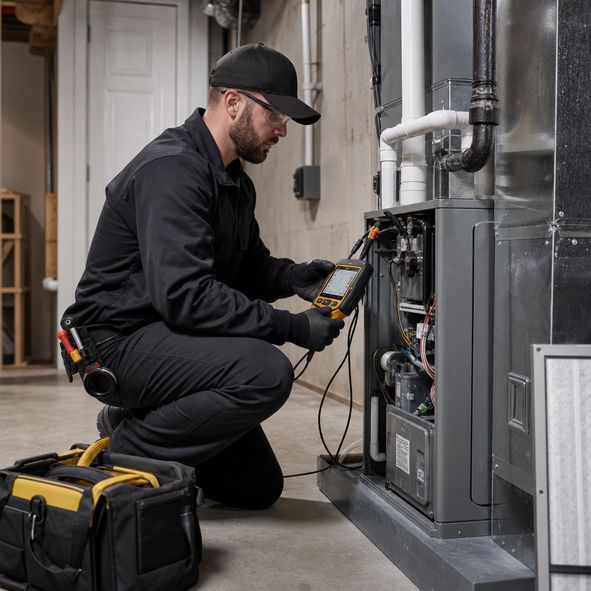
When the Heat Dies: What Every Vancouver Homeowner Must Know
It is 2:00 AM on a January night in Burnaby. The temperature outside has plunged to minus eight degrees Celsius, the kind of deep, damp cold that only Greater Vancouver residents truly understand. You wake up shivering, reach for your phone, and check the thermostat app — it reads 14°C inside your home and is still dropping. Your furnace is down. In that moment, what you do in the next fifteen minutes can mean the difference between a quick self-fix, a morning service call, or a genuinely dangerous situation involving gas, carbon monoxide, or a frozen pipe burst that costs tens of thousands of dollars in water damage.
This guide, written by BCRC Heating and Cooling’s Red Seal Master Technicians serving Greater Vancouver, Burnaby, Surrey, Langley, and the Fraser Valley, is the most thorough, technically accurate, and actionable furnace troubleshooting resource you will find. We walk you through every diagnostic step in the correct sequence — the same sequence our certified technicians follow on every no-heat service call. We cover the history of residential heating so you understand why your furnace works the way it does, we explain modern diagnostic technology, and we give you a detailed comparison matrix so you know exactly what system you have and what its failure modes look like. Let’s restore your heat.
The Ancient Roots of Forced-Air Heating: Why Your Furnace Exists
To truly understand a modern condensing gas furnace, it helps to appreciate the two-thousand-year engineering lineage behind it. The Romans engineered the hypocaust — from the Latin hypocaustum, meaning “heat from below” — as early as 100 BCE. Hollow floors and wall cavities channelled hot combustion gases from a wood-fired furnace beneath a building, radiating warmth upward through stone tiles. Roman bath houses, military garrisons in cold Britannia, and wealthy villas across the empire all relied on this principle: generate heat at a central source, distribute it through a structure, and exhaust the combustion gases safely away from occupants.
Medieval Europe regressed somewhat, relying on open hearths and rudimentary fireplaces with poor draft control. The critical leap forward came in the late 17th and 18th centuries when cast-iron stoves with enclosed fireboxes dramatically improved combustion efficiency and reduced the risk of chimney fires. By the mid-19th century, gravity warm-air furnaces — essentially a large cast-iron firebox in a basement surrounded by a sheet-metal plenum — were distributing heat through large floor registers via natural convection. No fans, no filters, no controls beyond a manual damper. The core concept, however — centralized combustion, heat transfer to air, distribution through a structure — was identical to what your modern furnace does today.
The Industrial Breakthroughs That Built the Modern Furnace
The 20th century transformed residential heating from an art into an engineering science. Several watershed inventions deserve recognition by every homeowner who relies on forced-air heat.
The Advent of Forced-Air and the Electric Blower Motor
The introduction of the electric blower motor in the 1930s was the single most transformative event in residential heating history. By mechanically forcing air across a heat exchanger rather than relying on convection, engineers could dramatically reduce furnace size, increase heat output, and distribute warm air to every room in a home through a network of ducts. This was the birth of the forced-air furnace as we know it. The heat exchanger — a sealed metal chamber through which combustion gases travel while household air flows over the outside — became the defining component, and its integrity remains the most critical safety element in any gas furnace today.
Electronic Ignition Replaces the Standing Pilot
Through the 1970s and into the 1980s, virtually every residential gas furnace used a standing pilot light — a small, continuously burning flame that ignited the main burners when the thermostat called for heat. Standing pilots wasted a measurable amount of gas around the clock and introduced a common failure point: thermocouple failure. The thermocouple is a small heat-sensing probe positioned in the pilot flame; when it senses heat, it generates a millivolt signal that holds the gas valve open. When the thermocouple degrades, it fails to hold the valve, and the pilot extinguishes — the most common furnace complaint of the era.
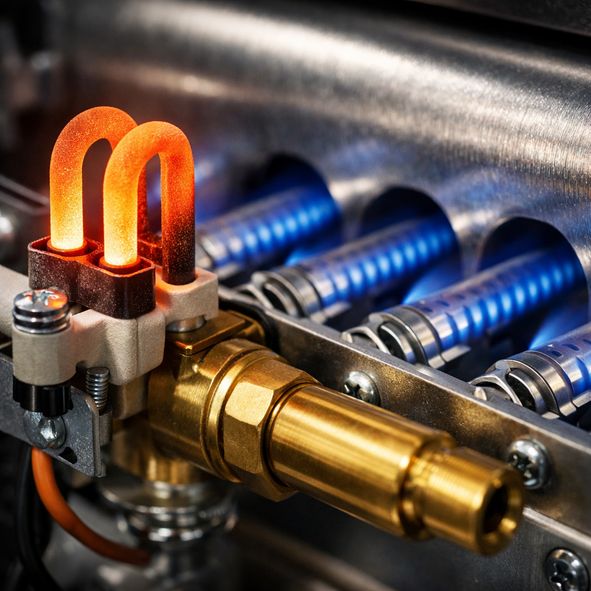
Electronic ignition, commercialized broadly through the 1980s and mandatory on new equipment by the 1990s in most Canadian jurisdictions, eliminated the standing pilot entirely. Modern furnaces use either an intermittent pilot igniter (IPI), which sparks a pilot only on demand, or more commonly today, a hot surface igniter (HSI) — a silicon carbide or silicon nitride element that glows to approximately 1,000°C within seconds to directly ignite the main burners. The HSI is now the most commonly replaced component in a modern gas furnace, with an average service life of seven to ten years.
Condensing Technology and the Two-Stage, Variable-Speed Revolution
The 1990s and 2000s brought the high-efficiency condensing furnace, achieving Annual Fuel Utilization Efficiency (AFUE) ratings of 90% to 98.5%. A conventional mid-efficiency furnace exhausts flue gases at 180°C to 230°C, losing enormous energy up the chimney. A condensing furnace adds a secondary heat exchanger that extracts so much additional heat from those gases that they cool to 35°C to 50°C — below the dew point of water vapour in the combustion products. The moisture condenses out as mildly acidic liquid (hence the plastic condensate drain line on modern high-efficiency furnaces) and the cooled exhaust is vented through inexpensive Schedule-40 PVC pipe rather than a masonry chimney. This is why your high-efficiency Lennox, Carrier, or Trane furnace has a white PVC exhaust pipe exiting your wall rather than a traditional flue.
How a Modern Gas Furnace Actually Works: A Technical Primer
Before you can diagnose a failure, you must understand the normal operating sequence. Every call for heat from your thermostat triggers the following sequence, known as the furnace control board’s ignition trial:
- Inducer Motor Pre-Purge: The draft inducer fan starts, purging residual combustion gases from the heat exchanger and establishing a negative pressure differential that proves the venting system is unobstructed. A pressure switch — a small diaphragm device connected to the inducer housing by a rubber hose — must close to confirm adequate draft before the sequence continues.
- Hot Surface Igniter Warm-Up: The control board energizes the HSI for approximately 17 seconds, allowing it to reach ignition temperature.
- Gas Valve Opening & Ignition: The main gas valve opens, introducing gas to the burners, which are ignited by the glowing HSI. A flame sensor — a single metal rod positioned in the burner flame — detects ionization current (typically 1 to 5 microamps) to confirm flame establishment.
- Blower Motor Start: After a timed delay (typically 30 to 90 seconds) allowing the heat exchanger to warm, the main air handler blower motor starts and distributes heated air through your ductwork.
- Steady-State Operation: The furnace runs until the thermostat is satisfied, at which point the gas valve closes, the burners extinguish, the inducer shuts off, and the blower continues briefly to extract residual heat from the heat exchanger.
Understanding this sequence is critical: when your furnace fails, it almost always fails at one specific step in this chain, and the LED fault code on your control board tells you exactly which step failed.
Step-by-Step Diagnostic Protocol: What To Do When Your Furnace Is Down
Follow these steps in strict order. Do not skip ahead. Each step builds on the last.
Step 1: Verify the Thermostat and Its Power Source
This sounds obvious, but thermostat issues account for a surprising percentage of no-heat service calls. Confirm the thermostat is set to HEAT mode (not COOL or OFF), the set-point temperature is at least 3°C above the current room temperature, and the fan setting is on AUTO, not ON. If your thermostat is battery-powered, replace the batteries even if the display appears active — low battery voltage can cause erratic behaviour without displaying a low-battery warning. If you have a smart thermostat such as an Ecobee or Nest, check whether it has lost its Wi-Fi connection or whether a software update has reset its programming schedule.
Step 2: Check the Electrical Supply to the Furnace
Your furnace requires a dedicated 120V circuit. Go to your electrical panel and check for a tripped breaker labelled FURNACE or HVAC. A tripped breaker sits in a middle position between ON and OFF — you must push it fully to OFF before resetting it to ON. Also check the furnace’s local power switch, which looks identical to a standard light switch and is typically mounted on the furnace cabinet or on the wall nearby. This switch is the number-one cause of furnace lockouts after maintenance visits — a technician or homeowner bumps it off and forgets to restore it.
Step 3: Read the Diagnostic Fault Codes on the Control Board
Every furnace manufactured after approximately 1995 has an LED diagnostic light on its control board, visible through a small sight glass on the lower access panel. Count the flashes carefully — a typical code might be three short flashes followed by one long flash, written as 3-1 in the service manual. These codes are specific and powerful. Common codes include: pressure switch stuck open (blocked condensate drain or failed inducer), ignition failure after three trials (failed HSI, contaminated flame sensor, or no gas pressure), limit switch open (overheating due to restricted airflow), and rollout switch tripped (a critical safety fault indicating combustion spillage — do not attempt to reset this without professional inspection). Your furnace’s fault code legend is printed on a label inside the lower access panel door. Read it carefully.
Step 4: Inspect and Replace the Air Filter
A severely restricted air filter is one of the most common causes of furnace lockout in Greater Vancouver homes. When airflow across the heat exchanger is insufficient, the heat exchanger overheats and the high-limit safety switch opens, shutting down the burners. If this occurs repeatedly, some control boards will lock the furnace out entirely and require a manual reset. Locate your filter — typically in a slot on the return-air side of the furnace cabinet or in a central return-air grille — and inspect it. A filter so clogged it appears grey or black must be replaced immediately. For most Greater Vancouver homes, a 1-inch MERV-8 filter should be replaced every 90 days, or monthly during peak heating season if you have pets.
Step 5: Check the Condensate Drain System (High-Efficiency Furnaces Only)
If you have a high-efficiency condensing furnace (identifiable by its white PVC vent pipes), check your condensate drain. The furnace produces up to 2 to 3 litres of condensate per hour during operation. This water drains through a plastic trap and tubing to a floor drain or condensate pump. If the drain is blocked by algae, mineral deposits, or debris, the condensate backs up into the pressure switch hose, holding the pressure switch open and preventing the furnace from progressing past the inducer pre-purge stage. Clear the condensate trap by disconnecting it and flushing with warm water. If a condensate pump is installed, verify it is operational and that the reservoir is not overflowing.
Step 6: Inspect the Venting and Combustion Air Intake
Your furnace has both an exhaust vent and a dedicated combustion air intake pipe, typically both running through an exterior wall. In Greater Vancouver’s winter conditions — particularly during the occasional snowfall or heavy rainstorm — these PVC termination fittings can become obstructed with ice, snow, nesting birds or rodents, or leaf debris. A blocked intake starves the furnace of combustion air; a blocked exhaust triggers the pressure switch. Visually inspect both pipe terminations from outside. They should be clear and unobstructed, terminating at least 30 cm above grade and away from gas meter regulators, electrical meters, and windows per BC Gas Code requirements.
Step 7: Verify the Gas Supply
Confirm the gas shutoff valve on the supply line immediately upstream of the furnace is fully open — the handle should be parallel to the pipe, not perpendicular. If other gas appliances in your home (range, water heater, fireplace) are also not working, your gas service may be interrupted; contact FortisBC at their 24-hour emergency line. Critical safety warning: if you smell natural gas — a rotten egg or sulphur odour added by mercaptan odorant — do not operate any electrical switches, do not use your phone inside the building, evacuate immediately, and call FortisBC’s emergency line from outside at a safe distance. Do not re-enter until FortisBC has cleared the premises.
Step 8: Attempt a Furnace Reset — Once
Most modern furnace control boards have a lockout reset procedure. Locate the red or white reset button on the furnace cabinet (more common on older mid-efficiency furnaces with a flame rollout switch that requires manual reset) or simply cycle power to the furnace by turning the local power switch off, waiting 30 seconds, and turning it back on. Watch the LED fault code as the furnace attempts ignition. You may attempt a power cycle reset no more than once. Repeated reset attempts on a furnace with an underlying gas delivery or ignition problem can flood the heat exchanger with unburned gas, creating a hazardous condition.
Step 9: Keep Your Household Safe While Awaiting Repair
If the furnace does not restore after the above steps, protect your household while waiting for a certified technician. Close off unused rooms to concentrate heat from any operational source. Use electric space heaters with tip-over protection — never use propane or kerosene heaters indoors due to carbon monoxide risk. Open cabinet doors under sinks on exterior walls to prevent pipe freezing. If your home’s interior temperature approaches 5°C, your primary concern shifts to freeze protection for pipes, particularly in crawl spaces, unheated garages, and exterior walls. At 0°C, water pipes can begin to freeze within hours.
Modern Era: Smart Diagnostics, Variable-Speed Motors, and Connected Furnaces
Today’s premium gas furnaces are sophisticated electromechanical systems with capabilities that would have seemed like science fiction to a 1970s HVAC technician. Variable-speed ECM (Electronically Commutated Motor) blowers adjust airflow in real time to maintain precise duct static pressure regardless of filter loading or damper position, consuming up to 75% less electricity than single-speed PSC motors. Two-stage and modulating gas valves allow the furnace to operate at 40% to 65% capacity during mild weather, cycling less frequently and maintaining more consistent indoor temperatures.
Communicating furnace systems — such as Lennox iComfort, Carrier Infinity, and Trane ComfortLink — establish a digital data bus between the furnace, air handler, thermostat, and air conditioner, allowing each component to share real-time performance data. When a fault occurs, these systems can transmit diagnostic fault logs directly to a technician’s tablet before they even arrive on site, dramatically reducing diagnostic time and ensuring the correct replacement parts are on the service vehicle.
Furnace System Comparison Matrix: Choosing the Right System for Your Vancouver Home
| Category | Mid-Efficiency Gas Furnace (80% AFUE) | High-Efficiency Condensing Gas Furnace (96%+ AFUE) | Electric Furnace | Air-Source Heat Pump + Gas Furnace (Dual Fuel) |
|---|---|---|---|---|
| Efficiency Rating | 80% AFUE | 96%–98.5% AFUE | 100% (site energy); ~300%+ HSPF equivalent with heat pump | Up to 400% COP in mild weather; gas backup in extreme cold |
| Typical Lifespan | 15–20 years | 15–20 years with annual maintenance | 20–25 years | 15–20 years (furnace); 15 years (heat pump outdoor unit) |
| Fuel Source | Natural Gas (FortisBC) | Natural Gas (FortisBC) | BC Hydro Electricity | Natural Gas + BC Hydro Electricity |
| Installation Cost (Greater Vancouver) | $2,800–$4,500 | $4,000–$7,500 | $1,500–$3,000 | $8,000–$14,000 (complete system) |
| Monthly Operating Cost (Avg. Vancouver Home) | $120–$180/month (heating season) | $80–$130/month (heating season) | $150–$250/month at current BC Hydro rates | $60–$110/month (heating season, CleanBC optimized) |
| Venting Requirement | Category I metal flue or masonry chimney | 2-pipe PVC (no chimney required) | No combustion venting required | 2-pipe PVC for furnace; refrigerant lines for heat pump |
| CleanBC Rebate Eligibility | Not eligible (below 95% AFUE threshold) | Eligible for CleanBC Better Homes rebates up to $1,000 | Not eligible as standalone heating | Up to $6,000 CleanBC rebate for qualifying cold-climate heat pumps |
| Best Application | Replacement of existing mid-efficiency in older homes with existing chimney | Standard upgrade for most Metro Vancouver homes | Smaller suites, vacation properties, areas without gas service | Maximum long-term savings; aligns with BC energy transition goals |
Greater Vancouver Homeowner Buying and Maintenance Guide
CleanBC and BC Hydro Incentives You Must Not Miss
British Columbia offers some of the most generous heating equipment incentives in Canada, funded through the Province’s CleanBC Better Homes and Home Renovation Rebate programs. As of the most recent program updates, homeowners replacing an older furnace with a qualifying high-efficiency gas furnace (95% AFUE or higher) may be eligible for rebates through FortisBC of up to $1,000. Homeowners making the transition to a qualifying cold-climate air-source heat pump as their primary heating system can access combined CleanBC and BC Hydro rebates ranging from $3,000 to $6,000 or more depending on equipment specifications and income-qualified programs. BCRC Heating and Cooling is a registered CleanBC Better Homes contractor and can process rebate applications on your behalf, ensuring no eligible incentive is left on the table.
Coastal Climate Durability Considerations
Greater Vancouver’s marine west coast climate presents unique challenges for residential HVAC equipment. The combination of high humidity, salt-laden air in coastal communities such as White Rock, Tsawwassen, and West Vancouver, and significant annual temperature cycling between subfreezing nights and mild, damp days accelerates corrosion of heat exchangers, burner assemblies, and outdoor heat pump components. When selecting a replacement furnace, prioritize stainless-steel or silicon-aluminum alloy secondary heat exchangers over standard steel in high-efficiency models. For outdoor heat pump units, verify that the cabinet and coil coating specifications meet coastal installation standards — many premium manufacturers offer enhanced corrosion-resistant coatings for marine environments.
Annual Maintenance: The Non-Negotiable Investment
BC Gas Safety regulations and virtually every furnace manufacturer’s warranty terms require annual inspection and maintenance by a licensed gasfitter. A comprehensive annual furnace tune-up performed by a Red Seal technician should include: combustion analysis (measuring CO, CO2, and flue gas temperature to verify heat exchanger integrity and burner efficiency); heat exchanger visual inspection using a combustion camera; flame sensor cleaning and microamp current verification; HSI resistance check; inducer motor amperage measurement; gas manifold pressure verification against manufacturer nameplate specifications; condensate system cleaning and flow test; blower motor lubrication where applicable; and a full safety controls test including limit switch and pressure switch function verification. This service, costing between $150 and $250 in Greater Vancouver, routinely prevents the $800 to $2,500 emergency repair calls that result from deferred maintenance.
Frequently Asked Questions: Furnace Troubleshooting in Vancouver
Q1: My furnace ignites and runs for a few minutes, then shuts off and the LED shows a limit switch fault. What is causing this?
A limit switch lockout after a brief run cycle is almost always a symptom of restricted airflow causing the heat exchanger to overheat. The most common causes in order of frequency are: a severely clogged air filter; a blocked or closed supply or return air register (often caused by furniture placed over floor registers); a failed or seized blower motor that is not moving adequate air volume; or, in more serious cases, a cracked heat exchanger that is allowing supply air to impinge directly on the burners, disrupting combustion and creating dangerous CO spillage. Replace your filter first. If the problem persists after a filter change, do not operate the furnace and call a certified technician — a cracked heat exchanger is a carbon monoxide hazard requiring immediate professional evaluation.
Q2: How do I safely relight the pilot light on my older gas furnace?
Most older standing-pilot furnaces with manual gas valves follow the same relighting procedure: locate the gas valve control knob on the furnace, turn it to the PILOT position, depress and hold the knob fully inward (this mechanically holds the pilot gas valve open), and use a long-reach barbecue lighter or fireplace match to ignite the pilot burner — a small brass orifice visible through the furnace’s burner compartment access panel. Hold the knob depressed for a full 30 to 60 seconds after the pilot ignites to allow the thermocouple to reach operating temperature and generate sufficient millivolt output to hold the safety valve open. If the pilot repeatedly extinguishes within seconds of releasing the knob, the thermocouple requires replacement — a straightforward task for a licensed gasfitter that typically costs $80 to $150. Never attempt to force a pilot to stay lit by holding the knob indefinitely, as this may indicate a gas pressure or valve problem requiring professional diagnosis.
Q3: My furnace is making a loud banging noise when it starts. Is this dangerous?
A loud bang or boom at furnace startup — technically called delayed ignition — is a potentially serious condition that should not be ignored. It occurs when gas accumulates in the burner assembly during the ignition trial before the HSI or pilot successfully ignites it, resulting in a small combustion event as the accumulated gas ignites at once. Causes include a dirty or degraded hot surface igniter with insufficient surface temperature, a contaminated flame sensor causing the control board to delay gas valve opening, partially clogged burner ports reducing flame propagation speed, or low gas pressure. Repeated delayed ignition events stress the heat exchanger with repeated thermal shock and can accelerate crack formation. Have a Red Seal technician clean the burner assembly, test igniter resistance, and verify gas manifold pressure at the next available service opportunity.
Q4: How long should a furnace in the Greater Vancouver area last, and when should I replace rather than repair?
A well-maintained gas furnace in Greater Vancouver should deliver 18 to 22 years of reliable service. The industry standard decision framework for repair versus replacement is the 5,000 Rule: multiply the age of the furnace in years by the estimated repair cost in dollars. If the result exceeds $5,000, replacement is typically the more economically sound decision. For example, a 15-year-old furnace facing a $400 heat exchanger weld repair scores 15 × $400 = $6,000 — above the threshold, suggesting replacement. Additionally, any furnace over 15 years old with a confirmed cracked heat exchanger should be replaced immediately regardless of cost, as operating a furnace with a compromised heat exchanger risks carbon monoxide poisoning. The energy savings from replacing an 80% AFUE furnace with a 96% AFUE model in Vancouver’s climate typically generate a payback period of 5 to 8 years, further supporting the replacement case for ageing equipment.
Your Next Step: Restore Your Heat with Confidence
A furnace failure in Greater Vancouver is never just an inconvenience — it is a potential safety event, a threat to your home’s structure through pipe freezing, and a source of genuine distress for your family. The diagnostic steps in this guide give you the tools to identify the most common failure modes quickly and safely, but they also define the clear boundary between homeowner-serviceable tasks and the work that legally and safely requires a licensed Red Seal gasfitter. Never attempt to repair gas valves, heat exchanger components, control boards, or refrigerant systems without proper certification — the risks to life, property, and your insurance coverage are simply too great.
BCRC Heating and Cooling’s Red Seal certified technicians serve Greater Vancouver, Burnaby, Coquitlam, Surrey, Langley, Abbotsford, and the entire Fraser Valley with same-day emergency furnace repair, annual maintenance programs, and expert system replacement consultation. Whether you need an urgent no-heat diagnosis tonight or are planning a proactive system upgrade to take advantage of current CleanBC incentives, our team is ready to deliver the highest standard of workmanship the industry offers. For dependable, certified furnace repair in Vancouver and the surrounding Lower Mainland, call the local experts at BCRC Heating and Cooling today at (604) 781-7272 — because your family’s comfort and safety cannot wait.