



The Quiet Miracle Beneath Your Roof: Hot Water on Demand in White Rock
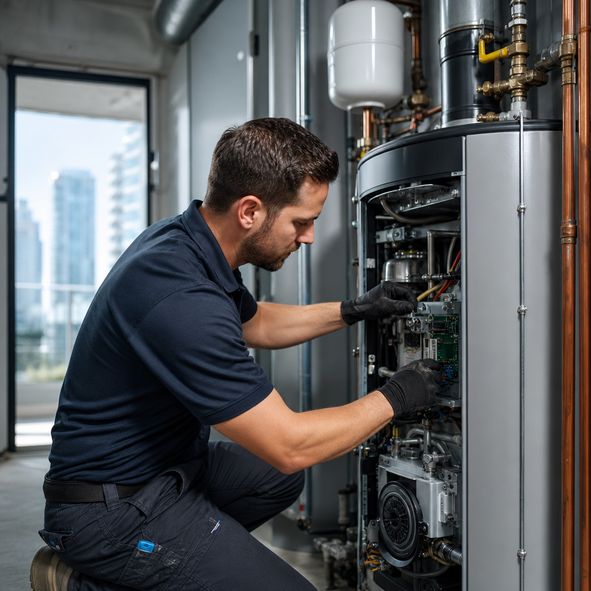
Think about the last time you stepped into a steaming shower on a cold, grey White Rock morning — the kind where Pacific fog rolls off Semiahmoo Bay and the temperature hovers just above freezing. You didn’t think twice about that hot water. It was simply there, instant and effortless, a modern comfort so reliable it has become invisible. But behind that invisible miracle lives a sophisticated piece of engineering that traces its roots back thousands of years, and that — when it fails — reminds you immediately and uncomfortably just how much you depend on it. At BCRC Heating and Cooling, our Red Seal certified technicians understand water heating at every level: its history, its physics, its cutting-edge technology, and its very particular demands in the coastal climate of Greater Vancouver’s South Surrey and White Rock corridor. This comprehensive guide will walk you through everything you need to know — from ancient Roman ingenuity to modern Wi-Fi-connected heat pump water heaters — so that when you make a decision about your home’s hot water system, you make it with confidence.
Ancient Roots and Early Engineering: Humanity’s Long Pursuit of Hot Water
The desire to control water temperature is not a modern invention. As far back as 25 BCE, Roman engineers constructed elaborate hypocaust systems — raised floor cavities and hollow wall channels through which hot combustion gases circulated, heating bathhouses and domestic spaces with remarkable sophistication. The thermae of ancient Rome were not merely places of hygiene; they were social institutions, and the engineering required to deliver consistent hot water to thousands of bathers daily represented one of antiquity’s greatest technical achievements.
Ancient Greeks heated water using bronze cauldrons suspended over open flames in balaneion bathhouses. In China’s Han Dynasty, archaeological evidence suggests rudimentary underfloor heating systems analogous to Roman hypocausts. The Japanese tradition of the ofuro — a deep soaking tub with a firebox integrated beneath — represents another independent cultural solution to the same fundamental engineering challenge. Even Indigenous peoples of the Pacific Northwest, in whose traditional territory White Rock sits, used heated stones dropped into water-filled vessels to achieve warm water for cooking and ceremonial purposes. The human instinct to tame water temperature is, it turns out, universal and ancient.
What all these early systems shared was a critical limitation: they required constant human attention, constant fuel input, and produced hot water only at the precise moment of active heating. The concept of stored hot water — available on demand, without immediate fire-tending — would not emerge until the industrial age began reshaping domestic life in the nineteenth century.
Industrial Breakthroughs: Maughan’s Geyser and Edwin Ruud’s Revolution
The modern water heater as we know it has two watershed moments of invention separated by roughly two decades and separated by an ocean. In 1868, London painter and part-time inventor Benjamin Waddy Maughan patented a device he called the Geyser — a gas-fired, instantaneous water heater that piped cold water past gas jets and delivered hot water directly to a bath or sink without the need for a central boiler. Maughan’s device was brilliant in concept but dangerously primitive in execution: it lacked any flue or venting system, releasing combustion gases directly into the bathroom, making it simultaneously revolutionary and potentially lethal. Nevertheless, it established the fundamental principle of the tankless, on-demand water heater that dominates the high-efficiency market more than 150 years later.
The second watershed moment came in 1889 in Pittsburgh, Pennsylvania. Norwegian-born mechanical engineer Edwin Ruud, working with Westinghouse, developed and patented the first automatic, storage-tank water heater. Ruud’s genius was the integration of a thermostat-controlled gas burner with a steel storage vessel — a design that could heat water, store it at a stable temperature, and automatically reheat it when the temperature dropped, all without manual intervention. This was a paradigm shift: for the first time in human history, hot water could be stored, ready and waiting, available instantaneously upon demand. The Ruud Manufacturing Company, founded in 1897, became the template for virtually every storage water heater manufactured for the next century. The fundamental architecture Ruud established — insulated tank, thermostat, burner or heating element, temperature and pressure relief valve — remains the backbone of conventional tank water heaters sold across Greater Vancouver today.
The 20th Century: Standardization, Electrification, and Mass Adoption
The first half of the twentieth century brought rapid standardization of residential water heating across North America. The expansion of municipal natural gas infrastructure through the 1920s and 1930s made gas-fired storage heaters the dominant technology in most Canadian cities. Simultaneously, the rural electrification programs of the 1930s and 1940s — driven in British Columbia by the expansion of BC Hydro’s hydroelectric generating capacity — made electric resistance storage water heaters a viable and clean alternative in areas where gas infrastructure was unavailable or cost-prohibitive.
Post-World War II suburban construction booms — including the rapid development of communities like White Rock and South Surrey — standardized the 40-to-60-US-gallon gas or electric storage tank as the default residential water heating solution. National building codes formalized minimum efficiency standards, temperature and pressure relief valve requirements, and venting specifications. By the 1970s, virtually every new home constructed in Greater Vancouver included a conventional storage tank water heater, and an entire ecosystem of plumbing and HVAC contractors — including the predecessors of modern companies like BCRC — developed around installing, servicing, and replacing these units on predictable 10-to-15-year replacement cycles.
The energy crises of 1973 and 1979 injected urgency into efficiency discussions that had previously been theoretical. Insulation standards for tank bodies improved dramatically. Pilot light designs evolved. The concept of Energy Factor (EF) ratings — later replaced by the more precise Uniform Energy Factor (UEF) — gave consumers and regulators a standardized metric for comparing water heater efficiency across fuel types and designs.
The Modern Era: Tankless On-Demand Revolution and Smart Wi-Fi Diagnostics
The late 1990s and early 2000s saw Maughan’s original 1868 concept reborn with twenty-first-century precision engineering. Modern condensing gas tankless water heaters — from manufacturers including Navien, Rinnai, Noritz, and Bosch — achieve Uniform Energy Factors of 0.87 to 0.96 or higher by extracting latent heat from combustion gases through a secondary stainless steel heat exchanger, condensing water vapour in the flue stream, and recovering thermal energy that conventional atmospheric-vented units release as waste. The result is a wall-mounted unit roughly the size of a carry-on suitcase that can deliver an effectively unlimited supply of hot water at flow rates of 7 to 11 US gallons per minute — sufficient to supply multiple simultaneous fixtures in a large White Rock home.
The integration of smart Wi-Fi connectivity and cloud-based diagnostics represents the most recent technological frontier. Modern units from Navien’s NPE series and Rinnai’s RUR series include onboard self-diagnostic systems that continuously monitor inlet and outlet temperatures, flow rates, combustion parameters, and error codes. Through companion smartphone applications, homeowners receive real-time alerts for anomalies — a blocked condensate drain, a deteriorating flow sensor, an ignition system approaching failure — before those anomalies become cold-water emergencies. BCRC technicians can in some cases perform preliminary remote diagnostics before even arriving at a White Rock home, arriving with the correct replacement component already in the service vehicle and dramatically reducing diagnostic time and labour cost for the homeowner.
Heat Pump Water Heaters: The Peak Efficiency Paradigm for BC Homeowners
Heat pump water heaters (HPWHs) represent arguably the most significant efficiency breakthrough in residential water heating since Edwin Ruud’s 1889 patent. Rather than generating heat through electrical resistance or combustion — both of which convert energy to heat at a theoretical maximum efficiency of 100% — HPWHs operate on the same refrigeration-cycle principle as your air conditioner, but in reverse: they extract ambient thermal energy from surrounding air and concentrate it into the water storage tank using a refrigerant circuit, compressor, and heat exchanger.
The result is a water heater with a Coefficient of Performance (COP) of 2.0 to 4.0, meaning it delivers two to four units of thermal energy for every one unit of electrical energy consumed. In practical terms, a heat pump water heater operating at a COP of 3.5 is 350% efficient by conventional measure — something that would be physically impossible for a resistance heater. For White Rock and South Surrey homeowners on BC Hydro’s residential electricity rates, this translates to annual hot water heating cost savings of 60% to 70% compared to a standard electric resistance tank.
HPWHs perform optimally in spaces where ambient air temperature remains above 10°C year-round — a requirement easily met by most Greater Vancouver mechanical rooms, parkade-level utility spaces, and conditioned crawlspaces. BC Hydro and the Province of British Columbia’s CleanBC Better Homes program currently offer substantial rebates for HPWH installations — up to $1,000 in combined incentives as of recent program years — making the already-compelling economics even more attractive. BCRC’s rebate-coordination service handles all application paperwork on behalf of qualifying White Rock and South Surrey homeowners, ensuring no eligible incentive dollar is left unclaimed.
Deep-Dive Comparison: Choosing the Right Water Heater for Your White Rock Home
| Category | Gas Storage Tank | Electric Storage Tank | Gas Tankless (Condensing) | Heat Pump Water Heater |
|---|---|---|---|---|
| Uniform Energy Factor (UEF) | 0.59 – 0.70 | 0.90 – 0.95 | 0.87 – 0.96+ | 2.0 – 4.0 (COP) |
| Typical Lifespan | 8 – 12 years | 10 – 15 years | 15 – 20+ years | 12 – 15 years |
| Primary Fuel | Natural Gas / Propane | Electricity (BC Hydro) | Natural Gas / Propane | Electricity (BC Hydro) |
| Approximate Install Cost (CAD) | $1,200 – $2,000 | $900 – $1,600 | $2,500 – $4,500 | $2,200 – $4,000 |
| Annual Operating Cost (Approx.) | $350 – $550 | $500 – $750 | $200 – $380 | $130 – $280 |
| Available Rebates (BC) | None currently | None currently | Varies by program year | Up to $1,000 (CleanBC) |
| Hot Water Supply | Limited by tank size | Limited by tank size | Effectively unlimited | Limited by tank (hybrid) |
| Space Requirement | Moderate (tank) | Moderate (tank) | Minimal (wall-mount) | Larger footprint + air space |
| GHG Emissions (BC Grid) | Moderate – High | Near Zero (BC Hydro) | Low – Moderate | Near Zero (BC Hydro) |
| Maintenance Complexity | Low – Moderate | Low | Moderate – High | Moderate |
Greater Vancouver Homeowner Buying and Maintenance Guide
Purchasing and maintaining a water heater in White Rock and South Surrey involves a unique set of considerations shaped by the region’s coastal climate, water chemistry, utility infrastructure, and provincial incentive landscape. Here is what every BCRC customer needs to know before making a decision:
- Water Chemistry and Anode Rod Maintenance: Greater Vancouver’s municipal water supply — including that distributed through the City of White Rock’s system — is characteristically soft and slightly acidic, with pH values typically ranging from 6.5 to 7.5. While this softness is gentle on appliances in some respects, it accelerates the electrochemical consumption of the magnesium or aluminium sacrificial anode rod that protects your storage tank’s steel interior from corrosive galvanic attack. BCRC recommends inspecting anode rods annually on tanks in White Rock and replacing them every two to four years — a relatively low-cost procedure (typically $150 to $300 including labour) that can extend your tank’s functional life by five or more years and prevent the catastrophic tank failure that results in thousands of dollars of water damage.
- Seismic Strapping Compliance: British Columbia’s seismic activity profile — including the documented risk of a major Cascadia Subduction Zone event — means that BC Building Code and local White Rock bylaws mandate that all water heater storage tanks be double-strapped to wall framing with approved seismic restraint straps. All BCRC installations include compliant seismic strapping as standard practice, never as an add-on.
- CleanBC Better Homes Rebates: The Province of British Columbia and BC Hydro jointly administer the CleanBC Better Homes rebate program, which currently incentivizes the replacement of fossil-fuel water heaters with heat pump water heaters and other high-efficiency electric alternatives. Rebate amounts and eligibility criteria are updated periodically; BCRC’s administrative team stays current with all program changes and can confirm your household’s eligibility at the time of your consultation.
- Condensate Management for Condensing Tankless Units: High-efficiency condensing gas tankless water heaters produce mildly acidic condensate (pH 3.5 to 5.0) as a byproduct of their secondary heat extraction process. BC plumbing codes require this condensate to be properly neutralized before discharge to the municipal sewer system. BCRC installs approved condensate neutralizer cartridges with every condensing tankless installation and includes neutralizer media replacement in our annual maintenance programs.
- Sizing for Multi-Zone and High-Demand White Rock Homes: White Rock’s housing stock includes a significant proportion of larger detached homes, often with multiple bathrooms, in-floor radiant heating systems, and suite accommodations. Proper water heater sizing — whether calculating first-hour rating for storage tanks or peak flow rate demand for tankless units — is a technical exercise that BCRC performs using Manual S-equivalent load calculations, not guesswork. An undersized unit is as problematic as an inefficient one.
Frequently Asked Questions: Water Heater Services in White Rock
How do I know when my water heater needs replacing versus repairing?
This is the question BCRC technicians are most frequently asked, and the answer involves several converging factors. The industry standard rule of thumb — and a defensible one from an engineering standpoint — is to apply the 50% rule: if the cost of a repair exceeds 50% of the cost of a comparable new unit, replacement is almost always the economically superior decision. Beyond cost, age is a critical variable. A gas storage tank beyond year ten or an electric tank beyond year twelve is statistically approaching the end of its design life regardless of its apparent current condition. Additional indicators that strongly suggest replacement over repair include: visible corrosion or mineral staining on the tank exterior or at connection fittings, rusty or discoloured hot water at fixtures (indicating internal tank corrosion), repeated pilot light or ignition failures within a 12-month period, and a temperature and pressure relief valve that has begun weeping or discharging. When BCRC technicians assess your unit, they provide a written condition report with a clear repair-versus-replace recommendation backed by documented rationale — never a sales-driven push toward the highest-margin option.
What is the actual payback period for a tankless water heater upgrade in White Rock?
Payback period calculations for condensing gas tankless water heaters in the White Rock and South Surrey area depend on three primary variables: current fuel costs, actual household hot water consumption, and the efficiency differential between the existing unit and the proposed replacement. Using BC Hydro and FortisBC’s current published rate structures, a household replacing a ten-year-old gas storage tank (UEF approximately 0.59) with a condensing tankless unit (UEF approximately 0.95) can anticipate annual fuel savings of $150 to $280 depending on household size. With a net installed cost differential of approximately $1,500 to $2,500 above a like-for-like tank replacement, simple payback periods typically range from six to fourteen years. When the dramatically extended lifespan of a tankless unit (15 to 20+ years versus 10 to 12 for a tank), the elimination of standby heat loss, and the reduced replacement frequency are factored into a full life-cycle cost analysis, the economic case for tankless is compelling for homeowners planning to remain in their White Rock homes for more than a decade.
Can a heat pump water heater work effectively in a White Rock home during winter?
Yes — with appropriate installation planning. The key performance variable for heat pump water heaters is ambient air temperature in the installation space. HPWHs extract thermal energy from surrounding air, and their COP declines as ambient temperature drops. Below approximately 7°C, most HPWHs automatically engage their backup electric resistance heating elements, which reduces but does not eliminate efficiency gains. In White Rock’s coastal climate — where even January average temperatures rarely drop below 3°C outdoors and mechanical rooms, utility spaces, and conditioned crawlspaces typically maintain temperatures well above 10°C year-round — HPWHs operate in high-efficiency heat pump mode for the overwhelming majority of annual operating hours. BCRC conducts a site assessment prior to recommending HPWH installation, confirming that the mechanical space provides adequate cubic footage of air (typically a minimum of 700 to 1,000 cubic feet for unrestricted operation), acceptable year-round temperature range, and appropriate condensate drainage. When these conditions are met — as they typically are in White Rock’s housing stock — HPWH performance is excellent throughout all four seasons.
What does a BCRC annual water heater maintenance visit actually include?
BCRC’s water heater maintenance service is a comprehensive technical inspection, not a cursory visual check. For gas storage tank units, our service includes: full visual inspection of the tank body and all fittings for corrosion or leakage; anode rod extraction, measurement, and condition assessment with replacement recommendation; temperature and pressure relief valve manual test; thermostat calibration and verification against measured outlet temperature; combustion analysis including carbon monoxide measurement at the flue; venting inspection for blockage, corrosion, and proper draft; and sediment flush of the tank bottom to remove calcium carbonate accumulation that reduces heat transfer efficiency and accelerates tank floor corrosion. For condensing tankless units, maintenance additionally includes: heat exchanger descaling using approved citric acid recirculation flush; inlet filter screen cleaning; flow sensor verification; condensate neutralizer media inspection and replacement if exhausted; igniter and flame sensor inspection; and firmware update check for Wi-Fi enabled units. For heat pump water heaters, service additionally includes: evaporator coil cleaning; air filter replacement; refrigerant pressure verification; compressor amperage measurement; and condensate pan and drain inspection. All findings are documented in a written service report provided to the homeowner at the conclusion of each visit.
Your White Rock Home Deserves Better Hot Water — BCRC Delivers It
From the Roman hypocaust to the Wi-Fi-connected heat pump water heater, the story of domestic hot water is a story of continuous human ingenuity in pursuit of comfort, efficiency, and reliability. Today, White Rock and South Surrey homeowners have access to water heating technology that would have seemed miraculous even twenty years ago — units that pay for themselves in energy savings, qualify for significant government rebates, last two decades with proper maintenance, and can be monitored remotely from a smartphone. But technology is only as good as the hands that install and maintain it. At BCRC Heating and Cooling, our Red Seal certified technicians bring manufacturer-trained expertise, genuine parts, and a commitment to transparent, honest service to every job — whether it’s a routine anode rod inspection, an emergency no-hot-water repair call, or a full system upgrade. For reliable, Red Seal certified water heater installation in Vancouver and throughout Greater Vancouver’s South of the Fraser communities, trust the team that White Rock homeowners have depended on for years. Call BCRC Heating and Cooling today at (604) 781-7272 to schedule your consultation, maintenance visit, or same-day service call — and experience what it means to have a true hot water expert in your corner.