


Tankless vs. Tank Water Heaters: Which Saves More?
Tankless vs. Tank Water Heaters: Which Actually Saves You More Money in the Lower Mainland?
If you’re a homeowner in Vancouver, Burnaby, Richmond, Coquitlam, or Surrey weighing tankless vs. tank water heaters, you’re asking exactly the right question. Your choice directly impacts long-term operating efficiency, system reliability, and whole-home comfort — especially during the Lower Mainland’s damp, cold snaps that push domestic hot water demand to its peak. This guide gives you a field engineer’s breakdown, not a sales pitch.
What Is the Core Technical Difference Between Tankless and Tank Water Heaters?
Direct Answer: Tank water heaters store and continuously reheat a fixed volume of water, creating standby heat loss. Tankless units fire on demand using a high-output burner or element, eliminating standby loss entirely. The result is a fundamentally different thermal efficiency profile under real-world operating conditions.
A conventional storage tank water heater — whether natural gas, electric, or propane — maintains a set water temperature around the clock. This is called standby heat loss, and it’s the primary efficiency killer in traditional units. Even well-insulated tanks radiate heat to their surroundings continuously.
Tankless (on-demand) water heaters use a high-BTU modulating burner or a high-wattage electric element that activates only when a hot water tap is opened. Modern condensing tankless units achieve Energy Factor (EF) ratings well above 0.90, and some reach 0.96–0.99 — meaning nearly all fuel consumed is converted directly to usable hot water heating. By contrast, standard storage tank units typically carry EF ratings between 0.58 and 0.70.
How Do Efficiency Metrics Apply to Water Heater Selection?
Direct Answer: For water heaters, the key metric is Uniform Energy Factor (UEF), not AFUE or SEER2. UEF measures efficiency across standardized draw patterns. Condensing tankless units consistently outperform storage tanks on UEF ratings, particularly under the mixed-draw patterns typical of Lower Mainland households.
Unlike furnaces (rated by AFUE) or heat pumps (rated by HSPF2/SEER2), water heaters use the Uniform Energy Factor (UEF) established by the DOE. UEF accounts for standby losses, cycling losses, and recovery efficiency under four draw patterns: very small, low, medium, and high volume.
For a typical 2–4 person household in Burnaby or Coquitlam running medium-to-high draw patterns daily, a condensing tankless unit will outperform a 40–60 gallon storage tank on UEF by a significant margin. However, the real-world advantage depends heavily on correct sizing — which is where most installations go wrong.
How Is a Tankless Water Heater Correctly Sized for a Lower Mainland Home?
Direct Answer: Tankless sizing is based on peak flow rate (GPM) and temperature rise — the difference between incoming groundwater temperature and your desired output. In the Lower Mainland, groundwater temperatures run approximately 8–10°C, requiring significant temperature rise calculations that directly affect required BTU output.
This is the most technically critical step homeowners overlook. A properly sized tankless unit requires two calculations:
- Peak Simultaneous Flow Rate (GPM): Add up the flow rates of all hot water fixtures that could realistically run at the same time — shower (1.5–2.5 GPM), dishwasher (1.0–1.5 GPM), kitchen tap (1.0–2.0 GPM). This gives your peak demand in gallons per minute.
- Required Temperature Rise (°F or °C): Incoming Lower Mainland groundwater averages 8–10°C (46–50°F). If your target delivery temperature is 49°C (120°F), you need approximately 39–41°C of temperature rise. Higher temperature rise at high GPM demands a higher BTU-rated unit.
Residential condensing tankless units typically range from 120,000 to 199,000 BTU/hr input. A certified technician performing a proper load assessment — analogous to a Manual J load calculation for HVAC — will cross-reference your household’s peak GPM demand against the required temperature rise to select the correct model. Undersizing causes cold water sandwiches and chronic comfort complaints. Oversizing wastes installation resources and can cause short-cycling on modulating units.
What Are the Reliability and Maintenance Differences Between the Two Systems?
Direct Answer: Tank water heaters have fewer components and simpler diagnostics. Tankless units are more mechanically complex — featuring modulating gas valves, heat exchangers, flow sensors, and condensate management — requiring annual servicing and periodic descaling, especially given Lower Mainland water mineral content.
In terms of service life, storage tank water heaters typically last 8–12 years before anode rod depletion, tank corrosion, or sediment accumulation forces replacement. A well-maintained tankless unit can reach 15–20 years of service life, with heat exchanger longevity being the primary variable.
Lower Mainland water supply, while generally of good quality, carries enough mineral content to deposit scale on tankless heat exchangers over time. Annual descaling with a food-grade descaling solution is a Technical Safety BC-aligned maintenance requirement to preserve heat exchanger integrity and maintain manufacturer warranty validity. Neglecting this step voids most manufacturer warranties and degrades thermal efficiency measurably within 2–3 years.
For storage tanks, annual inspection of the temperature and pressure relief (TPR) valve, anode rod assessment every 2–3 years, and sediment flushing are the core maintenance obligations under Technical Safety BC guidelines. These are straightforward procedures for a licensed gas fitter or HVAC technician.
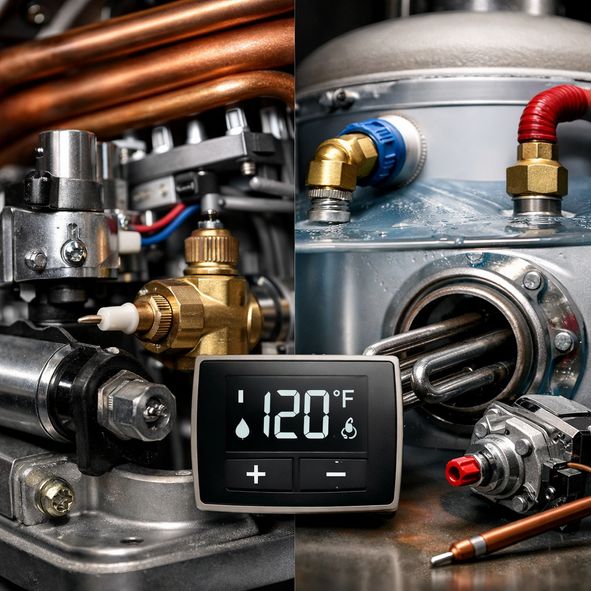
Technical Comparison: Tankless vs. Tank Water Heaters
| Specification / Factor | Tankless (On-Demand) | Storage Tank |
|---|---|---|
| Efficiency Metric (UEF) | 0.90 – 0.99 (condensing models) | 0.58 – 0.70 (standard models) |
| Standby Heat Loss | None — heats on demand only | Continuous — losses occur 24/7 |
| Sizing Basis | Peak GPM + Temperature Rise | Gallon Capacity + Recovery Rate (GPH) |
| Hot Water Supply | Unlimited (within rated GPM) | Limited to tank capacity; recovery lag |
| Expected Service Life | 15–20 years (with annual maintenance) | 8–12 years |
| Installation Complexity | High — dedicated gas line, venting, condensate drain | Moderate — standard venting and connections |
| Maintenance Requirements | Annual descaling, filter inspection, flow sensor check | Annual TPR valve test, periodic anode rod and flush |
| Footprint / Space | Wall-mounted — minimal floor space | Large floor footprint required |
| Technical Safety BC Compliance | Requires licensed gas fitter for installation and inspection | Requires licensed gas fitter for installation and inspection |
| Best Application | High-demand households, tight spaces, efficiency-focused owners | Lower simultaneous demand, simpler installations |
Frequently Asked Questions: Tankless vs. Tank Water Heaters
Q1: Can a single tankless unit handle a large family home in Surrey or Richmond?
Yes — provided it is correctly sized. A large household with high simultaneous hot water demand may require a high-output condensing unit rated at 180,000–199,000 BTU/hr, or in some cases, a cascaded dual-unit installation. A proper peak GPM and temperature rise assessment by a licensed technician determines this definitively. Do not size by square footage alone.
Q2: Does the Lower Mainland’s coastal humidity affect tankless water heater installation?
Yes, in two meaningful ways. First, condensing tankless units produce acidic condensate that must be properly neutralized and drained — a requirement under Technical Safety BC regulations. Second, exterior wall penetrations for direct-vent or power-vent systems must be correctly sealed and weatherproofed to prevent moisture intrusion, which is especially important given Vancouver’s persistent rainfall and humidity levels.
Q3: Are there warranty implications if I don’t maintain my tankless unit annually?
Absolutely. Most leading manufacturers — Navien, Rinnai, Bradford White, Noritz — explicitly require documented annual maintenance performed by a certified technician as a condition of warranty validity. Skipping descaling, neglecting filter screens, or ignoring error codes can void your heat exchanger warranty, which is the most expensive component in the system.
Q4: What venting changes are required when switching from a tank to a tankless unit?
This is one of the most commonly underestimated aspects of conversion. Condensing tankless units use PVC or CPVC venting (due to low flue gas temperatures of 40–60°C) rather than the Category I B-vent used by most storage tank units. New penetrations through walls or roofs are typically required, and all venting must comply with the BC Fuel Gas Code and Technical Safety BC standards — this is not a DIY project.
Conclusion: Which System Is Right for Your Lower Mainland Home?
Both tankless and storage tank water heaters have a legitimate place in Lower Mainland homes — the right choice depends on your household’s peak hot water demand, available installation space, existing gas line capacity, and long-term performance expectations. Tankless systems offer superior thermal efficiency and virtually unlimited hot water supply, but demand precise sizing and professional installation. Storage tanks offer simplicity and straightforward serviceability, but carry the ongoing penalty of standby heat loss.
The single most important step is a proper on-site technical assessment by a qualified, licensed HVAC and gas fitting professional who understands both the equipment specifications and the specific demands of Lower Mainland homes and climate conditions.
Don’t guess on a decision this important. The team at BCRC Heating and Cooling are Red Seal certified technicians serving Vancouver, Burnaby, Richmond, Coquitlam, Surrey, and across the Lower Mainland. We perform complete on-site assessments, accurate GPM and temperature rise calculations, and fully Technical Safety BC-compliant installations.
📞 Call BCRC Heating and Cooling today at (604) 781-7272 to schedule your on-site water heater inspection and technical assessment. Get the right system, sized correctly, installed to code — the first time.