


How Long Does a Furnace Last? Repair vs. Replace
How Long Does a Furnace Last in the Lower Mainland?
Most furnaces last between 15 and 25 years, but in Vancouver’s coastal climate — characterized by high humidity, damp cold snaps, and salt-laden air — heat exchangers and secondary components often degrade faster than interior BC averages. If your furnace is over 15 years old and showing performance issues, it’s time to seriously evaluate repair versus replacement.
At BCRC Heating and Cooling, we perform Technical Safety BC–compliant inspections across Vancouver, Burnaby, Richmond, Coquitlam, Surrey, and the broader Lower Mainland. In this guide, our Red Seal master technicians break down furnace lifespan by equipment type, efficiency rating, and operating environment — so you can make the most informed decision possible.
What Factors Determine Furnace Lifespan?
Furnace lifespan depends on equipment quality, AFUE rating, installation sizing accuracy, maintenance frequency, and local climate stress. A properly sized, annually serviced unit in a sealed, well-insulated Lower Mainland home can comfortably reach 20–25 years. Undersized or poorly maintained units often fail in under 15 years.
Here are the most critical technical variables our field engineers evaluate on every diagnostic call:
- AFUE Rating: Annual Fuel Utilization Efficiency measures how much fuel is converted to usable heat. Legacy 80% AFUE units work significantly harder than modern 96–98% AFUE condensing models, accelerating wear on heat exchangers and inducer motors.
- Manual J Load Calculation Compliance: Improper sizing — either oversized or undersized BTU capacity — causes short-cycling or continuous run conditions. Both dramatically reduce equipment lifespan and create uneven comfort zones throughout your Lower Mainland home.
- Single-Stage vs. Two-Stage vs. Variable-Speed Modulating: Single-stage furnaces blast at 100% capacity every cycle, creating thermal stress on components. Variable-speed modulating systems operate at 40–100% capacity in small increments, reducing mechanical fatigue and extending service life by 3–7 years compared to entry-level counterparts.
- Heat Exchanger Integrity: The heat exchanger is the most critical — and most expensive — component. Coastal humidity accelerates corrosion. A cracked heat exchanger is a carbon monoxide hazard and triggers mandatory Technical Safety BC reporting requirements.
- Annual Maintenance: Furnaces serviced annually by a certified Gas Fitter B or Gas Fitter A technician routinely outlast neglected units by 5–8 years. Filter maintenance, combustion analysis, and inducer motor inspections are non-negotiable in the Lower Mainland’s damp environment.
How Do I Know If My Furnace Needs Repair or Replacement?
If repair costs exceed 50% of a new unit’s value, or if your furnace is over 15 years old with recurring failures, replacement delivers better long-term reliability and comfort. Single component failures on newer units almost always justify repair. Repeated failures on aging equipment signal systemic decline.
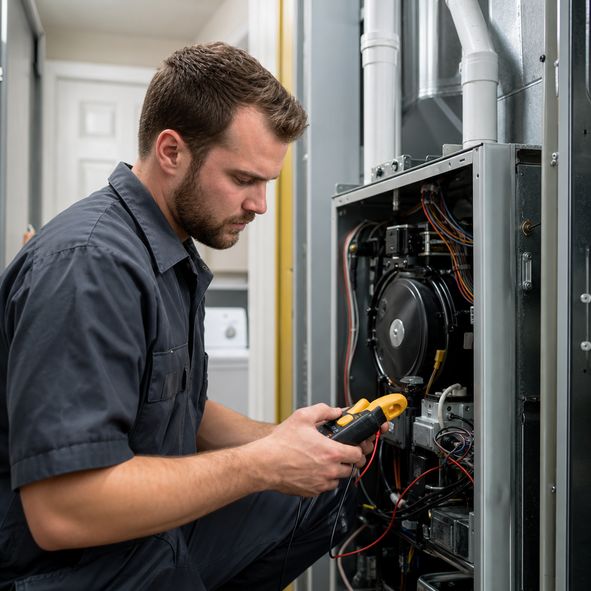
Our technicians use a structured diagnostic framework on every service call:
- Age Assessment: Locate the manufacture date on the data plate inside the furnace cabinet. Units manufactured before 2005 are approaching or past end-of-life under typical Lower Mainland operating conditions.
- Combustion Analysis: We use calibrated combustion analyzers to measure CO output, flue gas temperature, and oxygen levels. Elevated CO readings or abnormal flue temperatures indicate heat exchanger failure — a replacement trigger regardless of age.
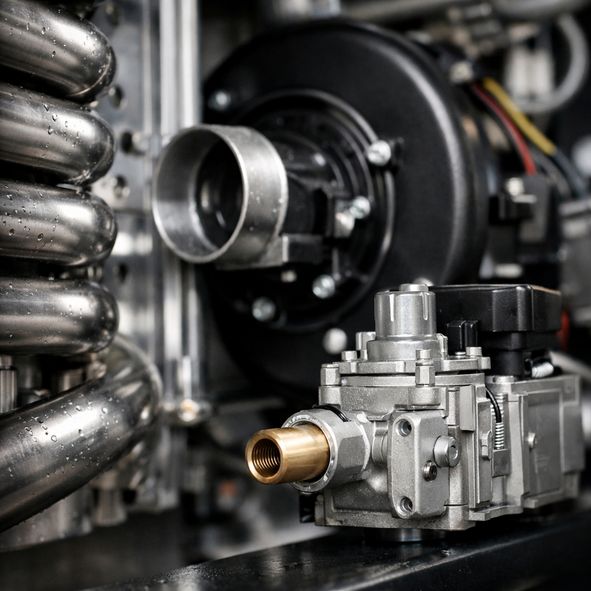
- Operational Stage Performance: On two-stage and modulating systems, we test first-stage and second-stage lockout behavior. A modulating furnace stuck at full fire indicates a faulty modulating gas valve — a significant repair that may warrant replacement on older units.
- Inducer Motor & Pressure Switch Testing: Coastal humidity causes inducer wheels to accumulate biofilm and debris. We measure amperage draw against nameplate specifications and inspect pressure switch tubing for moisture blockages — a very common Lower Mainland failure mode.
- Blower Motor & ECM Diagnostics: Variable-speed ECM (Electronically Commutated Motor) blowers are standard on high-efficiency systems. We test motor efficiency curves and check for capacitor degradation, which is common in units over 10 years old operating in humid environments.
Repair vs. Replace: Technical Comparison at a Glance
| Criteria | Repair (Recommended) | Replace (Recommended) |
|---|---|---|
| Unit Age | Under 12 years | 15 years or older |
| AFUE Efficiency | 90%+ already installed | Below 80% AFUE |
| System Type | Two-stage or modulating | Single-stage, oversized legacy unit |
| Heat Exchanger | Intact, no cracks detected | Cracked, corroded, CO leakage confirmed |
| Repair History | First or second repair event | Multiple repairs within 3–5 years |
| Comfort Performance | Even heat distribution maintained | Cold spots, humidity imbalance, short-cycling |
| Technical Safety BC Status | Fully compliant, no orders issued | Outstanding orders or red-tagged components |
| Air Quality | Acceptable combustion readings | Elevated CO, poor combustion efficiency |
| Blower Performance | ECM motor functioning within spec | PSC motor, high amp draw, restricted airflow |
What Type of Replacement Furnace Should I Choose for Vancouver’s Climate?
For Lower Mainland homes, a 96–98% AFUE two-stage or variable-speed modulating furnace with an ECM blower motor is the technically superior choice. It handles coastal humidity, supports zoning systems, and delivers consistent comfort during extended damp cold snaps without the short-cycling problems of single-stage units.
Here’s what our Red Seal technicians assess during equipment selection:
- BTU Sizing via Manual J: We never size by square footage alone. A proper Manual J load calculation accounts for your home’s insulation R-values, window glazing, infiltration rates, and Lower Mainland climate data (ASHRAE 99% design temperature for Vancouver: approximately -7°C). Oversizing by even 25% creates humidity problems and premature component wear.
- Modulating Gas Valves: Premium modulating furnaces adjust firing rate in 1% increments between 40–100% capacity. This eliminates temperature swings, reduces noise, and keeps your home’s relative humidity stable — critical in Vancouver’s already-humid coastal environment.
- Variable-Speed ECM Blowers: ECM motors consume a fraction of the energy of legacy PSC motors and maintain precise airflow across all static pressure conditions. This is especially important in Richmond and Burnaby homes with longer duct runs and higher static pressure profiles.
- Warranty Requirements: Most manufacturers require professional installation by a certified Gas Fitter and annual maintenance to honor 10-year parts warranties. Technical Safety BC permit issuance is mandatory on all new furnace installations — confirm your contractor pulls the required permits.
Frequently Asked Questions
Q: My 18-year-old furnace still runs — should I replace it proactively?
Yes, proactive replacement is technically advisable. At 18 years, your furnace’s heat exchanger is at high statistical risk of micro-cracking — an invisible carbon monoxide hazard. Additionally, legacy 80% AFUE single-stage units cannot match the comfort performance or air quality output of modern 96–98% AFUE modulating systems. A scheduled replacement on your terms is safer and more comfortable than an emergency failure during a January cold snap in the Lower Mainland.
Q: Can a furnace last 30 years in Vancouver?
Technically possible, but extremely rare and inadvisable from a safety standpoint. Units approaching 30 years predate modern heat exchanger metallurgy, ignition system standards, and Technical Safety BC safety regulations. Even if operational, combustion efficiency and CO containment cannot be guaranteed. Our field technicians have red-tagged functional-appearing 28-year-old units with severely compromised heat exchangers that showed no external signs of failure.
Q: How does Burnaby or Richmond’s humidity affect my furnace lifespan?
Coastal humidity is the primary accelerant of heat exchanger corrosion in the Lower Mainland. Flue gas condensation inside aging non-condensing heat exchangers creates acidic moisture that pits steel surfaces over time. In Richmond specifically, where homes often have higher infiltration rates due to slab-on-grade construction, we see inducer housing corrosion 20–30% more frequently than in dryer interior BC markets. Annual combustion analysis is essential in these areas.
Q: What does Technical Safety BC compliance mean for my furnace installation?
Technical Safety BC (TSBC) is the provincial authority governing gas appliance safety in British Columbia. Any new furnace installation requires a permit, a licensed Gas Fitter (Class B or A) to perform the work, and a TSBC inspection before the system is commissioned. Non-permitted installations void manufacturer warranties, create insurance liability, and — most critically — cannot be verified for safe combustion, proper venting, and correct gas pressure. Always demand permit documentation from your HVAC contractor.
Trust BCRC Heating and Cooling for Your Lower Mainland Furnace Assessment
Whether your furnace is showing early warning signs or has reached the end of its service life, the only way to get a definitive repair-versus-replace recommendation is through a professional on-site technical inspection — not an online calculator or a rushed phone estimate.
At BCRC Heating and Cooling, our Red Seal certified technicians serve Vancouver, Burnaby, Richmond, Coquitlam, Surrey, and the entire Lower Mainland with comprehensive furnace diagnostics, combustion analysis, Manual J sizing assessments, and Technical Safety BC–compliant installations. We evaluate your specific equipment, your home’s envelope, and your comfort requirements before making any recommendation.
Don’t wait for a mid-winter emergency. Call BCRC Heating and Cooling today at (604) 781-7272 to schedule your on-site furnace inspection and receive an honest, technically grounded assessment from a certified local expert. Visit us online to learn more about our services across the Lower Mainland.