


Radiant Floor Heating: Is It Worth It?
What Is Radiant Floor Heating and Why Are Lower Mainland Homeowners Talking About It?
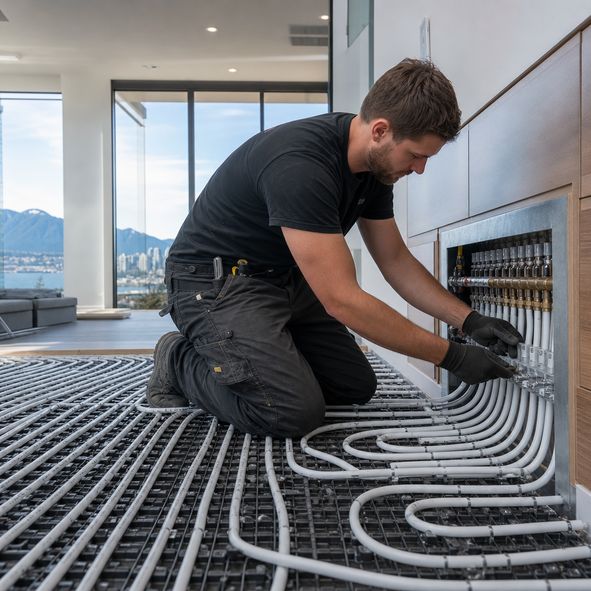
Radiant floor heating delivers consistent, whole-body warmth by circulating heated water through in-floor tubing or activating electric resistance elements beneath your flooring. For Vancouver, Burnaby, Richmond, Coquitlam, Surrey, and the broader Lower Mainland, where coastal humidity and damp cold snaps create a uniquely uncomfortable chill, radiant floor heating is emerging as one of the most technically sophisticated and comfort-forward heating solutions available. This guide cuts through the marketing noise and delivers a Red Seal technician’s honest assessment of whether radiant floor heating is genuinely worth the investment for your home.
How Does Radiant Floor Heating Actually Work?
Direct Answer: Radiant floor heating warms objects and people directly from the floor up using either hydronic tubing or electric elements. Unlike forced-air systems, it eliminates convective heat loss, reduces cold spots, and maintains even temperature distribution across the entire floor plane — ideal for BC’s damp, penetrating cold.
There are two primary system types: hydronic (wet) systems and electric (dry) systems. Hydronic systems circulate hot water through cross-linked polyethylene (PEX) tubing embedded in a concrete slab or installed beneath subfloor panels. A high-efficiency modulating boiler — typically achieving Annual Fuel Utilization Efficiency (AFUE) ratings of 95% or higher — drives the system. Electric systems use resistance wire or heating mats and are more common in retrofit or zone-specific applications like bathrooms. Both system types are governed by Technical Safety BC regulations, requiring installation by licensed gas contractors and registered electricians depending on the energy source.
Is Radiant Floor Heating Energy-Efficient for Vancouver’s Climate?
Direct Answer: Yes. Hydronic radiant systems paired with high-AFUE condensing boilers or variable-speed heat pumps operate at peak efficiency in Vancouver’s moderate, damp climate. Lower supply water temperatures — often 86°F to 120°F (30°C to 49°C) — mean the heat source works less aggressively, reducing overall energy consumption significantly.
Unlike forced-air systems rated by SEER2 or HSPF2 metrics for cooling and heat pump performance, radiant systems are evaluated primarily on boiler AFUE. A properly sized condensing boiler delivering 95%+ AFUE, combined with a modulating burner, can precisely match thermal output to your home’s load. When paired with an air-source heat pump in a hybrid configuration — leveraging the heat pump’s HSPF2 rating for mild shoulder seasons — radiant floor systems become exceptionally efficient year-round. The Lower Mainland’s relatively mild winters, rarely dropping below -5°C, mean the heat pump component operates within its optimal efficiency range for the majority of the heating season.
How Is Radiant Floor Heating Properly Sized?
Direct Answer: Accurate radiant floor sizing requires a full Manual J heat load calculation, accounting for your home’s insulation values (R-values), window U-factors, air infiltration rates, floor area, and local design temperatures. In the Lower Mainland, design temperatures typically range from -7°C to -10°C, shaping the entire system specification.
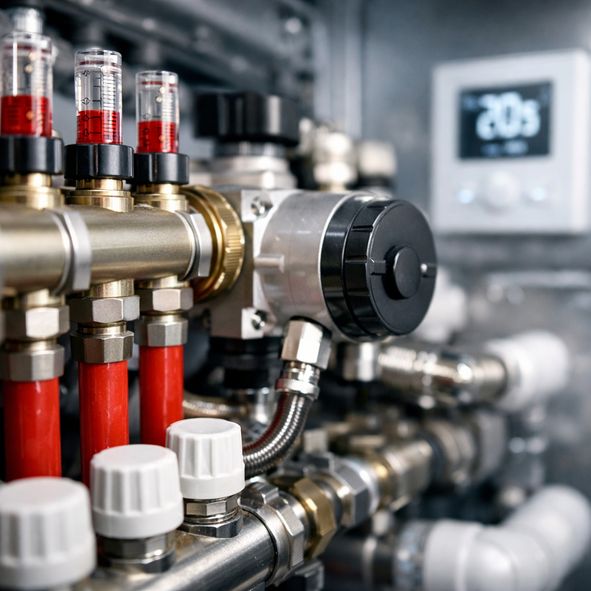
A Manual J calculation determines your home’s BTU-per-hour heat loss. From this figure, your HVAC engineer calculates tube spacing — typically 6-inch, 9-inch, or 12-inch on-center — slab or subfloor thermal resistance, supply water temperature, and manifold zone configuration. Oversizing a radiant system is just as damaging as undersizing: excessive water temperatures cause floor overheating, thermal stress on flooring materials, and cycling inefficiency. Undersizing leaves rooms cold and forces the boiler to run at maximum output, reducing efficiency and longevity. Proper zoning, using electronically controlled manifolds and thermostatic actuators, ensures each room receives precisely the heat it requires based on occupancy and exposure.
Single-Stage vs. Modulating Boilers: Which Is Right for Radiant Systems?
Direct Answer: Modulating condensing boilers are the gold standard for radiant floor heating. Variable-speed modulation allows the boiler to ramp output between 10% and 100% capacity, maintaining consistent supply water temperatures and maximizing condensing efficiency — critical for the low-temperature operation radiant systems demand.
Single-stage boilers operate at full capacity or not at all, creating on-off cycling that is fundamentally incompatible with radiant floor heating’s need for steady, low-temperature water delivery. Two-stage boilers are an improvement — offering a low-fire stage of roughly 60–70% capacity — but still cannot match the precise modulation of a variable-speed modulating unit. For Lower Mainland homes with varying internal gains (solar exposure, occupancy), a modulating boiler with outdoor reset control automatically adjusts supply water temperature based on outdoor ambient conditions. This outdoor reset function is arguably the single most important efficiency feature in a hydronic radiant system and should be non-negotiable in any professional specification.
Radiant Floor Heating vs. Forced-Air: Technical Comparison
| Specification | Hydronic Radiant Floor | Forced-Air Furnace |
|---|---|---|
| Heat Distribution | Radiant + convective from floor up | Convective from ceiling vents down |
| Temperature Consistency | Highly uniform, floor-to-ceiling | Stratification common (warm ceiling, cool floor) |
| AFUE / Efficiency Metric | Boiler: up to 99% AFUE (condensing) | Furnace: 80%–98% AFUE |
| Indoor Air Quality | No air movement; no dust/allergen circulation | Circulates air; requires HEPA filtration |
| Humidity Management | Passive; requires separate HRV or dehumidifier | Can integrate humidifier/dehumidifier inline |
| Response Time | Slow (slab thermal mass: 1–4 hours) | Fast (minutes to reach setpoint) |
| Zoning Capability | Excellent; manifold-based multi-zone | Good with damper systems; more complex |
| Flooring Compatibility | Tile, concrete, engineered hardwood, LVP | All floor types |
| Noise Level | Silent operation | Blower noise present |
| Technical Safety BC Compliance | Required; licensed gas/electrical contractor | Required; licensed gas contractor |
| Maintenance Interval | Annual boiler service; glycol check every 3–5 yrs | Annual furnace tune-up; filter changes quarterly |
| System Lifespan | Boiler: 20–25 yrs; PEX tubing: 50+ yrs | Furnace: 15–20 yrs; ductwork: 25+ yrs |
Is Radiant Floor Heating Suitable for Vancouver’s Humid Coastal Climate?
Direct Answer: Absolutely. Radiant heating does not circulate air, which is a significant advantage in Vancouver’s humidity-laden environment. It eliminates the forced-air system’s tendency to dry out indoor air excessively in winter and avoids redistributing mold spores or allergens through ductwork — a real concern in older Lower Mainland homes.
However, because radiant systems do not ventilate, homes must be paired with a Heat Recovery Ventilator (HRV) to maintain fresh air quality and control moisture buildup — a requirement under BC Building Code for new construction. In existing homes undergoing radiant retrofits, an HRV assessment should be part of every project specification. This is particularly important in Richmond and Delta, where high water tables contribute to elevated indoor humidity year-round.
Frequently Asked Questions About Radiant Floor Heating
Q1: Can radiant floor heating be installed in an existing Lower Mainland home without a full renovation?
Yes. Thin-profile hydronic systems using aluminum heat-transfer plates can be installed beneath existing subfloors from below (between floor joists) without demolishing finished floors. Electric mat systems can also be installed under tile or LVP in targeted zones like bathrooms or kitchens with minimal disruption. A full Manual J assessment determines whether the existing structure can support the required output at acceptable water temperatures.
Q2: What flooring materials work best with radiant heat in BC homes?
Porcelain tile and polished concrete are the most thermally conductive choices, transferring heat most efficiently. Engineered hardwood and luxury vinyl plank (LVP) are also compatible if the system maintains supply water temperatures below 29°C (84°F) to prevent warping. Solid hardwood and thick carpet are generally not recommended — carpet’s R-value insulates against the very heat you are trying to deliver, reducing system efficiency significantly.
Q3: How does radiant floor heating perform during Burnaby or Surrey cold snaps?
Because of radiant heating’s thermal mass lag — particularly in slab systems — the system must be programmed to anticipate temperature drops rather than react to them. Smart thermostats with outdoor temperature sensors and predictive algorithms manage this effectively. During cold snaps reaching -7°C to -10°C in the Lower Mainland, a properly sized modulating boiler will ramp to higher output continuously, maintaining comfort without the rapid cycling of a forced-air system.
Q4: Does radiant floor heating require a lot of maintenance?
Hydronic systems require annual boiler servicing — combustion analysis, heat exchanger inspection, pump and expansion tank checks — plus glycol concentration testing every three to five years to prevent corrosion and freezing in the hydronic loop. Electric radiant systems have virtually no moving parts and require minimal maintenance beyond thermostat checks. All service work on gas-fired boilers must be performed by a Technical Safety BC-licensed gas contractor.
The BCRC Verdict: Is Radiant Floor Heating Worth It?
For Lower Mainland homeowners prioritizing long-term comfort, superior indoor air quality, silent operation, and a heating system engineered to last decades, radiant floor heating is an exceptional choice. Its compatibility with high-AFUE condensing boilers and hybrid heat pump configurations makes it one of the most technically sound heating strategies available in Vancouver’s coastal climate. The key to success is not the system itself — it is the precision of the design, the accuracy of the Manual J calculation, and the quality of the installation team executing it.
At BCRC Heating and Cooling, our Red Seal-certified technicians bring deep hydronic expertise and local climate knowledge to every radiant floor project across Vancouver, Burnaby, Richmond, Coquitlam, Surrey, and the entire Lower Mainland. We perform comprehensive on-site assessments, full load calculations, Technical Safety BC-compliant installations, and long-term service agreements that protect your investment for decades.
Do not leave the comfort and efficiency of your home to guesswork. Call BCRC Heating and Cooling today at (604) 781-7272 to schedule your on-site technical inspection and radiant floor heating assessment. Our team is ready to design the system your home deserves.