

Emergency Heating Repair: Furnace Breakdown at Night
Emergency Heating Repair: What to Do When Your Furnace Breaks Down at Night
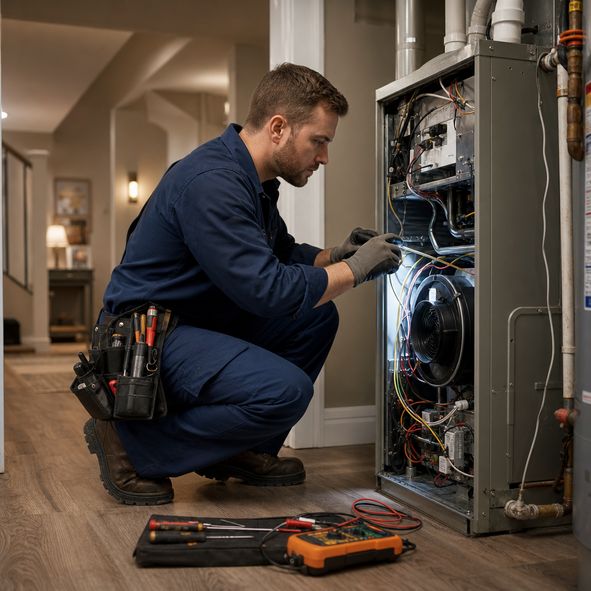
A furnace failure during a cold Lower Mainland night is more than an inconvenience — it is a genuine safety emergency. Whether you are in Burnaby, Richmond, Coquitlam, Surrey, or anywhere across Vancouver, knowing exactly what to do when your furnace breaks down at night can protect your family, prevent pipe freeze damage, and help your emergency heating repair technician diagnose the problem faster. This guide walks you through every critical step, from the moment your heat dies to the moment a Red Seal HVAC technician restores your comfort.
Why Do Furnaces Fail at Night More Often?
Furnaces fail at night because outdoor temperatures drop, demand spikes, and systems that were already stressed by wear reach their breaking point under peak thermal load. Components like heat exchangers, ignitors, and pressure switches are most vulnerable during sustained cold-snap operation.
In the Lower Mainland, coastal damp cold — the kind that settles in during November through February — forces furnaces to run in longer, more sustained cycles than in dry inland climates. A single-stage furnace that runs at 100% capacity every cycle accumulates fatigue stress far faster than a variable-speed modulating system that ramps up gradually. This is why upgrading from a single-stage to a two-stage or modulating furnace is often the long-term solution after repeated emergency callouts.
Step 1: Confirm It Is a Furnace Problem, Not a Thermostat or Power Issue
Before assuming furnace failure, verify your thermostat is set to HEAT and the setpoint is above room temperature, your electrical panel has not tripped the furnace breaker, and the furnace power switch — typically located on the unit or nearby wall — is in the ON position.
Check the thermostat display first. A blank screen on a digital thermostat often means dead batteries. Replace them and wait 60 seconds for the system to reboot. Next, locate your electrical panel and look for the breaker labeled FURNACE or HVAC — if it has tripped to the middle position, reset it once. If it trips again immediately, do not reset it a second time. A repeatedly tripping breaker indicates a serious electrical fault requiring a licensed HVAC technician compliant with Technical Safety BC regulations.
Step 2: Check the Furnace Filter and Airflow Immediately
A severely clogged air filter is one of the top causes of after-hours furnace shutdowns. A blocked filter restricts airflow, triggering the furnace’s high-limit safety switch, which shuts the system down to prevent heat exchanger damage — a serious and costly failure.
Locate your filter, typically in the blower compartment or return air duct. If it is visibly grey, matted, or completely blocked, replace it with the correct MERV-rated filter for your unit. In Vancouver and the Lower Mainland, where coastal humidity and urban particulates are constant factors, filters can load up faster than the standard 90-day replacement interval. After replacing the filter, wait 30 minutes and attempt a restart. Many after-hours service calls are resolved by this single action.
Step 3: Inspect the Furnace Flame Sensor and Ignitor — Do Not Touch
If your furnace attempts to start — you hear the inducer motor spin and the gas valve click — but shuts off within a few seconds, the most likely culprit is a dirty or failing hot surface ignitor or a contaminated flame sensor that cannot confirm combustion to the control board.
This is a visual diagnostic only for homeowners. Look through the sight glass on your furnace panel (if equipped) to see whether a flame appears and then disappears. A flame that lights and extinguishes within three to five seconds points directly to a flame sensor issue. Do not attempt to clean or replace ignitor or flame sensor components yourself. These repairs require proper calibration, correct microamp readings, and Technical Safety BC compliance. Contact an emergency HVAC technician immediately.
Step 4: Check for Error Codes on the Control Board
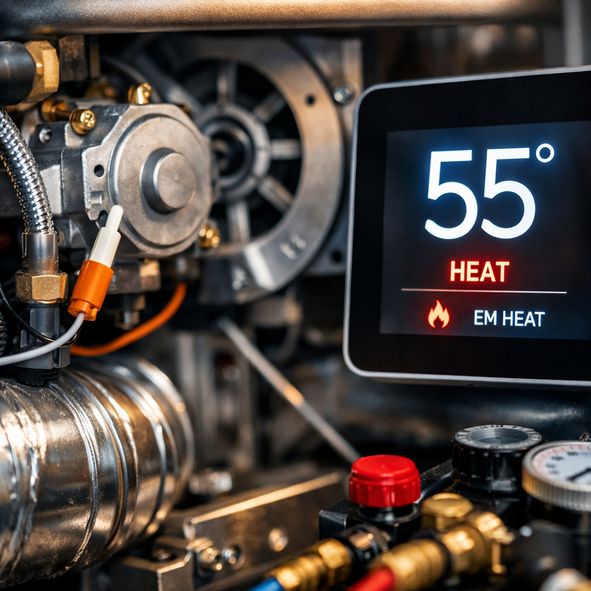
Modern furnaces communicate failure modes through LED blink codes displayed on the control board, visible through the lower access panel. These codes are your most direct diagnostic pathway and help your HVAC technician arrive prepared with the correct parts.
Remove the lower access panel carefully. Most furnaces have a legend sticker on the inside of the panel that decodes the blink sequences. Common codes indicate pressure switch faults, limit switch trips, ignition failures, or inducer motor problems. Photograph the blink sequence with your phone and relay this information when you call your emergency HVAC service line. For BCRC Heating and Cooling customers across Surrey, Coquitlam, and Richmond, providing this code dramatically reduces diagnostic time on an emergency call.
Step 5: Keep Your Home Safe While Awaiting Emergency Repair
While waiting for your emergency heating repair technician, prioritize pipe freeze prevention and safe supplemental heating. Protect vulnerable pipes under sinks, in crawl spaces, and in garages, and use only CSA-certified electric space heaters with tip-over protection in occupied rooms.
Never use gas ranges, barbecues, or unvented combustion devices for supplemental heat — carbon monoxide poisoning is a lethal risk. Open cabinet doors under sinks on exterior walls to allow ambient air circulation around pipes. If outdoor temperatures are forecast to drop below freezing, allow a thin trickle of water from cold-side faucets on exterior walls. In the Lower Mainland’s damp cold climate, pipes in poorly insulated areas can begin to freeze faster than homeowners expect.
Furnace System Comparison: What Type of System Are You Repairing or Replacing?
| System Type | AFUE Rating | Stage Operation | Best Application | Reliability in Damp Cold | Warranty Consideration |
|---|---|---|---|---|---|
| Single-Stage Gas Furnace | 80% AFUE | ON/OFF only | Budget replacement, mild climates | Moderate — high cycle stress | Basic coverage; shorter lifespan under heavy load |
| Two-Stage Gas Furnace | 96% AFUE | Low (65%) / High (100%) | Most Lower Mainland homes | Good — reduced cycling wear | Extended heat exchanger warranty typical |
| Variable-Speed Modulating Furnace | 98%+ AFUE | 33%–100% continuous modulation | Larger homes, maximum comfort | Excellent — minimal thermal stress | Longest warranty; requires professional commissioning |
| Heat Pump + Gas Backup (Hybrid) | HSPF2 up to 10+ | Variable compressor + gas assist | Year-round efficiency, BC climate | Excellent — dual-fuel redundancy | Manufacturer warranty requires certified install |
Frequently Asked Questions: Emergency Furnace Repair in the Lower Mainland
Is it safe to stay in my home if my furnace stops working at night?
Yes, for several hours, provided you use CSA-certified electric supplemental heating and monitor indoor temperatures. If indoor temperature drops below 10°C, prioritize moving vulnerable household members — including young children and elderly residents — to a warmer location. Persistent cold below this threshold risks both health complications and pipe damage in a typical Lower Mainland home.
How do I know if my furnace needs emergency repair versus full replacement?
If your furnace is over 15 years old, has required multiple repairs in the past two seasons, shows visible heat exchanger cracking, or consistently fails to reach setpoint temperatures during moderate cold snaps, replacement is likely the more reliable long-term solution. A licensed HVAC technician can perform a combustion analysis and heat exchanger inspection to give you a definitive technical assessment on-site.
What AFUE rating should I look for in a replacement furnace for Vancouver’s climate?
A minimum 96% AFUE two-stage furnace is the practical baseline recommendation for the Lower Mainland. The region’s sustained damp cold requires longer run cycles, making high-efficiency condensing furnaces — which recover latent heat from exhaust gases — significantly more effective than 80% AFUE non-condensing units. For larger homes in Surrey or Coquitlam, a variable-speed modulating furnace at 98%+ AFUE is the technically superior choice.
Does furnace repair in BC require a licensed technician?
Yes. In British Columbia, all gas appliance repairs, gas line work, and furnace installations must be performed by a Gas Fitter licensed under Technical Safety BC regulations. Unlicensed repairs void manufacturer warranties, may violate your home insurance policy, and create serious safety and liability risks. Always verify your technician holds a valid BC Gas Ticket (Class A or B) before authorizing any repair work.
Call BCRC Heating and Cooling for Emergency Furnace Repair Tonight
When your furnace breaks down at night across Vancouver, Burnaby, Richmond, Coquitlam, Surrey, or anywhere in the Lower Mainland, you need a team that combines field-proven technical expertise with rapid emergency response. At BCRC Heating and Cooling, our Red Seal certified technicians carry common replacement components on every service vehicle, perform full combustion analysis and Technical Safety BC-compliant diagnostics, and provide honest, transparent assessments — whether your system needs a targeted repair or a properly sized replacement using Manual J load calculation methodology.
Do not spend a cold night without heat. Call BCRC Heating and Cooling right now at (604) 781-7272 or visit bcrcheating.com to request emergency service. Our team is standing by to restore your comfort, protect your home, and get your heating system performing at its engineered specifications — tonight.