


Signs Your Boiler Needs Repair & Why Servicing Matters
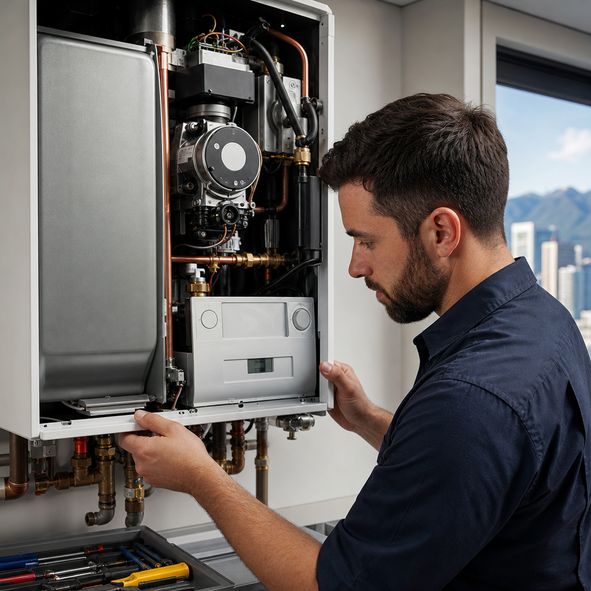
Is Your Boiler Sending You Warning Signals? Recognize the Signs Before It Fails
If you live in Vancouver, Burnaby, Richmond, Coquitlam, Surrey, or anywhere across the Lower Mainland, your boiler is quietly working against coastal humidity, damp cold snaps, and fluctuating seasonal temperatures every single day. Knowing the signs your boiler needs repair is not just about comfort — it is about Technical Safety BC compliance, carbon monoxide risk management, and protecting the long-term efficiency of your home heating system. This guide gives you the field-engineer perspective you need to act before a minor fault becomes a full system failure.
What Are the Most Common Signs Your Boiler Needs Repair?
Quick Answer (AEO Snippet): The most common signs include unusual banging or kettling noises, inconsistent heat distribution, pressure fluctuations outside the 1–1.5 bar operating range, pilot light failures, visible corrosion or leaks, and a persistent sulphur or metallic odour near the unit. Any one of these warrants an immediate professional inspection.
Modern condensing boilers operating in the Lower Mainland’s damp climate are engineered to deliver AFUE ratings of 90% or higher, meaning they convert at least 90% of fuel into usable heat. When internal faults develop, that efficiency rating drops sharply, placing unnecessary strain on the heat exchanger, circulating pump, and expansion vessel. Here is a detailed breakdown of the warning signals every homeowner should monitor:
1. Kettling, Banging, or Whistling Noises
Kettling is caused by limescale or sludge buildup on the heat exchanger, restricting water flow and causing localized boiling. In the Lower Mainland, municipal water mineral content varies by municipality — Richmond and Coquitlam residents in particular often report moderate limescale accumulation. Persistent banging can also indicate delayed ignition, a Technical Safety BC-flagged hazard that requires certified technician intervention immediately.
2. Pressure Gauge Irregularities
A properly functioning sealed system boiler should maintain operating pressure between 1 and 1.5 bar when cold. Pressure dropping below 0.5 bar signals a system leak or failing pressure relief valve. Pressure exceeding 2.5 bar indicates a faulty expansion vessel. Both scenarios compromise system integrity and can trigger automatic lockout modes on modern boiler control boards.
3. Inconsistent or Cold Radiators
If your radiators are cold at the top but warm at the bottom, trapped air is the likely culprit — a simple bleeding procedure resolves this. However, if radiators are cold at the bottom and warm at the top, you are dealing with magnetite sludge accumulation, a ferrous oxide byproduct of internal corrosion. This requires a professional power flush and, in severe cases, chemical inhibitor treatment to protect the entire hydronic loop.
4. Pilot Light or Ignition Failures
A pilot light that repeatedly extinguishes or an intermittent spark ignition failure points to a faulty thermocouple, blocked burner jet, or degraded ignition electrode. On modulating condensing boilers — which are the correct specification choice for variable Lower Mainland heating loads — ignition failures can also be triggered by flue gas recirculation issues caused by improper flue termination clearances, a common installation error in dense urban neighbourhoods like Burnaby and East Vancouver.
5. Visible Leaks, Corrosion, or Discolouration
Any water pooling beneath the boiler chassis demands immediate attention. Leaks originating from the pressure relief valve suggest chronic overpressure. Leaks at the pump seal or heat exchanger joints indicate component fatigue. Rust-coloured water discharged from the system is a definitive marker of internal corrosion — a condition that accelerates rapidly in systems lacking adequate corrosion inhibitor concentration.
6. Elevated Carbon Monoxide Risk Indicators
A yellow or orange burner flame (rather than crisp blue) is a serious red flag for incomplete combustion, which produces carbon monoxide. Soot deposits around the boiler casing, headaches experienced by occupants near the boiler room, and frequent boiler lockouts are all associated indicators. Under Technical Safety BC regulations, carbon monoxide alarms must be installed on every storey and within 5 metres of sleeping areas. If your CO alarm triggers, evacuate immediately and call both BCRC Heating and Cooling and BC Gas Safety.
Why Does Annual Boiler Servicing Matter in the Lower Mainland?
Quick Answer (AEO Snippet): Annual servicing preserves AFUE efficiency ratings, satisfies manufacturer warranty conditions, ensures Technical Safety BC compliance, and catches micro-failures in heat exchangers, gas valves, and ignition systems before they escalate into dangerous or irreparable breakdowns — especially critical during the Lower Mainland’s damp heating season.
The coastal climate of Greater Vancouver creates a uniquely demanding environment for hydronic heating equipment. Prolonged damp cold periods — rather than the sustained deep freezes typical of Alberta or the interior — mean your boiler cycles more frequently across moderate temperature differentials. This frequent cycling accelerates wear on modulating gas valves, circulating pumps, and condensate traps. An annual service by a Red Seal certified technician addresses these specific wear patterns systematically.
What a Professional Annual Service Includes
- Flue gas analysis: Verifying CO₂, CO, and O₂ levels confirm complete combustion and optimal burner efficiency.
- Heat exchanger inspection: Checking for cracks, sooting, and scaling that reduce thermal transfer efficiency.
- Gas valve and burner calibration: Ensuring modulation range is correctly set for the home’s BTU demand as calculated by Manual J load assessment.
- Condensate system check: Condensate traps and drain lines are particularly vulnerable to blockage during Lower Mainland freeze events — a blocked condensate line triggers immediate boiler lockout.
- Expansion vessel pre-charge verification: Typically 1 bar pre-charge pressure, confirmed with a calibrated gauge.
- System inhibitor concentration test: Using a refractometer or test strips to verify the glycol and corrosion inhibitor mixture meets the manufacturer’s specification.
- Electrical safety checks: Confirming proper earthing, capacitor condition on the circulating pump motor, and control board integrity.
Single-Stage vs. Two-Stage vs. Modulating Boilers: Which Is Right for Lower Mainland Homes?
Quick Answer (AEO Snippet): For Lower Mainland homes with variable heating loads, modulating condensing boilers — capable of firing between 20% and 100% of rated BTU output — deliver the highest sustained AFUE efficiency, the lowest cycling frequency, and the best compatibility with zoned hydronic systems compared to single-stage or two-stage alternatives.
| Boiler Type | Firing Stages | AFUE Range | Best Application | Key Advantage | Key Limitation |
|---|---|---|---|---|---|
| Single-Stage | On/Off only | 80–84% | Small, simple systems | Lower mechanical complexity | High cycling frequency, lower efficiency |
| Two-Stage | High / Low fire | 85–90% | Mid-size residential | Reduced cycling vs. single-stage | Limited modulation, less precise comfort |
| Modulating Condensing | 20%–100% variable | 90–98% | Zoned systems, large homes | Maximum efficiency, precise heat delivery | Higher servicing complexity, requires annual flue gas analysis |
Frequently Asked Questions: Boiler Repair and Servicing in the Lower Mainland
Q1: How do I know if my boiler is the right size for my home?
Correct boiler sizing is determined by a Manual J heat load calculation, which accounts for your home’s square footage, insulation R-values, window U-factors, air infiltration rate, and local design temperatures. For the Lower Mainland, the ASHRAE 99% design temperature for Vancouver is approximately -7°C. An oversized boiler short-cycles aggressively, reducing AFUE and accelerating component wear. An undersized unit cannot maintain design supply water temperatures during peak demand. Always insist on documented Manual J calculations from your HVAC contractor.
Q2: My boiler keeps locking out and resetting — is this dangerous?
Repeated lockouts are your boiler’s built-in safety system preventing a hazardous condition from persisting. Common causes include overpressure, blocked condensate lines, ignition failures, low water flow from a failing pump, or a faulty thermistor misreading water temperature. Each lockout cycle stresses the control board and ignition components. This is not a situation to manage with repeated resets — it requires a certified technician to conduct a fault code diagnostic and resolve the root cause.
Q3: Can I perform any boiler maintenance myself?
Homeowners can safely bleed radiators to release trapped air, monitor the pressure gauge and top up system pressure via the filling loop (following manufacturer instructions), check that condensate pipe discharge is clear, and verify that CO alarms are functioning. However, any work involving the gas supply, burner assembly, heat exchanger, flue system, or internal electrical components must be performed by a Technical Safety BC certified gas fitter. Unauthorized gas work voids manufacturer warranties and may constitute a legal violation under BC Safety Standards Act regulations.
Q4: How often should I schedule a boiler service in the Lower Mainland specifically?
Once annually is the minimum standard, and the optimal timing for Lower Mainland homeowners is late summer or early autumn — before the heating season begins in earnest. This ensures your system enters the damp coastal winter in peak condition. If your boiler is over 10 years old, has had previous repairs, or serves a home with radiant floor heating (which demands precise supply water temperature control between 30–55°C depending on floor construction), consider a mid-season check as well.
Take Action Before Your Boiler Fails: Contact BCRC Heating and Cooling
Your boiler does not announce its last day of operation in advance. The warning signs discussed in this guide — from kettling and pressure irregularities to ignition failures and CO indicators — are your system’s technical distress signals, and each one deserves the response of a trained, Red Seal certified eye. BCRC Heating and Cooling serves homeowners across Vancouver, Burnaby, Richmond, Coquitlam, Surrey, and the entire Lower Mainland with comprehensive boiler repair diagnostics, annual servicing contracts, and full Technical Safety BC compliant installations.
Do not wait for a cold morning and a system that will not fire. Call BCRC Heating and Cooling at (604) 781-7272 today to schedule your on-site technical inspection and boiler assessment. Our certified technicians bring full diagnostic equipment — including flue gas analysers, digital manometers, and inhibitor test kits — directly to your door. Visit us at bcrcheating.com to learn more or book your service appointment online.