


Furnace Blowing Cold Air? Causes & Fixes
Why Is My Furnace Blowing Cold Air? The Direct Answer
If your furnace is blowing cold air, the most common culprits are an overheated heat exchanger that triggered a safety lockout, a malfunctioning pilot light or ignitor, incorrect thermostat fan settings, a clogged air filter restricting airflow, or a condensate drainage fault on high-efficiency units. Most causes are diagnosable within minutes — but some demand certified intervention.
In the Lower Mainland’s coastal climate, where damp cold snaps hit hard between November and March, a furnace that suddenly pushes cold air through your vents isn’t just an inconvenience — it’s a technical emergency. At BCRC Heating and Cooling, our Red Seal technicians respond to this exact call dozens of times every heating season across Vancouver, Burnaby, Richmond, Coquitlam, Surrey, and the wider Lower Mainland. This guide gives you the complete technical breakdown so you understand what’s happening inside your system — and when to pick up the phone.
Is It Your Thermostat Fan Setting Causing Cold Air?
Quick Answer: If your thermostat fan is set to ON instead of AUTO, the blower motor runs continuously — even between heating cycles — pushing unconditioned room-temperature air through the vents. Switching to AUTO resolves this immediately and costs nothing.
This is the first diagnostic check every technician performs. When the fan runs on ON mode, it circulates air 100% of the time regardless of whether the burner is actively firing. Homeowners frequently mistake this lukewarm airflow for a mechanical failure. On a smart thermostat or a programmable unit, verify the fan logic is set to AUTO so the blower only operates during active heating cycles. In BC’s shoulder seasons — September and April — this misconfig is surprisingly common after summer cooling mode use.
Could a Dirty Air Filter Be Restricting Furnace Airflow?
Quick Answer: A severely clogged air filter reduces airflow across the heat exchanger so dramatically that the furnace overheats, triggering the high-limit safety switch. The burner shuts off, but the blower keeps running to cool the system — delivering cold air until the unit resets.
The Lower Mainland’s coastal air carries fine particulate matter, construction dust, and elevated humidity-borne allergens year-round. A standard 1-inch MERV-8 filter in an average 2,000 sq. ft. Vancouver home should be replaced every 60–90 days during the heating season. If your system uses a higher-efficiency MERV-11 or MERV-13 media filter, the static pressure restriction can be even more aggressive on older single-stage furnaces not designed for elevated external static pressure. Always match your filter MERV rating to the furnace’s rated external static pressure tolerance — check the equipment data plate or consult your installation manual.
What Role Does the Heat Exchanger Play in Cold Air Output?
Quick Answer: A cracked or overheated heat exchanger triggers the furnace’s high-limit switch, killing the burner flame while leaving the blower active. The result is continuous cold airflow. A cracked heat exchanger also presents a serious carbon monoxide risk — this is a Technical Safety BC compliance issue requiring immediate professional service.
Modern mid-efficiency furnaces operate at 80% AFUE, while high-efficiency condensing units reach 96–98% AFUE by extracting latent heat from flue gases. This secondary heat exchange process produces acidic condensate — and in the Lower Mainland’s damp environment, improper condensate neutralization or blocked drain lines can trigger pressure switch faults that lock out the burner entirely. The blower, however, continues to run post-lockout, delivering cold air. A heat exchanger failure on an aging furnace is non-negotiable: the unit must be red-tagged, isolated, and replaced. Technical Safety BC regulations require any equipment with confirmed heat exchanger breach to be decommissioned immediately.
How Does the Ignitor or Pilot Light Affect Furnace Heat Output?
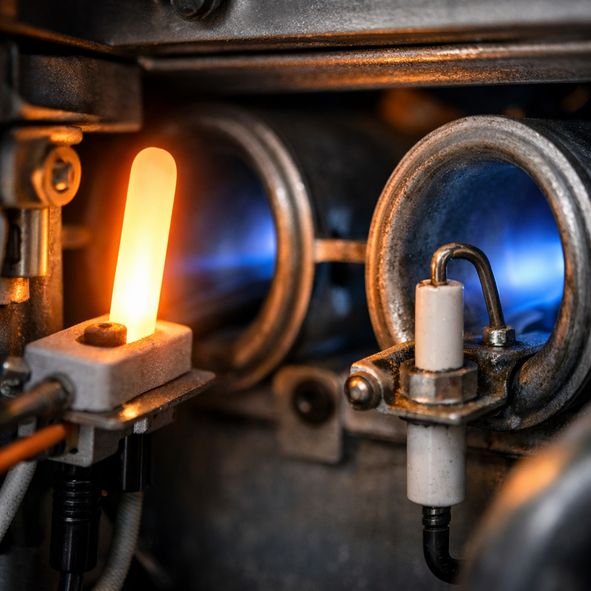
Quick Answer: If the electronic ignitor fails to glow or the standing pilot light extinguishes, the gas valve never opens, no combustion occurs, and only cold air circulates. On modern furnaces, a failed hot surface ignitor (HSI) is one of the most frequent service calls across the Lower Mainland each winter.
Pre-2000 furnaces often used standing pilot lights susceptible to drafts and thermocouple wear. Contemporary systems use silicon carbide or silicon nitride hot surface ignitors that heat to approximately 2,500°F to ignite the gas burner. When an HSI cracks — common after 5–7 years of thermal cycling — the control board detects no flame signal from the flame sensor rod and enters a lockout sequence after 2–3 failed ignition attempts. The inducer and blower may still run, producing cold airflow. This is a straightforward parts replacement for a licensed gas fitter, but the system should also be assessed for underlying gas pressure irregularities or control board faults that may have caused premature ignitor failure.
Can Ductwork Leaks Cause Cold Air From Furnace Vents?
Quick Answer: Yes. Significant duct leakage — particularly in unconditioned crawlspaces and attics common in Metro Vancouver’s older housing stock — allows heated air to escape and draws cold outside air into the return. The result is noticeably cooler supply air at registers despite normal burner operation.
Duct leakage rates exceeding 15–20% of system airflow are not uncommon in pre-1990 homes across Burnaby, Coquitlam, and South Surrey. A proper Manual J load calculation paired with a duct leakage test (blower door test) quantifies actual heat loss. Variable-speed modulating furnaces are especially sensitive to duct system integrity because their ECM blower motors continuously adjust airflow based on system static pressure feedback — compromised ductwork produces erratic comfort performance. Mastic sealant or UL-181-rated foil tape applied by a certified technician dramatically improves system efficiency and eliminates cold spot complaints.
Furnace System Comparison: Single-Stage vs. Two-Stage vs. Variable-Speed Modulating
| Feature | Single-Stage (80% AFUE) | Two-Stage (95% AFUE) | Variable-Speed Modulating (98% AFUE) |
|---|---|---|---|
| Heating Output Control | ON/OFF only (100%) | Low (65%) + High (100%) | Continuous modulation (40–100%) |
| Comfort in Damp BC Cold | Temperature swings common | Improved consistency | Precise, stable temperature control |
| Cold Air Risk (Oversizing) | High — short cycling | Moderate | Low — modulates to actual load |
| AFUE Efficiency Rating | Up to 80% | Up to 96% | Up to 98% |
| Blower Motor Type | PSC (fixed speed) | PSC or ECM | ECM variable-speed |
| Manual J Sizing Requirement | Critical — oversizing causes lockouts | Important | Most tolerant but still required |
| Technical Safety BC Compliance | Mandatory | Mandatory | Mandatory |
| Warranty (Typical) | 5–10 yr heat exchanger | 10–20 yr heat exchanger | Lifetime heat exchanger (select models) |
| Best Application | Smaller, well-insulated homes | Mid-size Lower Mainland homes | Larger homes, high-humidity climates |
Frequently Asked Questions: Furnace Blowing Cold Air in Metro Vancouver
Q1: My furnace kicks on, runs for a few minutes, then blows cold air. What’s happening?
This is a classic short-cycling pattern caused by a high-limit switch activation. The burner fires but an overheating condition — caused by restricted airflow (dirty filter, blocked registers, or duct restriction) — trips the safety cutout. The blower continues to run to dissipate residual heat. Check and replace your air filter first. If the problem persists after filter replacement, a technician needs to evaluate heat exchanger condition, blower motor performance, and system static pressure. Do not ignore repeated high-limit trips — they accelerate heat exchanger fatigue.
Q2: How do I know if my furnace’s heat exchanger is cracked?
Without specialized equipment, you cannot reliably self-diagnose a cracked heat exchanger. A licensed HVAC technician uses combustion analysis, visual inspection with a combustion camera, and carbon monoxide (CO) testing at supply registers. Warning signs include a persistent burning smell, visible soot around the furnace, unexplained CO detector alerts, or a flickering burner flame when the blower activates. In BC, a confirmed cracked heat exchanger triggers a Technical Safety BC mandatory red-tag — the appliance must be shut down. Do not operate a red-tagged furnace.
Q3: My high-efficiency furnace is flashing an error code and blowing cold air. What does this mean?
High-efficiency condensing furnaces (96–98% AFUE) use onboard diagnostic LED flash codes or digital fault displays to communicate specific failures. Common codes relate to pressure switch faults (blocked condensate drain or failed inducer motor), flame sensor contamination, ignition lockout, or inducer proving switch issues. In Metro Vancouver’s damp climate, condensate drain blockages are especially prevalent. Each manufacturer’s fault code chart is unique — Lennox, Carrier, Goodman, and Bryant all use different sequences. A technician with the correct service manual and diagnostic tools interprets these codes in minutes and resolves the underlying fault safely.
Q4: Should I repair my old furnace or replace it when it keeps blowing cold air?
The industry benchmark is the 50% rule: if the repair exceeds 50% of the replacement value of the equipment, replacement is the stronger long-term decision. For furnaces over 15 years old operating below 80% AFUE, upgrading to a variable-speed modulating system rated at 96–98% AFUE delivers substantially better comfort, more precise BTU delivery matched to Manual J load calculations, and significantly lower fuel consumption — all critical in the Lower Mainland’s natural gas market. A BCRC technician performs a full system assessment and provides honest, unbiased guidance based on your home’s actual heating load and equipment condition.
Conclusion: Don’t Let a Cold Furnace Outlast a Vancouver Winter
A furnace blowing cold air is never a symptom to ignore — especially during the Lower Mainland’s damp, persistent winter cold that runs from October through March. Whether the root cause is a simple thermostat misconfiguration, a failed hot surface ignitor, a high-limit lockout from restricted airflow, a compromised heat exchanger, or a condensate drainage fault on your high-efficiency system, every scenario has a clear technical resolution when diagnosed by a qualified professional.
At BCRC Heating and Cooling, our Red Seal certified gas fitters and HVAC technicians serve Vancouver, Burnaby, Richmond, Coquitlam, Surrey, and all of the Lower Mainland with on-site diagnostic inspections, Technical Safety BC compliant installations, and honest system assessments. We perform proper Manual J load calculations, verify duct integrity, and recommend the right equipment — single-stage, two-stage, or variable-speed modulating — based on your home’s actual requirements, not a generic sales pitch.
Don’t spend another night shivering while your furnace runs. Call BCRC Heating and Cooling now at (604) 781-7272 to schedule your on-site technical inspection and get your heat back — fast, safe, and done right.