


8 Easy Ways to Lower Your Heating Bill This Winter
Why Is My Heating Bill So High Every Winter in the Lower Mainland?
The Lower Mainland’s coastal climate is deceptively brutal on heating systems. Damp, bone-chilling cold snaps combined with sustained humidity drive heating equipment to work far harder than in drier inland climates — and if your system isn’t properly sized, tuned, or maintained, you’re losing comfort and efficiency every single day. Here are 8 easy ways to lower your heating bill this winter using real HVAC engineering principles.
1. Schedule a Professional Furnace or Heat Pump Tune-Up Before Peak Season
Quick Answer: A professional pre-season tune-up ensures your heating system operates at its rated AFUE or HSPF2 efficiency. Dirty burners, fouled heat exchangers, or degraded refrigerant charge can silently slash system performance by 15–25%, forcing your equipment to run longer cycles to meet setpoint.
During a comprehensive tune-up, a certified technician will measure combustion efficiency (CO₂ and O₂ ratios, flue gas temperature), inspect the heat exchanger for cracks — a critical Technical Safety BC compliance item — clean the blower wheel, verify refrigerant charge on heat pumps, and calibrate the gas valve. A two-stage or variable-speed modulating furnace running on a fouled flame sensor will default to high-fire lock-out, eliminating the efficiency advantage those systems were engineered to deliver. Don’t let that happen.
2. Upgrade to a Variable-Speed Modulating Furnace or Cold-Climate Heat Pump
Quick Answer: Variable-speed modulating systems adjust output in small increments — as low as 40% capacity — to match your home’s actual heat loss in real time. Compared to single-stage systems running at 100% or nothing, modulating equipment dramatically reduces short-cycling, maintains steadier temperatures, and delivers superior AFUE ratings above 96%.
In Vancouver’s mild-but-damp winters, a properly sized cold-climate heat pump (rated to HSPF2 of 8.5 or higher, with rated heating capacity at -15°C) can extract meaningful heat from outdoor air on most winter days, consuming far less energy than resistance electric heat. When sizing equipment, a Manual J load calculation — accounting for your home’s envelope, window U-values, infiltration rate, and local Design Temperature data — is non-negotiable. Oversized equipment short-cycles aggressively, causing humidity issues and premature component wear. Undersized equipment runs continuously without reaching setpoint during cold snaps.
3. Install or Upgrade to a Smart, Programmable Thermostat
Quick Answer: A smart thermostat with learning algorithms and occupancy sensing allows your heating system to operate at reduced setpoints during unoccupied or sleeping hours, then pre-condition the space before occupants return — all without sacrificing comfort or pushing equipment into recovery overdrive.
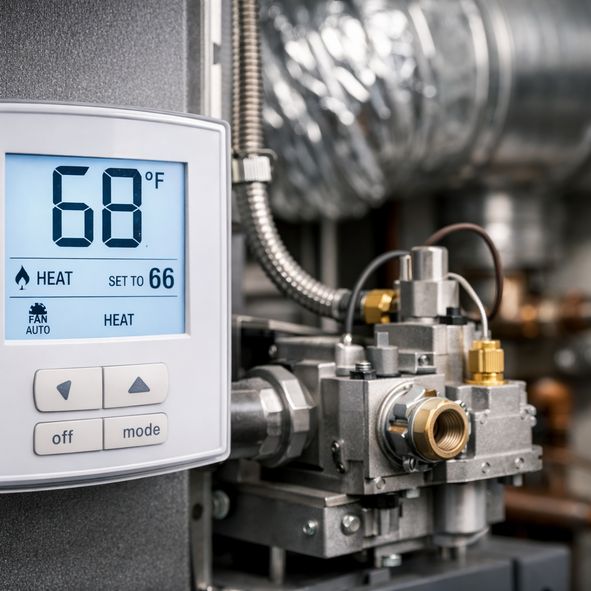
For Lower Mainland homes with heat pump systems, thermostat selection is technically critical. A standard setback thermostat on a heat pump can trigger emergency/auxiliary strip heat during recovery — actually increasing energy consumption. Choose a thermostat rated and configured specifically for heat pump operation, with dedicated auxiliary lockout controls. For multi-zone forced-air systems, zone damper controllers with individual room sensors provide granular load management that a single-point thermostat simply cannot achieve.
4. Seal Air Leaks and Improve Envelope Insulation
Quick Answer: Air leakage (infiltration) accounts for a significant portion of heat loss in typical Lower Mainland homes, particularly older wood-frame construction common in Burnaby, Surrey, and Coquitlam. Sealing attic bypasses, rim joists, and penetrations reduces the heating load your equipment must overcome every single hour it operates.
From an HVAC engineering standpoint, reducing your home’s effective leakage area directly reduces the Manual J heating load, which means your existing system operates fewer hours per day and your equipment’s rated AFUE or HSPF2 translates into real-world savings. Priority sealing locations include attic hatch perimeters, recessed light fixtures, top plates, and plumbing/electrical penetrations. In Burnaby and Richmond, crawlspace encapsulation and rim joist spray foam are consistently among the highest-impact interventions our technicians identify during home assessments.
5. Replace or Upgrade Your Air Filter — and Stick to a Schedule
Quick Answer: A clogged air filter increases static pressure across the air handler, forcing the blower motor to work harder, reducing airflow across the heat exchanger or evaporator coil, and in furnaces, risking high-limit trips and heat exchanger stress. Check filters monthly during peak heating season in the Lower Mainland.
Filter selection matters technically. A MERV-13 filter improves indoor air quality — important given the Lower Mainland’s wildfire smoke seasons — but its higher resistance requires verification that your system’s blower can maintain adequate airflow (measured in CFM) against the added static pressure. Variable-speed ECM blower motors can compensate to a degree, but older PSC motors cannot. Your BCRC technician can measure static pressure with a manometer and confirm the right filter specification for your exact system configuration.
6. Optimize and Balance Your Duct System
Quick Answer: Leaky, unbalanced, or poorly insulated ductwork in unconditioned spaces — attics, crawlspaces, garages — can waste a large percentage of your system’s output before conditioned air ever reaches living spaces. Duct sealing and balancing directly improves distribution efficiency and room-by-room comfort.
In the Lower Mainland’s older housing stock, flex duct that has sagged, kinked, or partially collapsed is a common finding. A duct leakage test (using a duct blaster) quantifies total leakage to outside. Supply and return duct insulation should meet or exceed BC Energy Step Code requirements for the climate zone. Balancing involves measuring supply air volumes at each register using a flow hood, then adjusting dampers to match the Manual J room-by-room load distribution. Rooms that are chronically too cold or too hot are almost always a duct system problem — not an equipment sizing problem.
7. Maintain Proper Refrigerant Charge on Heat Pump Systems
Quick Answer: An undercharged or overcharged heat pump refrigerant circuit dramatically reduces HSPF2 performance, causes compressor short-cycling, and in severe cases leads to compressor failure. Annual refrigerant charge verification using superheat and subcooling measurements is essential for peak winter efficiency.
In Coquitlam, Surrey, and the broader Lower Mainland, heat pumps operating through multiple heating seasons can develop slow refrigerant leaks at flare fittings or service valve cores. A system running 10% low on refrigerant charge can lose a significant portion of its rated heating capacity. Our Red Seal technicians perform precise superheat and subcooling measurements — not just pressure gauge readings — to confirm charge accuracy per manufacturer specifications, ensuring your system delivers its rated HSPF2 throughout the heating season.
8. Consider Zoning Solutions and Ductless Mini-Split Systems for Targeted Heating
Quick Answer: Ductless mini-split heat pumps allow room-by-room temperature control, eliminating the energy waste of heating unoccupied zones. Multi-zone systems with a single outdoor unit and up to five indoor heads are ideal for Vancouver and Burnaby homes with addition suites, finished basements, or inconsistent comfort zones.
Zoning with a ductless system means each occupied space receives precisely the heating it needs — no more, no less. Modern variable-speed inverter compressors in mini-splits achieve HSPF2 ratings that exceed most ducted systems, and their flexibility makes them ideal for Lower Mainland homes where whole-home duct retrofits are impractical. Proper indoor unit placement — accounting for airflow throw distance, wall mounting height, and furniture layout — is critical for uniform comfort and maximum efficiency.
System Comparison: Single-Stage vs. Two-Stage vs. Variable-Speed Modulating
| Feature | Single-Stage Furnace | Two-Stage Furnace | Variable-Speed Modulating Furnace | Cold-Climate Heat Pump |
|---|---|---|---|---|
| Efficiency Rating | AFUE 80–92% | AFUE 92–96% | AFUE 96–98% | HSPF2 8.5–12+ |
| Capacity Control | On/Off (100%) | Low/High (65%/100%) | 40–100% modulating | Variable inverter-driven |
| Short-Cycling Risk | High | Moderate | Low | Very Low |
| Humidity Control | Basic | Improved | Excellent | Excellent |
| BC Climate Suitability | Adequate | Good | Excellent | Excellent (rated to -15°C+) |
| Technical Safety BC Compliance | Required | Required | Required | Required |
| Sizing Method | Manual J Required | Manual J Required | Manual J Required | Manual J Required |
| Blower Motor Type | PSC | PSC or ECM | ECM Variable-Speed | ECM Variable-Speed |
Frequently Asked Questions
How often should I have my furnace serviced in the Lower Mainland’s climate?
Every 12 months, ideally in early fall before the heating season. The Lower Mainland’s coastal humidity accelerates corrosion on heat exchangers, burner assemblies, and drain components. Annual servicing allows a certified technician to catch developing issues — including heat exchanger cracks that pose carbon monoxide risks — before they become safety or performance failures. Technical Safety BC requires that gas appliances be maintained in a safe operating condition at all times.
Is my existing furnace properly sized for my home?
Probably not, if it was installed more than 15 years ago without a Manual J load calculation. Older HVAC practice relied on rules-of-thumb that consistently resulted in oversized equipment. An oversized furnace short-cycles, fails to adequately dehumidify your home (critical in Vancouver’s coastal climate), and experiences accelerated heat exchanger fatigue. Our technicians perform full Manual J calculations using your home’s measured square footage, insulation values, window specifications, and local climate data to confirm correct sizing.
What is the difference between AFUE and HSPF2, and which matters for my home?
AFUE (Annual Fuel Utilization Efficiency) measures how efficiently a gas furnace converts fuel to usable heat — a 96% AFUE furnace wastes only 4% of fuel input. HSPF2 (Heating Seasonal Performance Factor 2) measures heat pump heating efficiency under the updated DOE 2023 test standard — higher HSPF2 means more heat output per unit of electricity consumed. If you have a gas furnace, AFUE is your primary metric. If you have or are considering a heat pump, HSPF2 is critical for evaluating real-world Lower Mainland performance.
Do ductless mini-splits work effectively during cold Lower Mainland winters?
Absolutely, when specified correctly. Modern cold-climate inverter mini-splits from leading manufacturers are rated to deliver full or near-full heating capacity at outdoor temperatures as low as -15°C to -25°C — well below anything Metro Vancouver typically experiences. The key is selecting a unit with a verified low-temperature heating capacity rating, not just a nominal HSPF2 number. Our technicians evaluate your specific exposure, orientation, and load profile to specify the right unit for reliable year-round performance in Richmond, Surrey, Coquitlam, and beyond.
Ready to Maximize Your Heating Efficiency This Winter?
Every one of these eight strategies delivers measurable, real-world performance improvements — but only when implemented correctly, with equipment properly sized, installed to Technical Safety BC standards, and calibrated for the Lower Mainland’s unique coastal climate. Guesswork costs comfort and equipment longevity. Precision engineering delivers both.
BCRC Heating and Cooling serves Vancouver, Burnaby, Richmond, Coquitlam, Surrey, and the entire Lower Mainland with certified Red Seal HVAC technicians who bring genuine field expertise to every inspection, installation, and service call. Don’t let another winter pass with an underperforming system.
Call BCRC Heating and Cooling today at (604) 781-7272 to book your comprehensive on-site technical inspection and heating system assessment. Our team is ready to evaluate your system, perform a Manual J load analysis, and give you a clear, honest picture of exactly what your home needs to stay warm, efficient, and safe all winter long.