


7 Warning Signs Your Furnace Is About to Fail
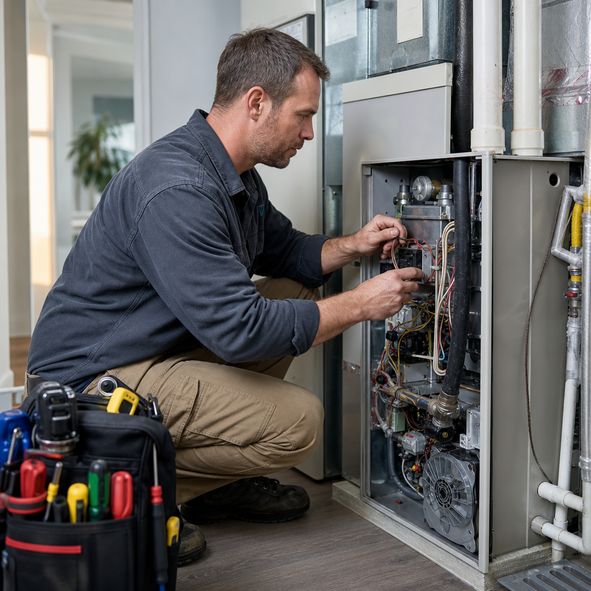
Is Your Furnace Sending You Distress Signals?
In Vancouver and the broader Lower Mainland, winters bring a relentless combination of coastal humidity and sharp cold snaps that place extraordinary demands on residential heating systems. Recognizing the 7 warning signs your furnace is about to fail could be the difference between a proactive repair and a complete system breakdown at 2 a.m. in January. This guide gives you technically precise, field-tested diagnostics so you can act before failure—not after.
1. Unusual or Escalating Furnace Noises
Direct Answer: Banging, rattling, squealing, or rumbling sounds from your furnace are never normal. These noises typically signal cracked heat exchangers, failing inducer motors, loose blower components, or ignition problems—all of which demand immediate professional inspection to prevent dangerous system failure.
In a properly functioning gas furnace, operational sound should be minimal—a soft ignition click, steady airflow, and a quiet blower. When that baseline shifts, it is a mechanical distress signal. A banging or popping sound upon startup often indicates delayed ignition caused by a dirty burner or a failing gas valve, allowing gas to accumulate before igniting. A squealing or screeching noise typically points to a failing blower motor bearing or a worn belt on older belt-drive assemblies. A rattling sound can indicate loose panels, a cracked heat exchanger, or a deteriorating inducer motor housing. In Lower Mainland homes where coastal humidity accelerates metal fatigue and corrosion, these symptoms can escalate rapidly. Technical Safety BC regulations require that any suspected cracked heat exchanger be immediately assessed by a licensed gas technician—carbon monoxide leakage risk is real and life-threatening.
2. Inconsistent or Uneven Heating Across Rooms
Direct Answer: If some rooms are too cold while others are too warm, your furnace may be undersized, losing capacity, or suffering from airflow restrictions. Proper heating in Lower Mainland homes requires a Manual J load calculation to confirm your system still matches your actual building envelope demands.
An aging furnace gradually loses its ability to deliver consistent BTU output across all zones. This is particularly problematic in multi-story Vancouver homes or retrofitted Burnaby ranchers where duct layouts were never engineered to current ASHRAE standards. A furnace that once kept every room at 21°C now leaves bedrooms at 17°C while the main floor overheats. This inconsistency can stem from a failing heat exchanger, a degraded blower motor (single-stage systems are especially vulnerable), or simply a unit that has worn beyond its rated AFUE (Annual Fuel Utilization Efficiency) performance curve. Modern variable-speed modulating furnaces maintain precise output across a 40–100% firing range, eliminating the hot-cold cycling pattern that single-stage units create. If your system is producing uneven heat, that performance gap signals it is approaching end-of-life.
3. Furnace Is Short-Cycling Frequently
Direct Answer: Short-cycling—where the furnace turns on and off repeatedly without completing a full heating cycle—indicates overheating, a faulty limit switch, or an oversized system. Left unaddressed, short-cycling destroys heat exchangers and dramatically shortens equipment lifespan.
Short-cycling places enormous thermal stress on every internal component. Each startup event forces the ignitor, gas valve, burner assembly, and heat exchanger through rapid temperature swings. A furnace cycling more than four times per hour is operating abnormally. Common causes include a clogged air filter restricting airflow, a malfunctioning high-limit switch, or an incorrectly sized unit. In Richmond and Surrey, where newer construction sometimes includes poorly specified HVAC packages, original equipment may have been oversized relative to actual Manual J load calculations—causing chronic short-cycling from day one. A two-stage or variable-speed modulating furnace communicates with smart thermostats and adjusts firing rates to prevent short-cycling entirely. If your current unit cannot resolve this on its own, it is functionally failing.
4. Yellow or Flickering Burner Flame
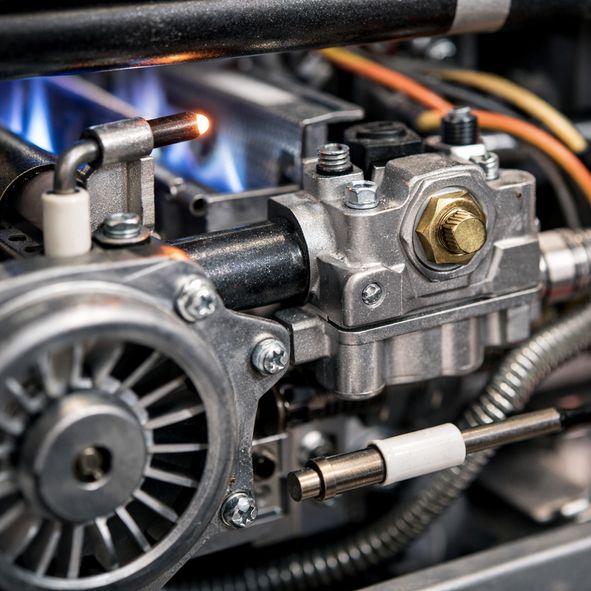
Direct Answer: A healthy gas furnace flame burns steady blue. A yellow, orange, or flickering flame means incomplete combustion—a serious indicator of a cracked heat exchanger, improper gas mixture, or carbon monoxide production. This is a life-safety emergency requiring immediate shutdown and professional inspection.
The combustion process in a properly tuned furnace produces a consistent, stable blue flame with only a small yellow tip on the inner cone. When that flame turns predominantly yellow or flickers erratically, combustion chemistry has broken down. This typically means the fuel-air mixture is off, the burners are fouled with rust or debris, or—most critically—a cracked heat exchanger is allowing exhaust gases to contaminate the air stream. Carbon monoxide, a colorless and odorless byproduct of incomplete combustion, can accumulate to dangerous levels within hours. Under Technical Safety BC protocols, a gas technician must perform a combustion analysis using a calibrated flue gas analyzer to confirm proper CO₂ and O₂ ratios. Do not operate a furnace with a yellow flame until it has been professionally inspected.
5. Spike in Heating System Run Time
Direct Answer: When a furnace runs significantly longer to reach the set temperature, its thermal efficiency has degraded. In the Lower Mainland’s damp climate, this often reflects heat exchanger scaling, burner deterioration, or blower motor wear that has pushed real-world AFUE well below the nameplate rating.
A furnace rated at 96% AFUE when new may be operating at effectively 78–82% AFUE after 15 years of service without proper maintenance in Coquitlam’s humidity-heavy environment. Longer run times mean the combustion assembly is working harder to extract the same usable heat. Signs that accompany degraded run time include a flue pipe that stays cooler than normal (indicating poor heat transfer), increased moisture condensation around the unit in non-condensing models, and the thermostat struggling to satisfy setpoints during cold snaps below -5°C. At this stage, a comprehensive combustion efficiency test and heat exchanger inspection should determine whether tune-up can restore performance or whether replacement with a high-efficiency modulating system is the technically appropriate decision.
6. Visible Rust, Cracks, or Corrosion on the Unit
Direct Answer: Physical deterioration—rust streaks, visible cracks around the heat exchanger or flue collar, or corroded burner assemblies—indicates structural failure risk. In coastal BC, salt-laden humid air accelerates metal degradation, making annual visual inspections by a Red Seal technician non-negotiable.
The Lower Mainland’s marine climate is uniquely harsh on ferrous HVAC components. Heat exchangers in furnaces over ten years old frequently show stress cracks at weld seams and expansion joints—microscopic at first, detectable only with combustion analysis or a proper heat exchanger camera inspection. Corrosion on the flue collar or secondary heat exchanger of a condensing unit indicates acidic condensate is pooling rather than draining correctly. Corroded burner ports produce uneven flame distribution, further accelerating heat exchanger degradation. Any visible rust flaking into the air stream is also an indoor air quality concern under BC’s clean air standards. A Red Seal licensed gas fitter must assess whether the structural integrity of the heat exchanger can still be certified for safe operation.
7. Frequent Repairs with No Lasting Resolution
Direct Answer: If your furnace has required multiple service calls within one or two heating seasons with no durable fix, the system is in cascading failure mode. At this point, continuing repairs is technically and practically inferior to replacing the unit with a properly sized, warranted system.
Modern furnaces—particularly variable-speed, two-stage modulating units from major manufacturers—come with 10-year parts warranties, provided installation is completed by a licensed contractor and warranty registration is submitted. When a furnace begins generating repeat failures—ignitor replacements, pressure switch swaps, inducer motor rebuilds within 18 months—it signals that systemic wear has overtaken isolated component failure. Each subsequent repair carries diminishing reliability returns. In Burnaby and Vancouver, where heating system downtime during a cold snap creates genuine occupant risk, a strategy of perpetual repair on a failing unit is operationally unsound. A proper load calculation (Manual J) and system sizing review by a certified HVAC engineer ensures the replacement unit is correctly matched to your home’s thermal envelope—not simply swapped for an identical spec.
Furnace System Comparison: Single-Stage vs Two-Stage vs Variable-Speed Modulating
| Feature | Single-Stage | Two-Stage | Variable-Speed Modulating |
|---|---|---|---|
| Firing Rate | 100% only | 65% / 100% | 40%–100% continuous modulation |
| AFUE Rating | 80%–92% | 92%–96% | 96%–98% |
| Short-Cycling Risk | High | Moderate | Very Low |
| Comfort Consistency | Low (on/off swings) | Moderate | Excellent (±0.5°C precision) |
| Humidity Control | Poor | Better | Best (longer low-speed cycles) |
| Heat Exchanger Lifespan | 10–15 years | 15–18 years | 18–22 years |
| Technical Safety BC Compliance | Standard | Standard | Standard + smart diagnostics |
| Best Suited For | Small, simple layouts | Mid-size Lower Mainland homes | Large or multi-zone Vancouver homes |
| Warranty (Parts) | 5–10 years | 10 years | 10 years (lifetime HX on select models) |
Frequently Asked Questions
Q1: How long should a gas furnace last in the Lower Mainland?
A properly maintained, correctly sized gas furnace in the Lower Mainland should deliver 18–22 years of reliable service. However, coastal humidity in Vancouver and Richmond accelerates heat exchanger corrosion, so units without annual professional maintenance often fail significantly sooner—sometimes by year 12–14. Annual combustion analysis, burner cleaning, and heat exchanger inspection are non-negotiable in this climate.
Q2: What is a cracked heat exchanger and why is it dangerous?
The heat exchanger is the metal chamber that separates combustion gases from your breathing air. A crack—even microscopic—can allow carbon monoxide (CO) to enter your living space. CO is odorless and colorless, making it undetectable without CO alarms or a professional combustion analysis. Technical Safety BC mandates immediate system shutdown when a cracked heat exchanger is confirmed. Never operate a furnace with a suspected heat exchanger failure.
Q3: Can I just replace the heat exchanger instead of the whole furnace?
In most cases where the heat exchanger has failed on a furnace older than 12–15 years, full system replacement is the technically superior decision. Heat exchanger replacement on an aged unit leaves all other wear components in place—inducer motor, gas valve, ignitor, circuit board—meaning subsequent failures are statistically likely within 2–3 heating seasons. A licensed Red Seal technician will assess whether the remaining system components justify component-level repair.
Q4: How do I know if my furnace is properly sized for my home?
Proper furnace sizing requires a Manual J load calculation—an engineering assessment of your home’s square footage, insulation R-values, window glazing, infiltration rate, ceiling height, and local design temperatures. In the Lower Mainland, design temperatures range from -8°C to -12°C depending on municipality. An oversized furnace short-cycles and degrades prematurely; an undersized unit runs continuously and never satisfies setpoint. BCRC Heating and Cooling performs full Manual J calculations as part of every system assessment.
Take Action Before Your Furnace Fails Completely
Every one of the seven warning signs outlined in this guide represents a system under measurable mechanical and thermal stress. In the Lower Mainland’s climate—where cold snaps arrive without warning and humidity compounds every mechanical vulnerability—waiting is not a neutral decision. It is a risk calculation that increasingly favors failure.
Whether your furnace is exhibiting one warning sign or all seven, the correct next step is an on-site technical inspection by a Red Seal certified HVAC technician who can perform combustion analysis, heat exchanger assessment, airflow measurement, and a Manual J sizing review. That data—not guesswork—is what informs a sound repair-versus-replace decision.
Call BCRC Heating and Cooling at (604) 781-7272 today to schedule your comprehensive furnace inspection. We serve Vancouver, Burnaby, Richmond, Coquitlam, Surrey, and all of the Lower Mainland with Technical Safety BC compliant diagnostics and installations. Do not wait for a complete breakdown—act on the warning signs now.